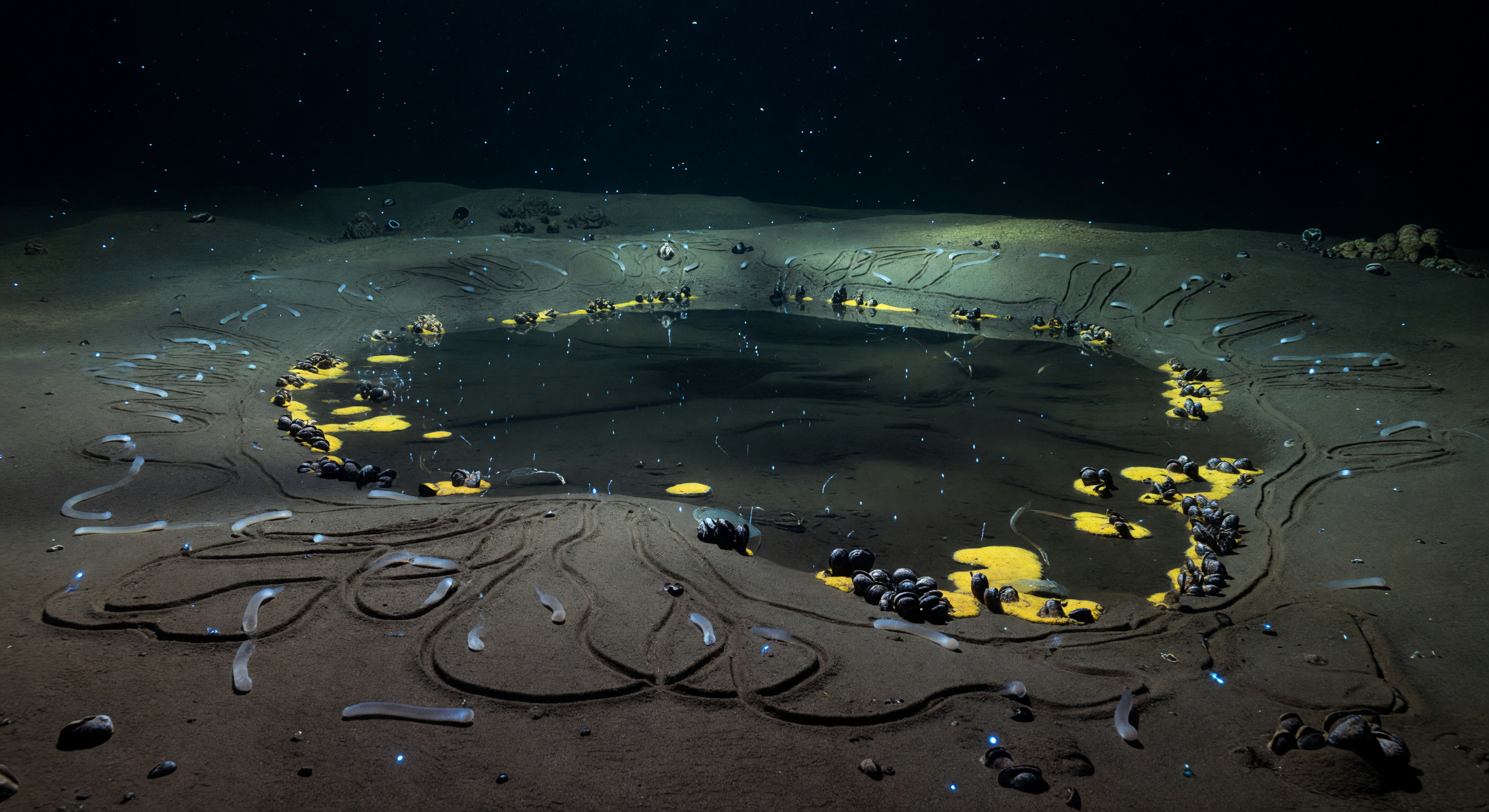
At roughly 4,500 to 5,000 metres below the surface, where pressures exceed 450 atmospheres and ambient temperatures hover near 2 °C, an abyssal brine pool rests in a shallow depression of the flat sediment plain like a dark inland sea submerged within the ocean itself — its hypersaline body, perhaps five to eight times saltier than the surrounding water, so dense that cold seawater simply floats above it, forming a mirror-like halocline that shimmers with refractive wavering and silvery mirage-like distortions. Along the outer terrace, pale holothurians — sea cucumbers of the family Holothuriidae — graze in loose, unhurried ranks, drawing looping feeding furrows through chocolate-brown abyssal mud as they ingest sediment and extract organic matter, their tracks converging toward sulfur-yellow bacterial mats that mark where methane and sulfide seep upward to sustain entire chemosynthetic communities in the absence of any photosynthetic energy. Compact clusters of symbiont-bearing mussels cling near these bacterial carpets, their tissues harboring chemoautotrophic bacteria that fix carbon from reduced sulfur compounds, while half-buried manganese nodules — accreted over millions of years at rates of mere millimetres per million years — punctuate the sediment like scattered monuments to geological time. The brine edge itself is lethal to most metazoans, its anoxic, hypersaline chemistry dissolving the biochemical tolerances of any organism that crosses it, and so life arranges itself in concentric tolerance rings around the pool, the entire community existing in crushing, primordial silence broken only by the intermittent cold blue and cyan flicker of bioluminescent plankton drifting freely through the blackness above.
Other languages
- Français: Sillons d'holothuries jardins
- Español: Surcos de holoturia abisales
- Português: Trilhos do jardim de holotúrias
- Deutsch: Holothurien Gartenpfade
- العربية: مسارات حديقة الخيار البحري
- हिन्दी: समुद्री ककड़ी उद्यान पथ
- 日本語: ナマコの庭の轍
- 한국어: 해삼 정원의 흔적
- Italiano: Tracce di oloturie abissali
- Nederlands: Zeekomkommer tuinsporen