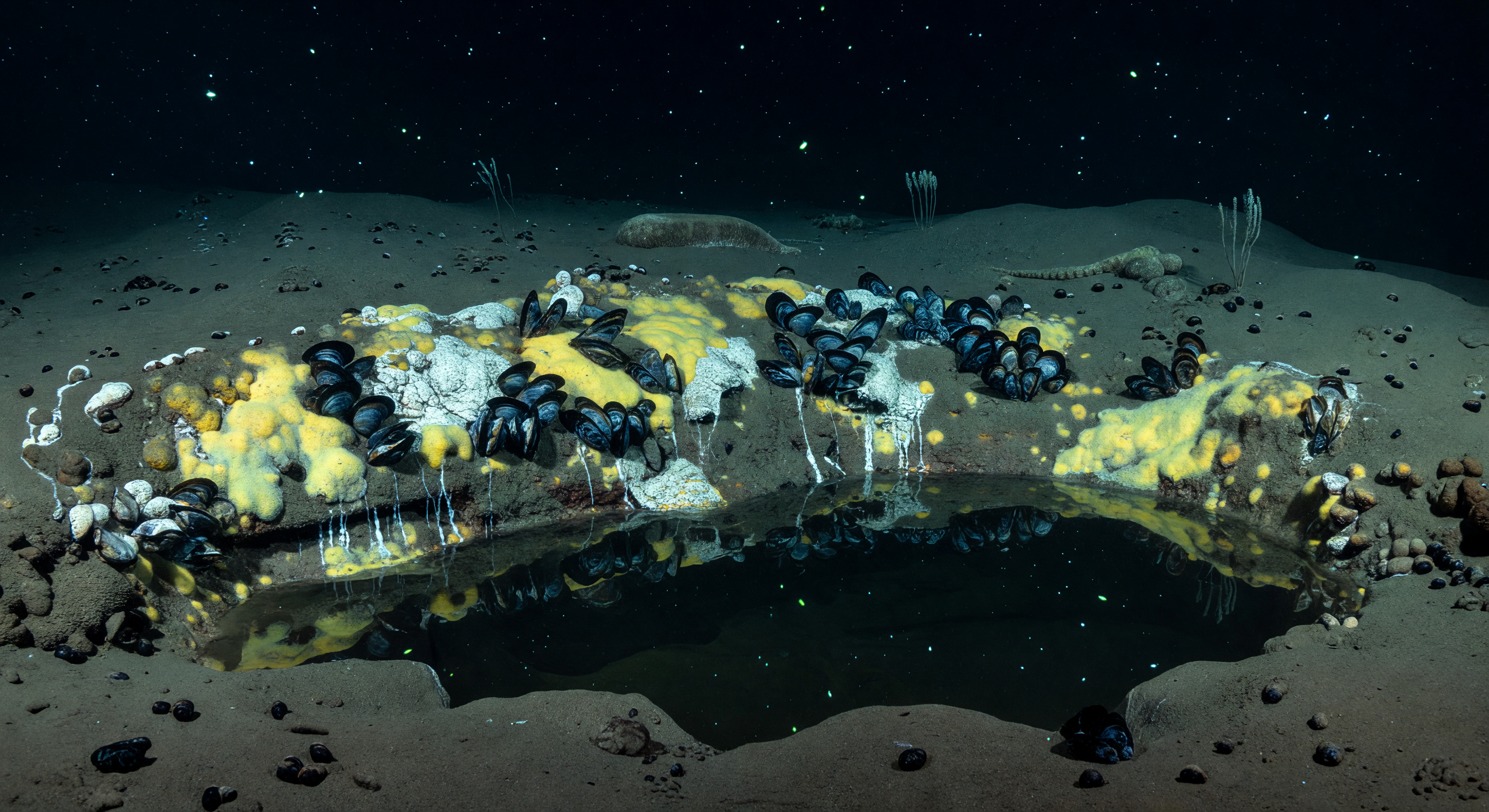
At the margin of an abyssal brine pool lying somewhere between four and six kilometers beneath the surface, a low escarpment descends through pressures exceeding four hundred atmospheres into one of the ocean's most chemically alien environments. The slope is blanketed in sulfur-yellow bacterial mats — vast colonies of sulfur-oxidizing microorganisms drawing energy not from sunlight but from the hydrogen sulfide seeping upward through fractured sediment — and across this microbial carpet, dense aggregations of symbiont-bearing mussels press together in interlocking mosaics of blue-black shell, their tissues harboring chemosynthetic bacteria that fix carbon in permanent darkness. Where fresh hypersaline brine trickles downslope in thin rivulets, chalky precipitate crusts of barite and carbonate crust over the mussel bed, marking the chemical frontier where normal seawater chemistry collapses into something far denser and far more hostile. At the foot of the escarpment, the brine pool itself lies perfectly still, its upper surface a mirror-dark interface — sharp as glass, shimmering with subtle refraction — where seawater meeting brine five to eight times saltier creates an optical boundary like black liquid mercury, swallowing detail into lightless depth below. Beyond the seep margin, scattered manganese nodules mottle the abyssal plain, a distant holothurian moves imperceptibly through the cold, and a few delicate sea pens stand unmoving in the immense, silent pressure, their existence entirely indifferent to any witness.
Other languages
- Français: Falaise aux moules sulfureuses
- Español: Escarpe de mejillones bacterianos
- Português: Escarpa de mexilhões sulfurosos
- Deutsch: Muschelmatten-Steilhang
- العربية: منحدر بساط بلح البحر
- हिन्दी: शंबुक चटाई कगार
- 日本語: ムール貝マットの断崖
- 한국어: 홍합 매트 절벽
- Italiano: Scarpata di cozze batteriche
- Nederlands: Mosselmat Steilwand