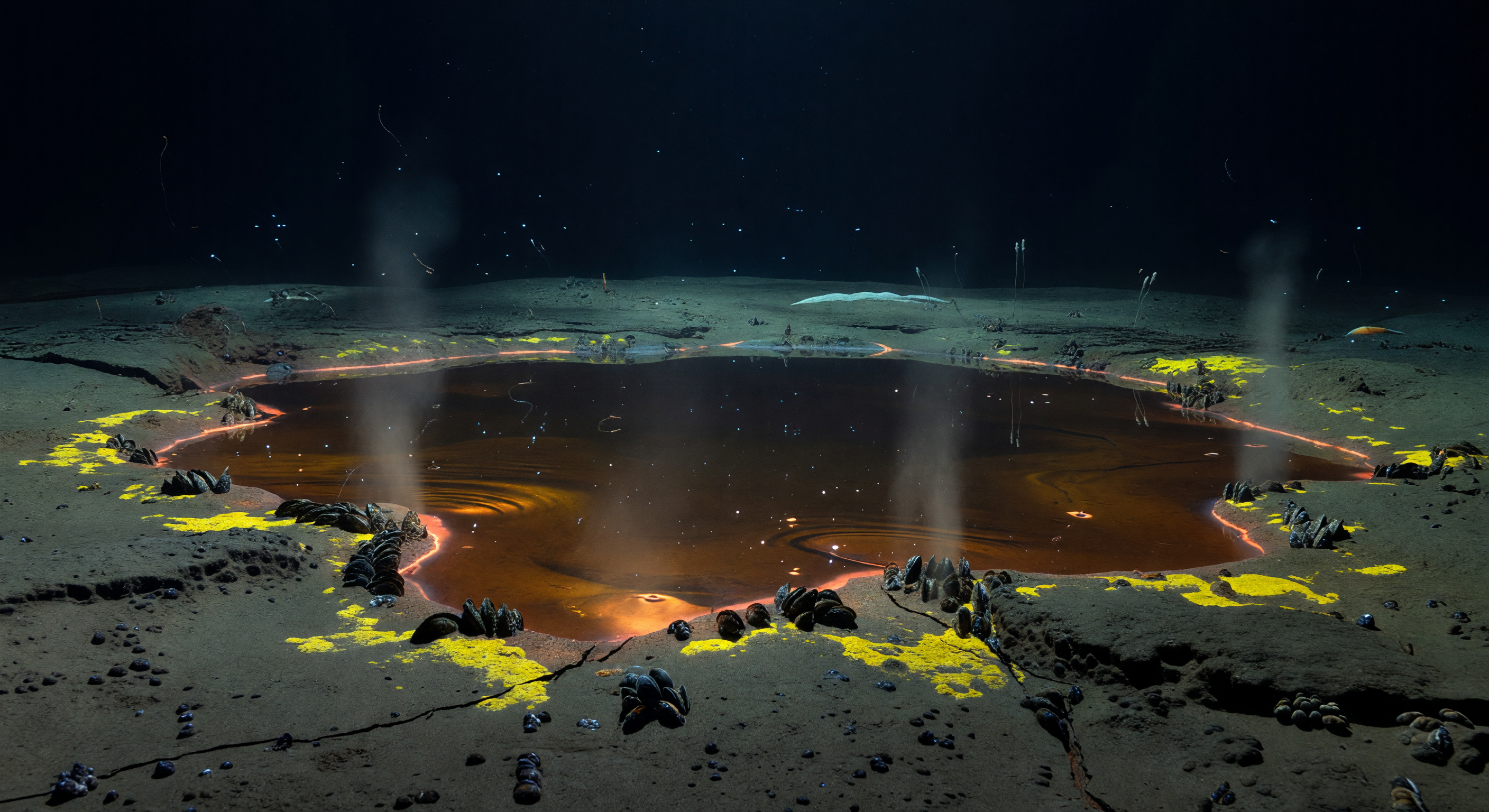
At depths where pressure crushes the water column to something approaching solidity, a fault-bounded basin cradles one of the ocean's most alien phenomena: a lake within the ocean, its amber brine so dense with dissolved salts and metals that it refuses to mix with the near-freezing abyssal seawater resting above it, the boundary between them shimmering like a liquid mirror distorted by competing densities. Along the fractured rim, chemosynthetic bacterial mats spread in sulfurous yellow-orange sheets, and dense clusters of symbiont-bearing mussels colonize the thin cracks where reduced fluids seep upward, entire communities sustaining themselves not on sunlight but on the chemical energy of hydrogen sulfide and methane welling from below. Where the hottest fractures trace the muddy scarp, a faint orange-red chemiluminescent shimmer betrays oxidation reactions occurring spontaneously in the sediment, while ghostly microbial films cast a dim diffuse glow across the basin's edge, and scattered cyan-blue bioluminescent points drift cold and sparse through the surrounding black water. At four to six thousand meters, under four hundred to six hundred atmospheres, the copper-amber brine lies oily and opaque, anoxic and hypersaline, lethal to most metazoan life yet ringed by organisms that have evolved to exploit the precise gradient where poison becomes fuel. Beyond the basin, a pale holothurian moves in slow muscular waves across the pockmarked mud, and distant sea pens stand motionless in the absolute stillness of a plain that has never known sunlight, existing entirely on its own terms.
Abyssal brine pools