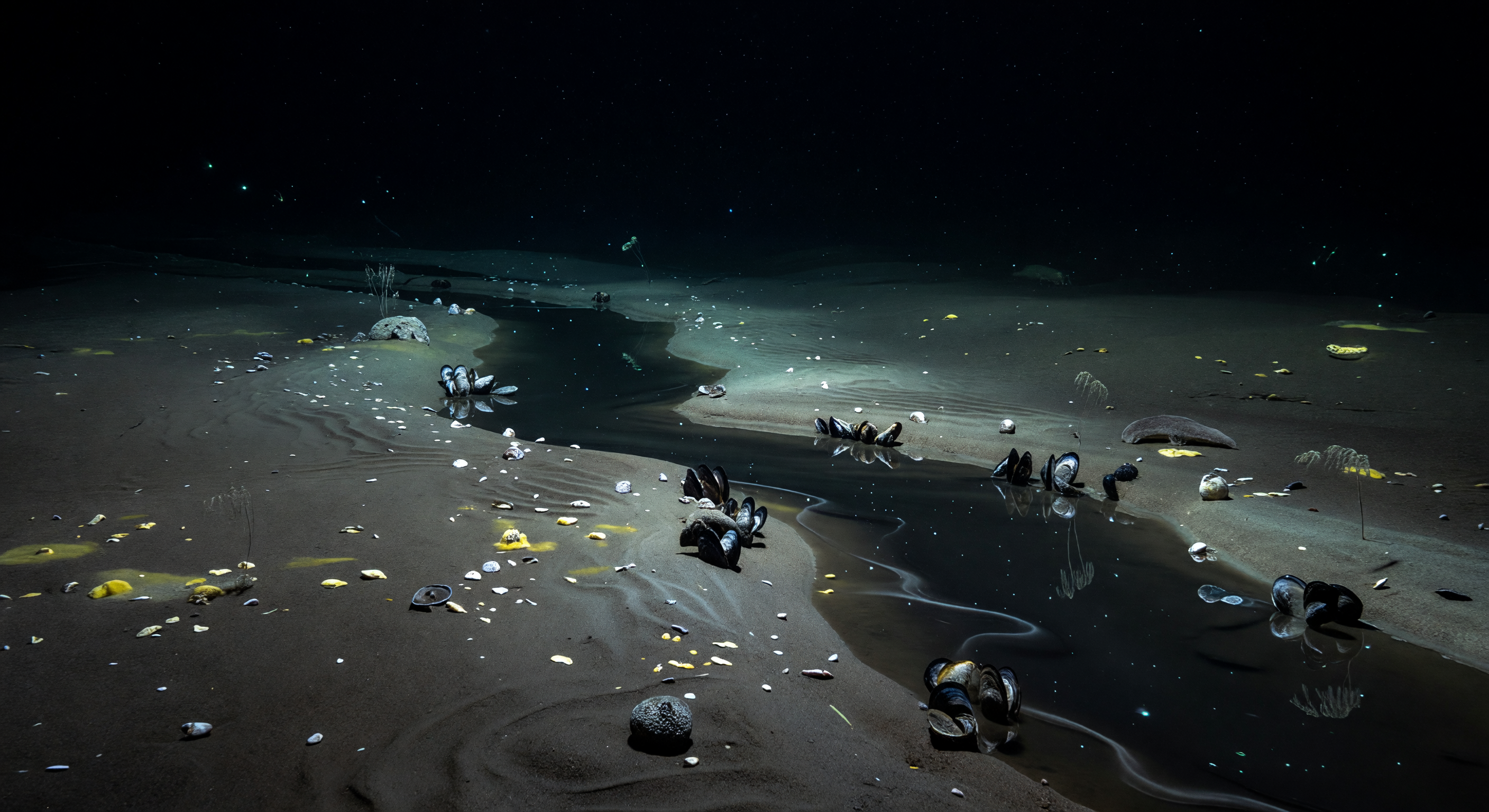
At roughly 5,000 metres below the surface, where pressures exceed 500 atmospheres and ambient temperatures hover near 2 °C, a narrow river of hypersaline brine traces a slow, sinuous course across the abyssal plain — a liquid anomaly resting inside the ocean like a buried sea within a sea. Its upper boundary is unnervingly sharp, a mirror-like halocline where the brine's density, two to five times that of the surrounding water, causes it to pool and flow as a coherent body, folding perfect inverted reflections of pale silt levees, scattered shell hash, and sulfur-yellow bacterial mats into its dark, glassy surface. Along the chemical boundary, clusters of mytilid mussels harbour chemosynthetic symbionts that fix energy not from sunlight — which vanished kilometres above — but from the methane and sulfide exhaled by the seeping seafloor, while faint cold luminescence pulses in near-invisible pinpricks from drifting microorganisms and microbial films edge the brine's margins in a dim, ghostly cyan. A holothurian moves with glacial patience across the adjacent sediment plain, and fragile sea pens stand motionless in the near-stillness, surrounded by the slow vertical drift of marine snow — particulate organic matter descending from the sunlit world above, a faint and distant snowfall settling through crushing darkness. Here the ocean exists entirely on its own terms: anoxic, lethal, chemically alien, and indifferent — a landscape governed by density gradients, mineral dissolution, and the quiet metabolisms of organisms that have never required the sun.
Abyssal brine pools