Scientific confidence: Very High
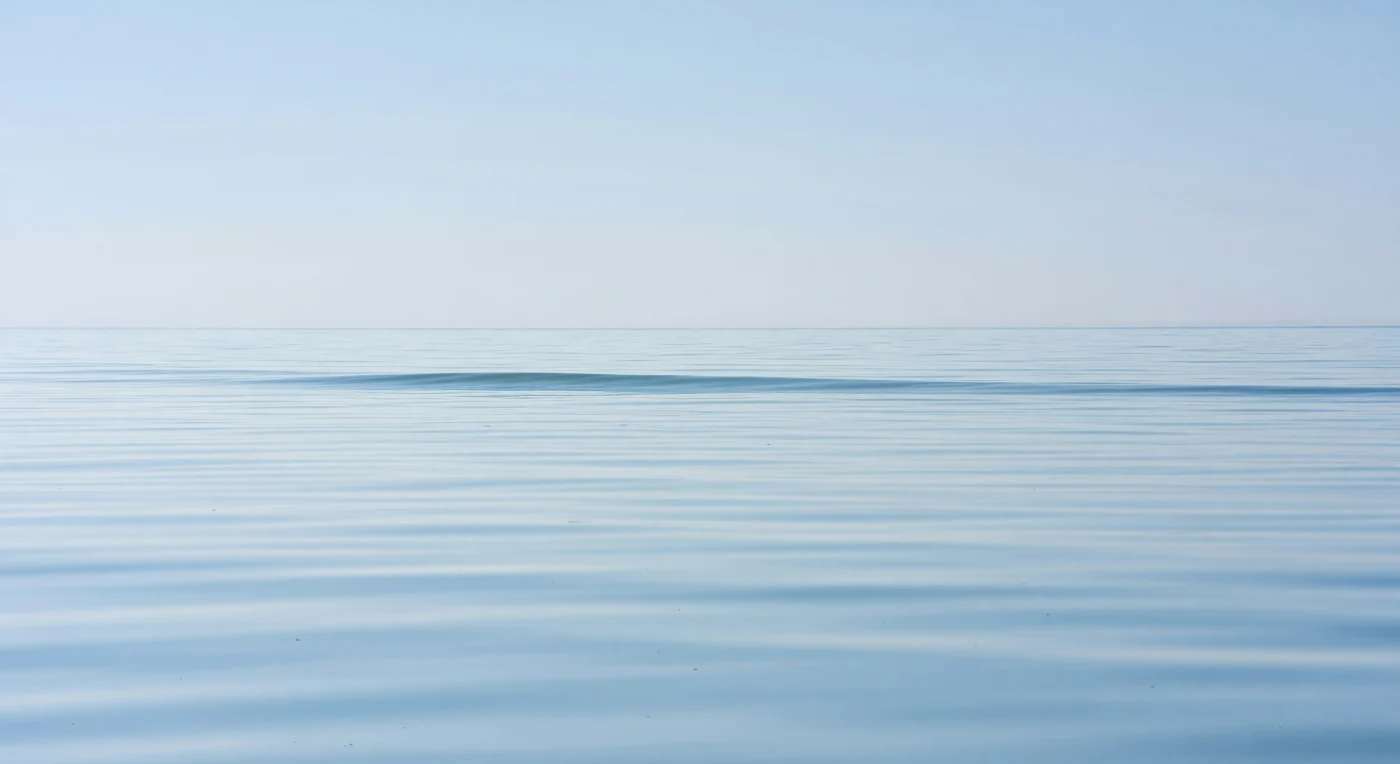
At the very boundary where atmosphere meets ocean, the air–sea interface under Beaufort 0–1 conditions becomes one of the most physically intricate surfaces on Earth, yet one of the most serene to behold. The sea-surface microlayer — a film measurable in micrometers — concentrates dissolved organic compounds, lipids, and surfactants secreted by phytoplankton blooms far below, and it is precisely this biological chemistry that suppresses capillary waves and produces the glassy, oil-like stillness of a true mer d'huile. Beneath that skin, the upper centimeters of exceptionally clear oceanic water carry minute suspended particles — transparent exopolymer particles, diatom frustules, copepod eggs drifting in near-neutral buoyancy — invisible to any ordinary eye but present in extraordinary abundance, forming the base of a sunlit food web that begins here and extends downward through the entire photic zone. The pale turquoise transparency that occasionally thins the mirror is not an optical illusion but a real consequence of low-angle solar penetration through shallow water of minimal particulate load, where the Rayleigh-like scattering of pure seawater briefly overwhelms reflectance. This surface exists in silence, indifferent and ancient, exchanging gases with the atmosphere, absorbing solar energy, seeding clouds with sea-salt aerosols, regulating planetary heat — a world measured in microns yet governing an ocean measured in kilometers.
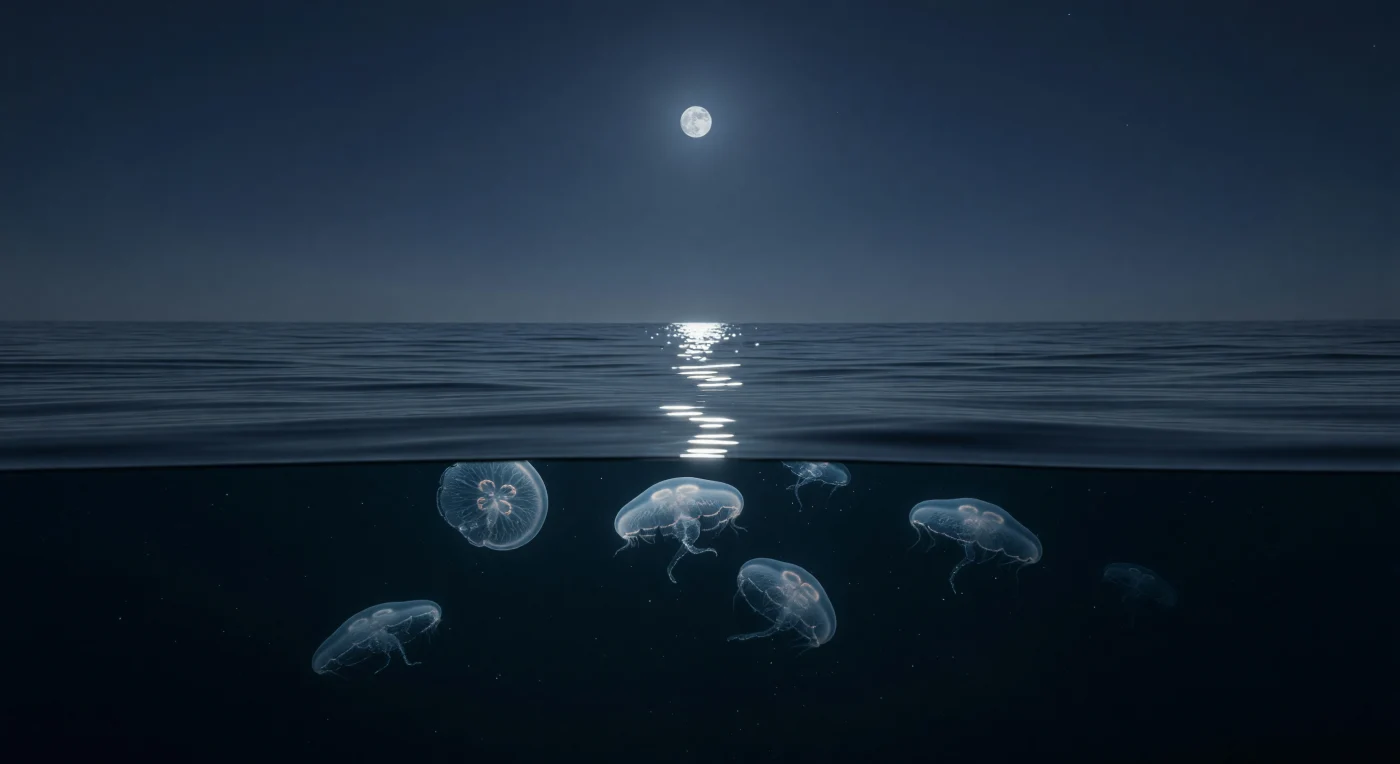
Beneath a full moon riding a cloudless sky, the ocean surface lies in near-perfect stillness — a mer d'huile where only the faintest capillary corrugations interrupt a black-blue mirror, and a slender silver ribbon of moonlight trembles across the water in slow, elongated reflections. Within the uppermost decimeters, several moon jellies — *Aurelia aurita* — drift on passive buoyancy, their translucent bells a few centimeters to nearly thirty across, the four-lobed gonads and radial canals faintly legible in the soft silver-blue illumination filtering down from above. At this air-sea interface, the sea-surface microlayer — a film no more than a millimeter thick — concentrates dissolved organics, lipids, and microbial life at densities many times higher than the water immediately below, making this invisible skin one of the most biochemically active boundaries on Earth. Under Beaufort 0–1 conditions, heat and gas exchange between ocean and atmosphere slow to their quietest rate, CO₂ and oxygen crossing by molecular diffusion rather than the turbulent ventilation that rougher seas drive. The jellies hang suspended in this luminous threshold world, pulsing almost imperceptibly, their entire existence governed by currents they cannot resist and a moonlit stillness that will dissolve the moment the first breath of wind returns.
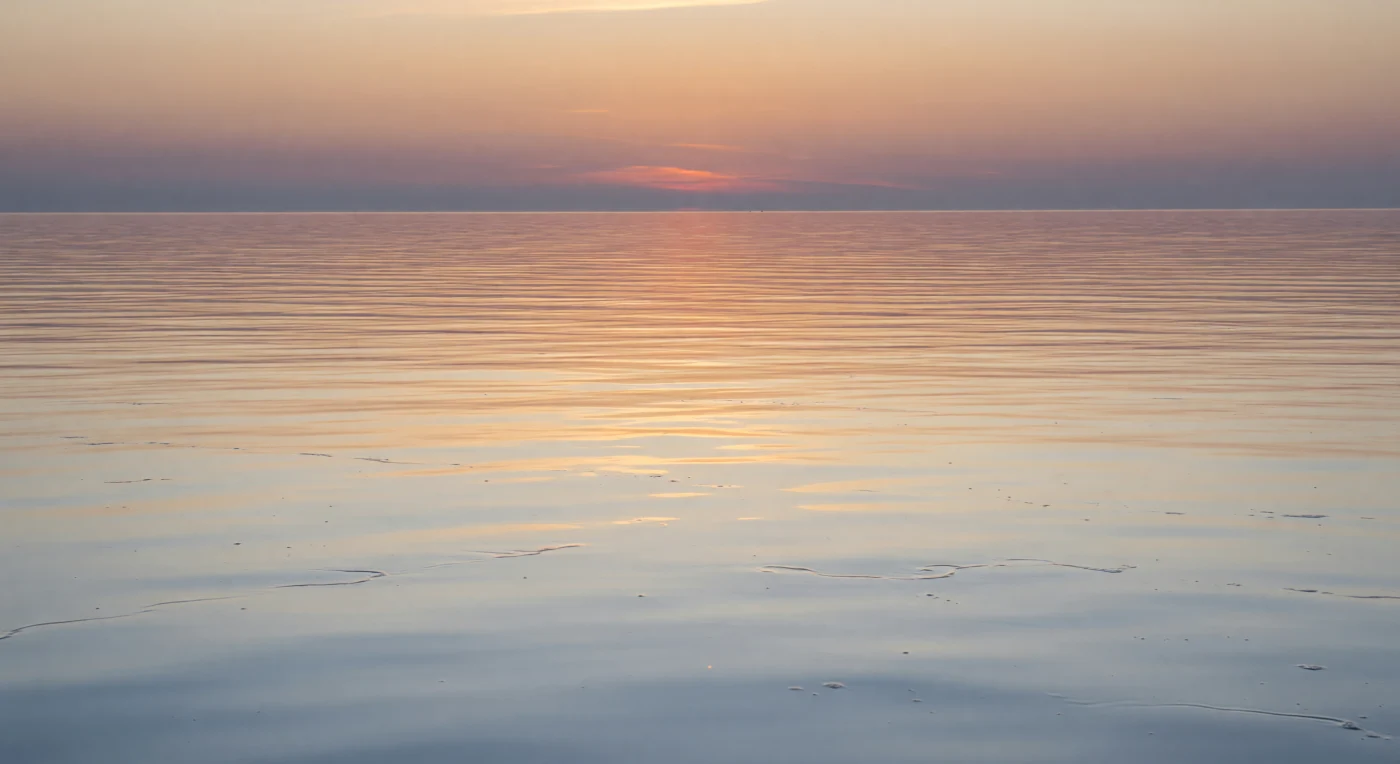
At the ocean's skin — a boundary measured not in fathoms but in micrometers — the air and sea negotiate their exchange across a film thinner than a human hair. Here, where wind stress has nearly vanished under a Beaufort 0 sky, surface tension governs everything: the sea-surface microlayer, a gel-rich lens of lipids, transparent exopolymers, and dissolved organics, stretches unbroken across the water, compressing the dusk light into long specular bands of copper and rose-gold that slide over undulations barely tall enough to cast a shadow. Beneath this luminous skin, the uppermost meters of the water column hold their own quiet world — neuston organisms, the larvae of countless pelagic species, and colonies of bacteria exploiting the microlayer's chemical richness, all suspended in a blue-gray transparency where the day's final photons still reach. The physics of gas exchange — carbon dioxide, oxygen, water vapor moving between ocean and atmosphere — slow almost to a standstill when wind speed drops this low, turning this glassy interface into a temporary seal between two vast reservoirs. Nothing breaks the stillness; the planet breathes in near-silence, the sea folding light back into sky as if the two have no clear boundary between them.
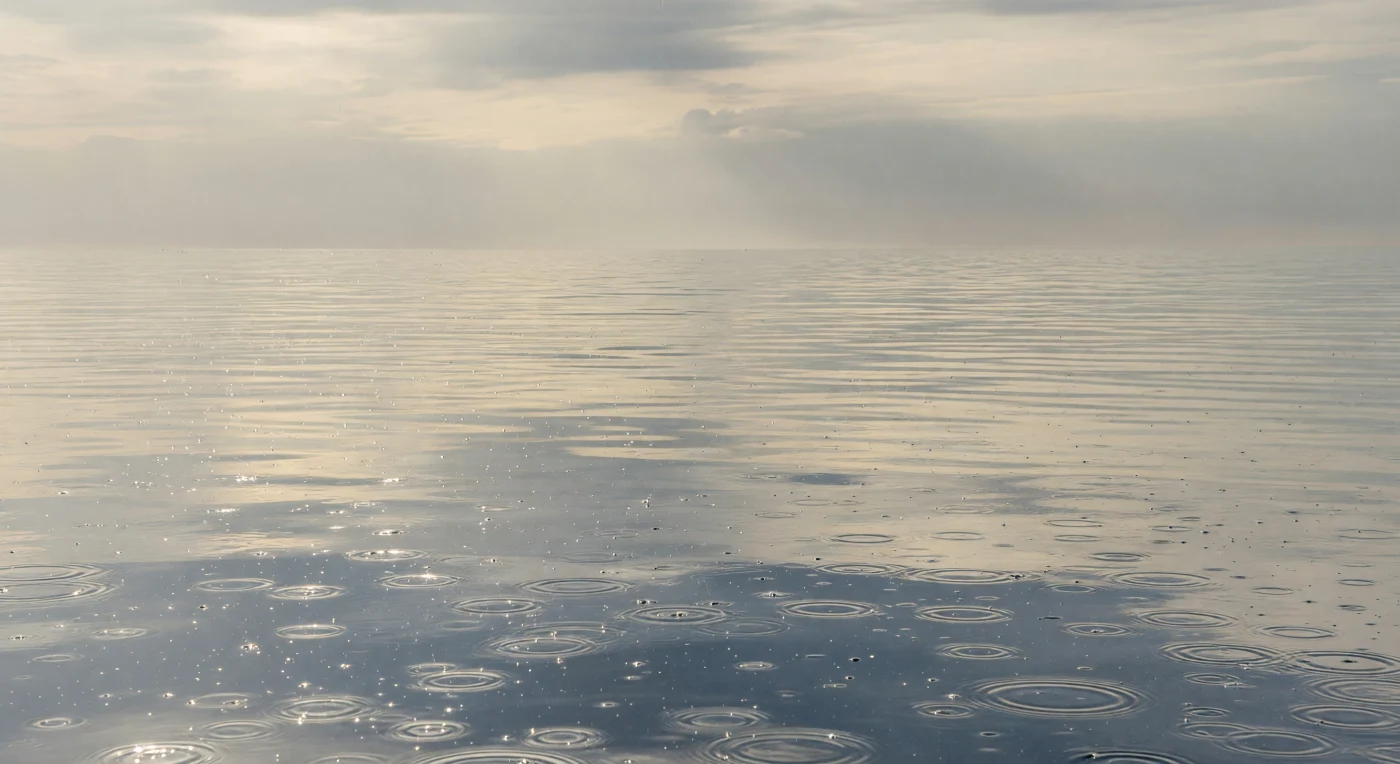
At the boundary where atmosphere meets ocean, the sea-surface microlayer — a film mere micrometers thick yet chemically and biologically distinct from the water below — trembles under a warm overcast sky as fine rain stipples its oil-smooth expanse into an ever-shifting geometry of concentric rings. Each raindrop's impact momentarily disrupts this uppermost skin of the ocean: surface tension fractures into transient crown splashes, capillary wavelets radiate outward, and fleeting microbubbles carry trace gases briefly into solution before dissolving into the diffuse silver-gray light filtering through cloud cover. This microlayer is among the most biologically concentrated habitats on Earth — enriched with dissolved organic carbon, lipids, bacteria, phytoplankton cells, and neuston organisms that spend their entire lives suspended at this precise threshold between air and water, their existence shaped by Beaufort-calm conditions where vertical mixing is minimal and the interface remains intact. Beneath the trembling skin, the upper meters of open ocean appear as clear blue-gray translucence, dense with suspended marine particulate and photosynthetically active plankton drifting in a water column where pressure is negligible, light is abundant, and the slow pulse of distant swell tilts the reflective plain in long, unhurried rhythms. Here at the surface — serene, pressureless, and immense — the ocean exists as its own complete world, rain writing temporary mathematics onto glass, the horizon clean and distant, the silence broken only by the soft percussion of water meeting water.
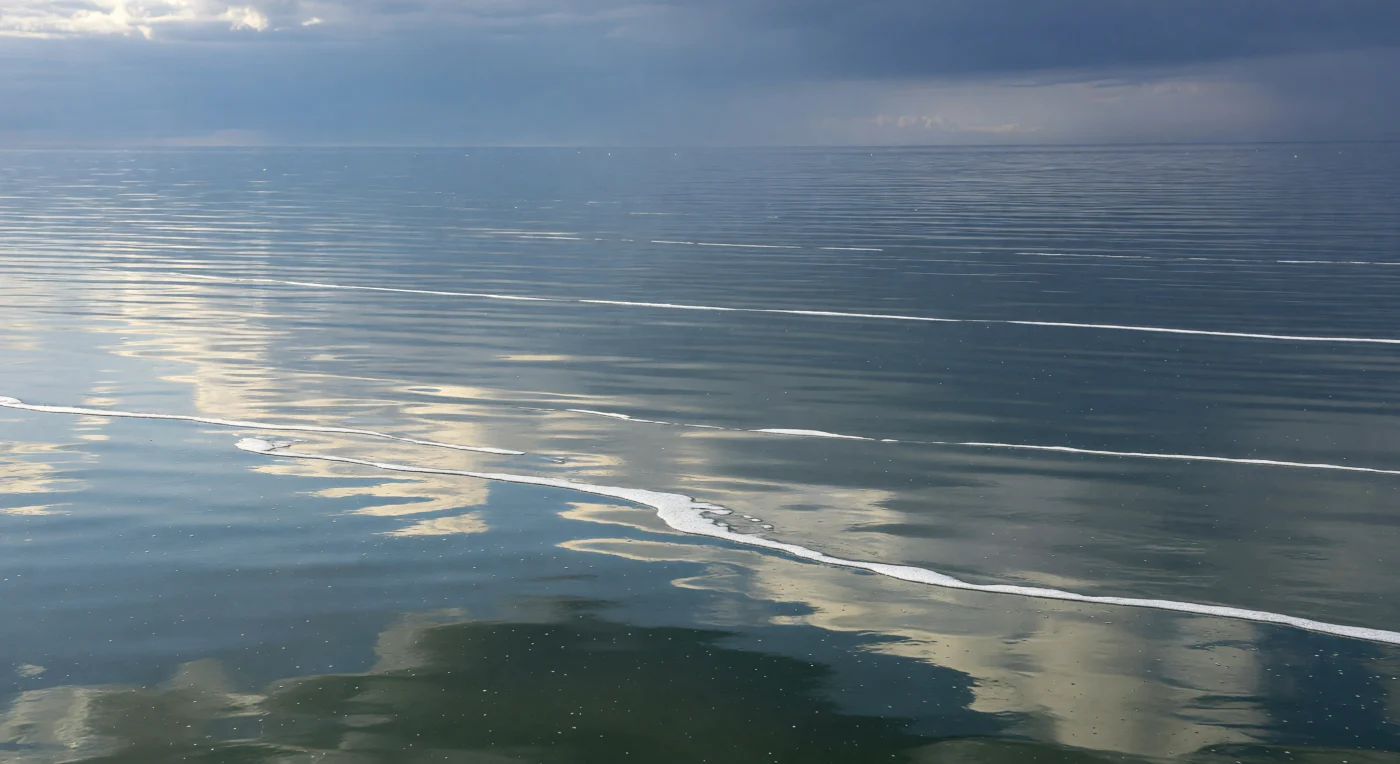
Where ocean and atmosphere press against each other in the quietest of negotiations, the sea surface after a passing squall settles into a state that oceanographers call a mer d'huile — a sea of oil — governed by Beaufort conditions barely registering above zero. The sea-surface microlayer, a film measuring only micrometers to fractions of a millimeter in thickness, concentrates dissolved organic compounds, lipids, and sparse living cells into a biochemically dense skin that subtly alters how light bends and scatters at the interface, smoothing capillary waves into the faint corrugations visible across glassy slick bands. Where Langmuir circulation and residual convergence lines from the squall's departing winds have organized the uppermost water column into parallel rolling cells, surfactants and foam aggregate into those pale, tapering seams that drift without turbulence toward the rain-dark horizon, brightening softly against the deeper steel-blue of undisturbed surface water. Broken sunlight crossing through moist post-storm air lays silver and pale blue across the reflective patches, each cloud gap igniting a shifting mirror of sky in the upper centimeters of extraordinarily clear water where sparse suspended particulate and dissipating microbubbles drift freely, unhurried. This is the ocean as it has always been between storms — self-organizing, chemically alive at scales invisible to ordinary sight, and entirely indifferent to any witness.
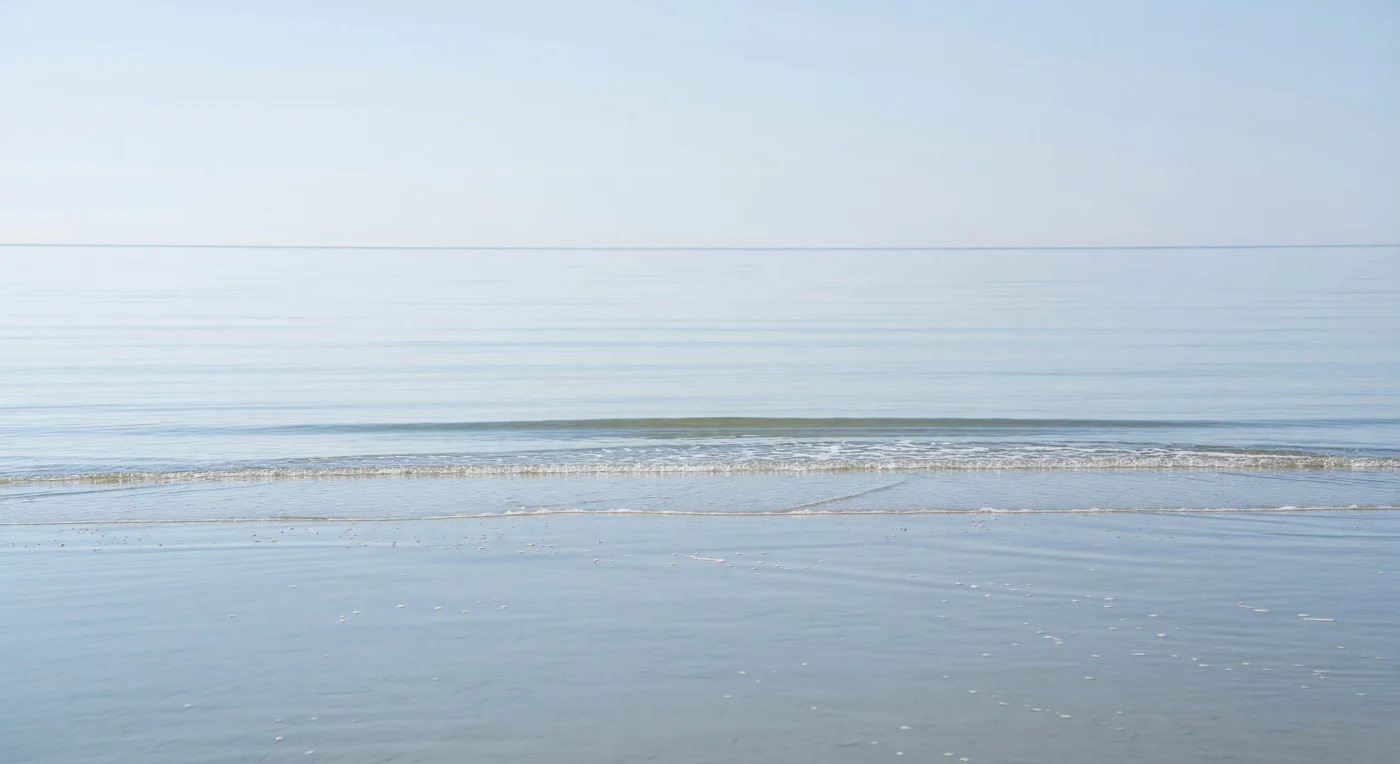
At the air-sea boundary, where atmosphere and ocean negotiate their terms in near silence, the physical world reduces itself to essentials: a broad sky of diffused daylight pressing down on a mer d'huile, its surface so undisturbed that the boundary between reflection and reality dissolves into slow silver-blue bands. Here, within the uppermost micrometers, the sea-surface microlayer — a film thinner than a human hair — concentrates dissolved organic compounds, lipids, and microbial communities in densities orders of magnitude greater than the water immediately below, a hidden biological membrane that regulates gas exchange between ocean and atmosphere. Where the seafloor rises abruptly beneath a shallow sand shoal, the long swell — generated perhaps days and hundreds of kilometers away by a distant weather system — feels the bottom's drag, steepens as its lower half slows against the sand, and tips briefly into a feathered line of white water: a hydraulic event that momentarily suspends fine droplets into the sunlit air, oxygenates the shallows, and redistributes sediment across the pale sandy floor. Through the turquoise water column above that floor, sunlight traces shifting caustic nets — refractive interference patterns cast by surface capillary texture — painting the bottom in flickering gold before the foam thins to scattered microbubbles and the sea settles again into its reflective, unhurried self.
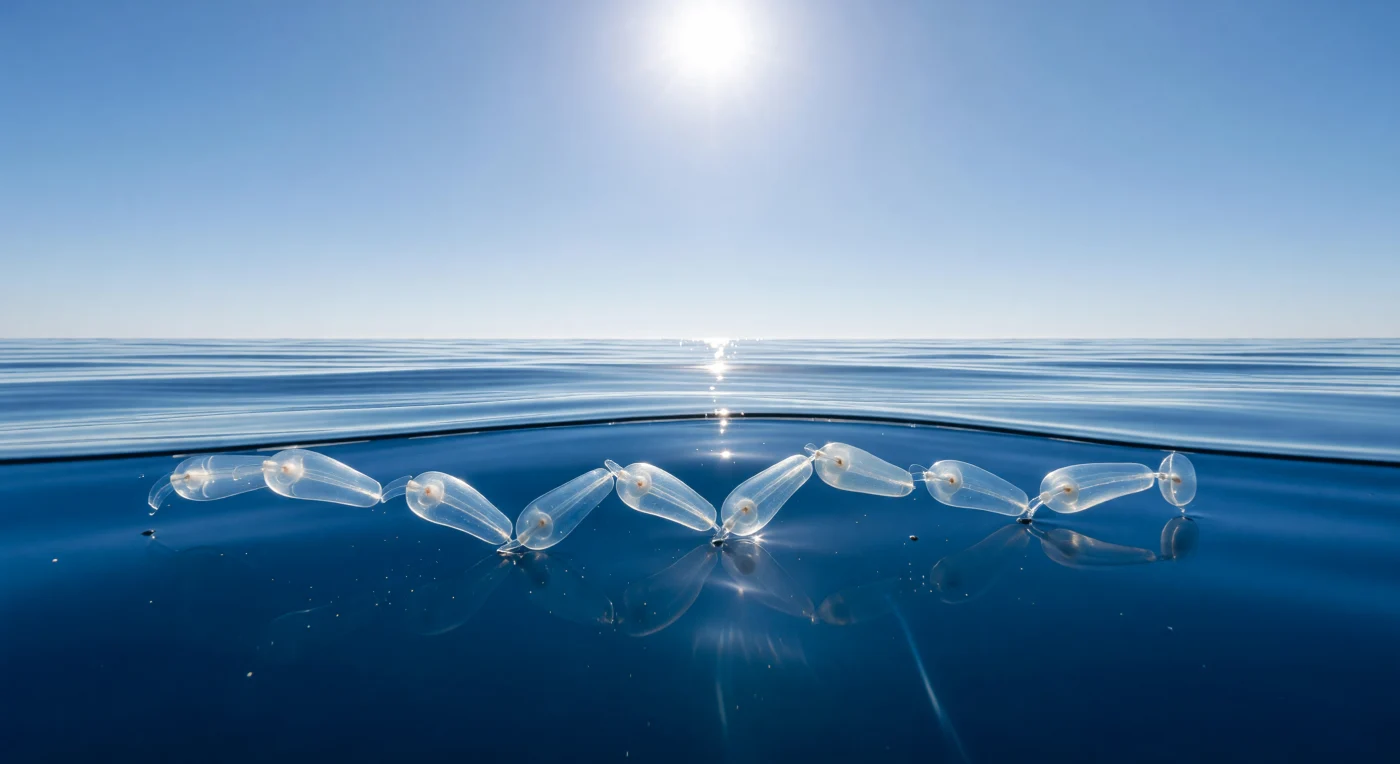
Beneath the mirror of a windless open ocean at solar noon, a chain of salps drifts motionless in the uppermost meter of water, their colonial bodies strung together in a translucent garland that neither rises nor sinks, suspended in perfect gravitational equilibrium. These barrel-shaped tunicates — members of the class Thaliacea — are among the most efficient filter feeders in the pelagic realm, each individual rhythmically pulsing seawater through fine mucous nets to harvest phytoplankton and bacterial particles invisible to any ordinary eye. At this sunlit interface, solar irradiance penetrates with almost no attenuation, bathing the salp chain in vertical white light that refracts along their curved gelatinous walls and catches the amber glow of their digestive organs, while soft caustic patterns trace across the surrounding water like the projections of a living lens. The sea-surface microlayer just above — a film measured in micrometers yet chemically and biologically distinct from the bulk water beneath — holds its own invisible community of neuston organisms, lipid films, and dissolved organic aggregates enriched by upward diffusion and bubble scavenging. Here at Beaufort 0, under a cobalt sky and an undisturbed horizon, the ocean exists entirely in its own terms: a vast, silent, productive system cycling carbon and nutrients without witness, the salps quietly repackaging the photosynthetic wealth of the sunlit world into dense fecal pellets that will eventually carry fixed carbon down into the permanent dark below.
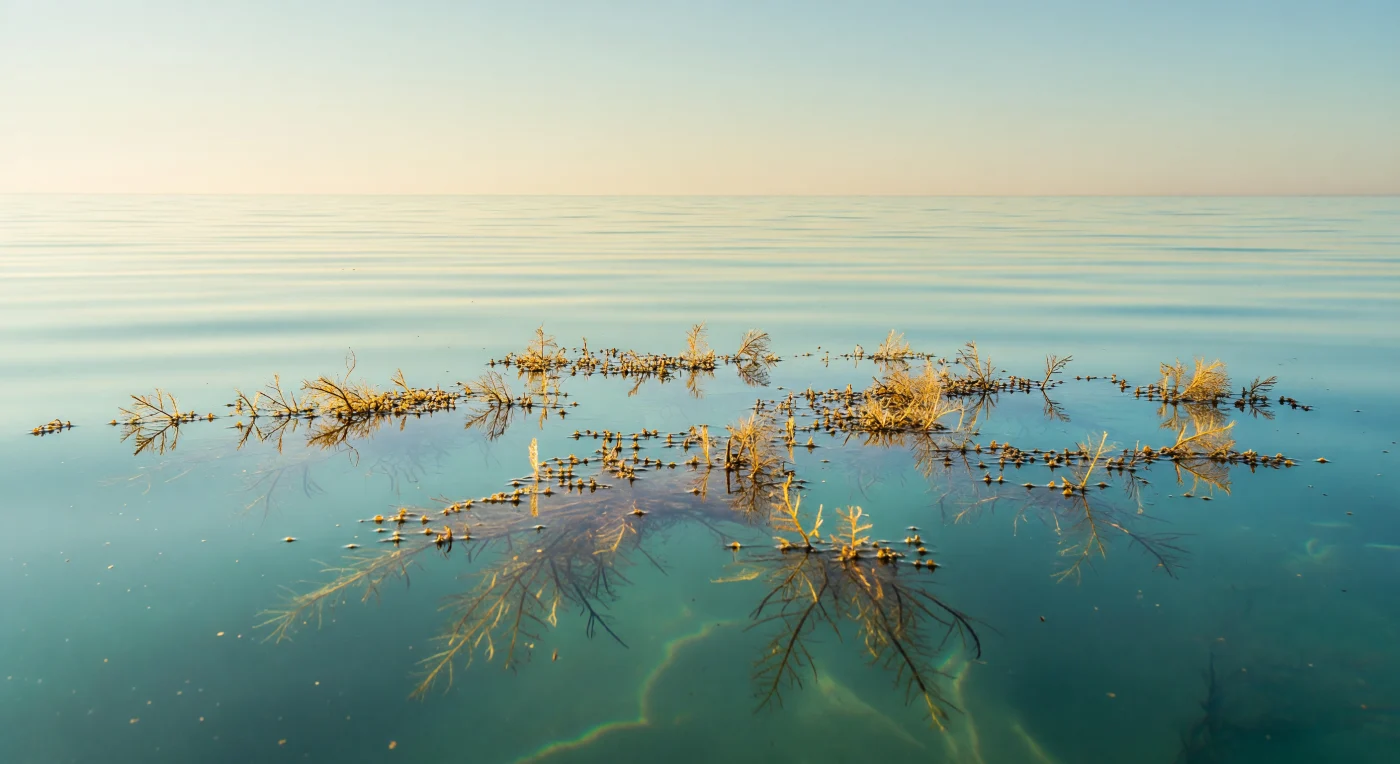
Beneath the slow, glassy interface of a Beaufort 0 sea, the uppermost meter of the open Atlantic unfolds in crystalline stillness — a thin, luminous world where low morning sunlight skims the surface and refracts into soft caustic ribbons that dance across drifting Sargassum fronds. This pelagic macroalgae, *Sargassum natans* and *S. fluitans*, forms the structural foundation of a floating ecosystem unique to the North Atlantic Subtropical Gyre, where converging surface currents concentrate buoyant material into loose golden rafts that can persist for weeks. Each hollow pneumatocyst — the small round air bladder evolved to keep fronds aloft — catches the light from above while casting a gentle brown shadow into the transparent blue-green column below, the water itself shifting from pale luminous turquoise at the air-sea interface to richer cyan within the first few decimeters, the color gradient a direct expression of differential light absorption across wavelengths. The sea-surface microlayer here, a film just micrometers thick, is biologically and chemically distinct from the water beneath — enriched in dissolved organic compounds, microbial neuston, and the eggs of creatures that exploit this sun-warmed boundary zone. Without a breath of local wind to disturb it, this mer d'huile holds a rare and transient equilibrium: a mirror held up to the open sky, alive with invisible biological exchange, indifferent to any witness.
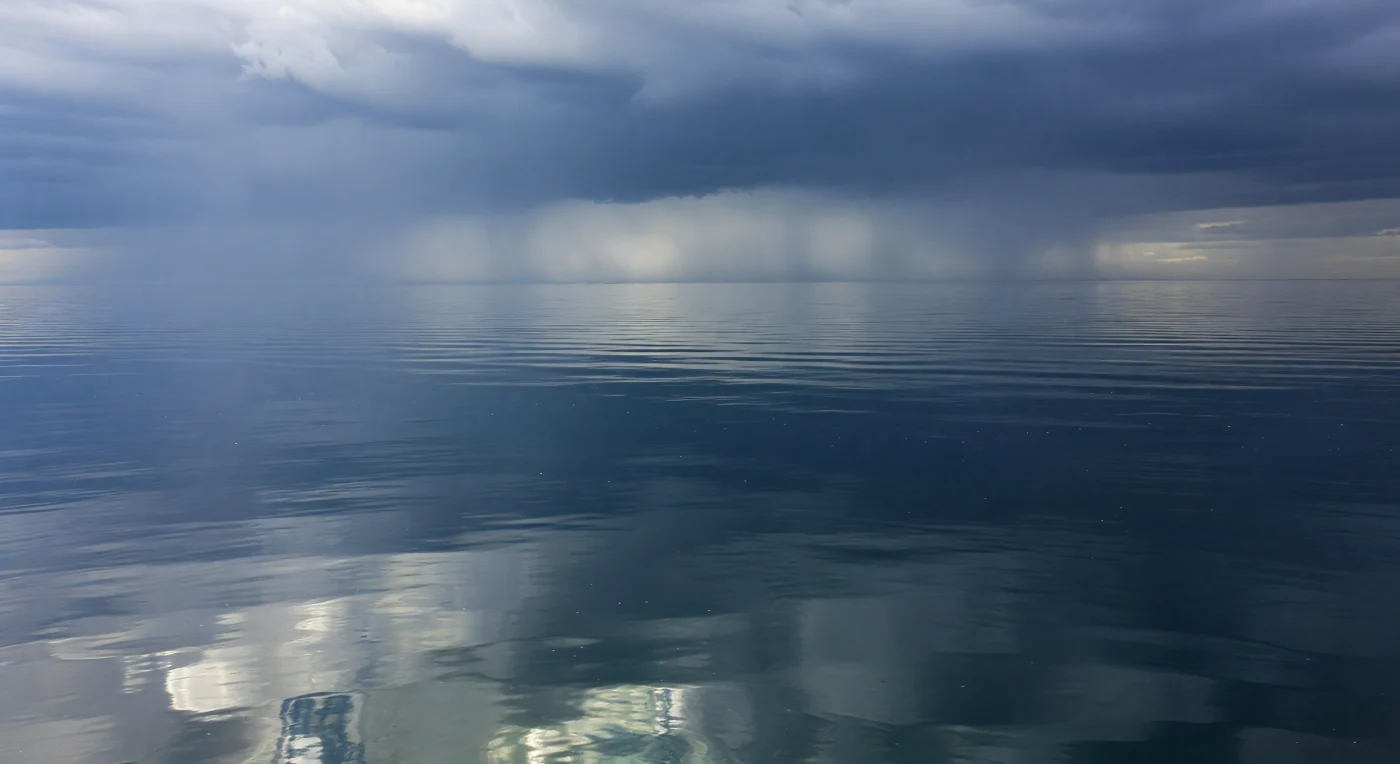
At the boundary where ocean meets sky, the sea-surface microlayer stretches as a luminous, near-perfect mirror — a film only micrometers thick yet chemically and biologically distinct from the water below, enriched with lipids, proteins, and dissolved organic compounds concentrated by surface tension and slow molecular diffusion. Under Beaufort 0–1 conditions, capillary wave generation is suppressed almost entirely, allowing this gelatinous skin to remain intact as a coherent optical surface, reflecting the underside of a convective storm system with extraordinary fidelity while a distant precipitation curtain slowly alters the far-field atmospheric pressure gradient that will eventually shatter the calm. Beneath this glassy film, the uppermost centimeters of the water column hold the neuston — a sparse community of organisms uniquely adapted to life at the interface, including sea skaters, siphonophore floats, and the violet snail Janthina, which suspends itself from a self-secreted bubble raft, grazing the boundary between two worlds. Deeper still, within the photic zone's upper stratum, diffuse daylight penetrates at oblique angles through dense overcast, scattering weakly against the finest suspended particulate — marine snow in its earliest aggregation, transparent zooplankton rising in the dying afternoon — while the long-period swell, generated days ago by the same distant storm whose rain curtain now blurs the horizon, passes beneath the surface without breaking it, a slow pneumatic breathing entirely indifferent to witness.
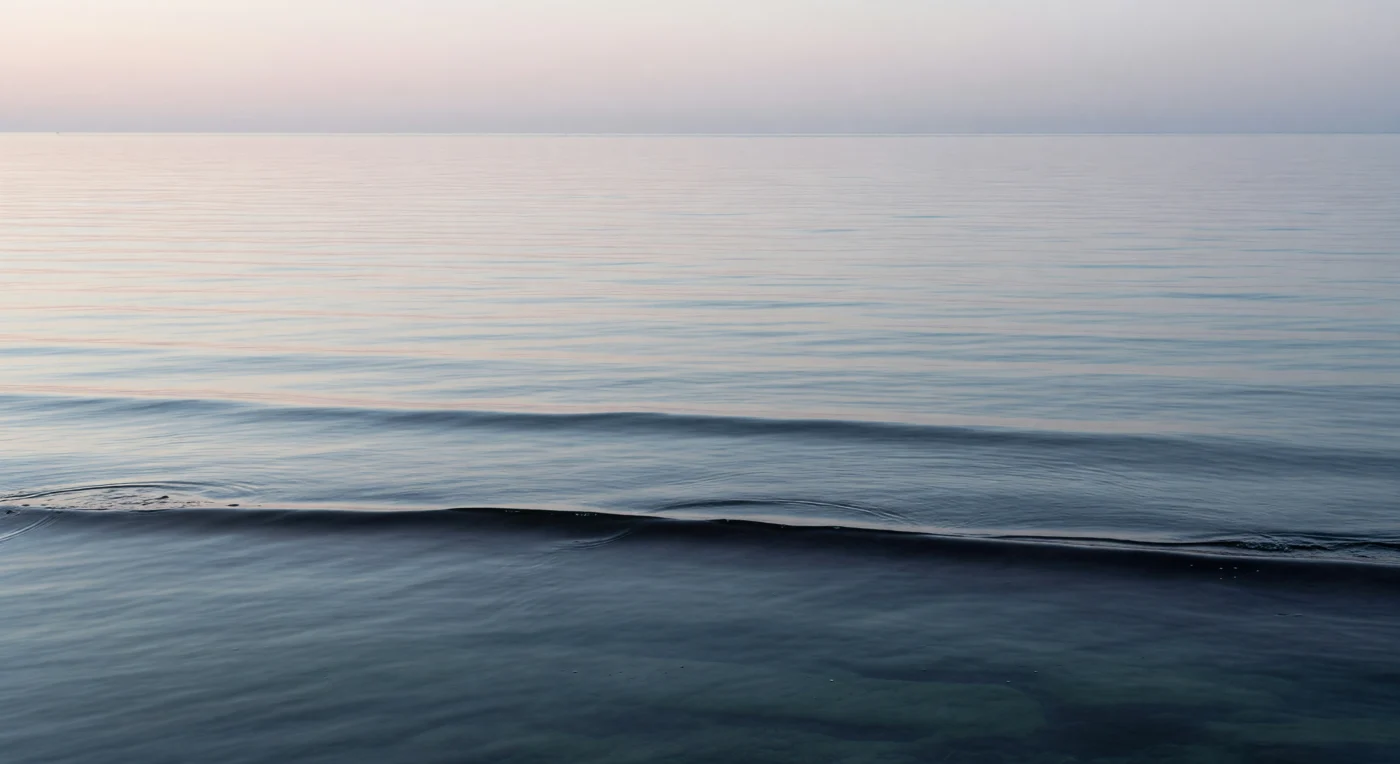
At the edge of night and day, the ocean surface lies almost perfectly still — a mer d'huile stretched beneath a brightening sky, where the air-sea interface is measured not in fathoms but in micrometers, a skin of water so thin it exists as chemistry more than depth. Dawn light arrives at an extreme angle, skimming the near-glassy plane and igniting cold pink and pearl reflections across the long dark swells that the submerged basalt ridge organizes from below, its volcanic geometry pressing its linear signature up through the water column as subtle banding visible only under such raking illumination. Within the sea-surface microlayer — that uppermost millimeter of ocean, biochemically distinct from everything beneath — dissolved organic films, lipid sheets, and microscopic life accumulate in a world of extraordinary concentration, where surface tension itself becomes an ecological force and neuston organisms navigate an interface between two atmospheres. The basalt ridge below, born of ancient seafloor spreading, slows and refracts the long swells into the faintest capillary corrugation, its dark flanks softened by refraction and traced in caustic shimmer as first light penetrates the upper meters with exceptional clarity. This is the ocean as it almost always is — vast, unhurried, indifferent, organizing itself according to physics and geology and biology with no witness required.
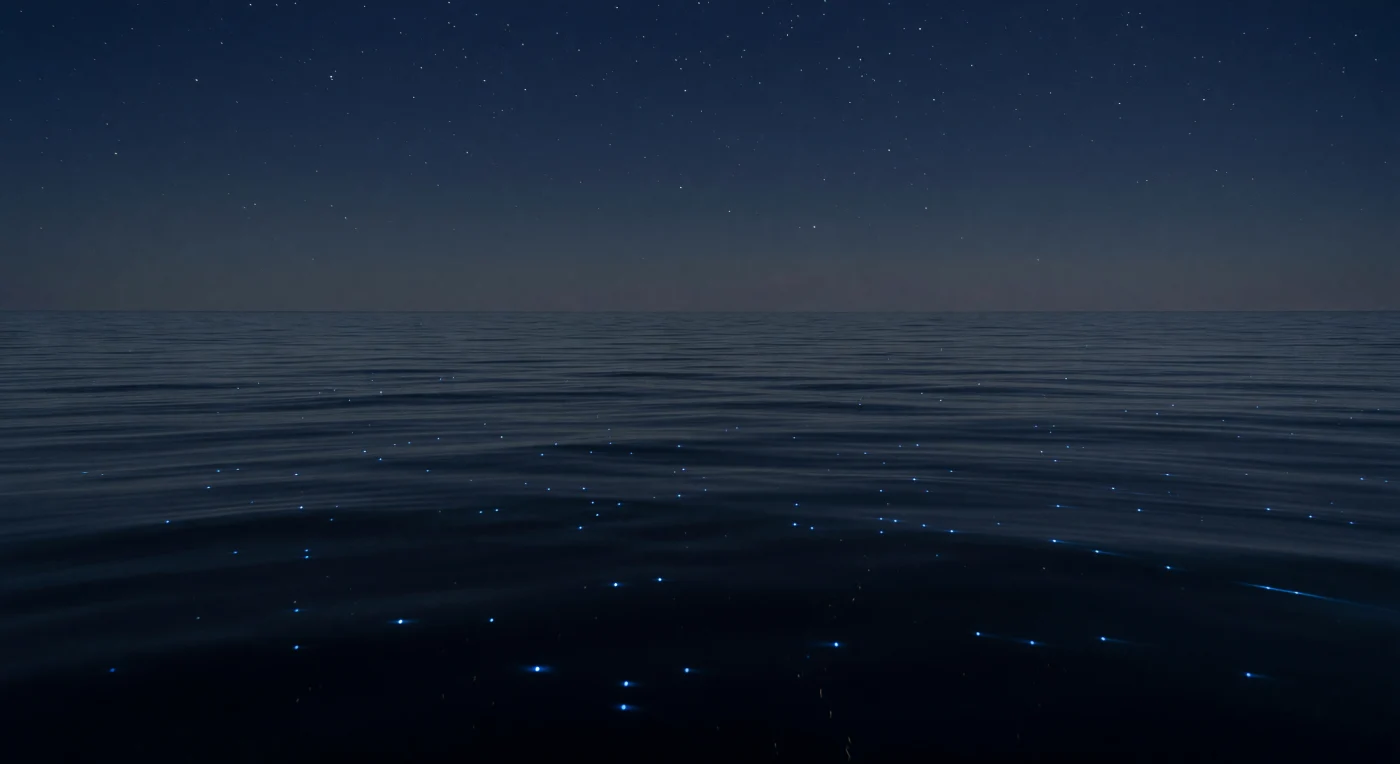
At the outermost boundary where ocean and atmosphere press silently against one another, the sea-surface microlayer — a film measuring mere micrometers in thickness — concentrates organic compounds, lipids, and living cells into a biochemically dense world invisible to any casual glance. Here, within the uppermost millimeter of a tropical ocean running at Beaufort 0 to 1, dinoflagellates such as *Noctiluca scintillans* and *Pyrocystis* species respond to the faint mechanical stress of passing capillary waves with bursts of cold blue light, a calcium-triggered luciferin-luciferase reaction that costs the organism almost nothing yet illuminates the night in scattered sapphire constellations. The ocean beneath this reflective skin is exceptionally oligotrophic, warm, and stratified, its upper thermocline acting as a lid that traps heat and limits the upwelling of nutrients, which is why the bioluminescent sparks appear sparse rather than continuous — each flash a solitary metabolic event set against vast, unlit darkness. Starlight, attenuated by water vapor in a humid tropical atmosphere, barely penetrates the first few centimeters before being absorbed, leaving the deep column beneath the interface in absolute blackness that the surface film briefly, electrically interrupts. This is the ocean as it has always been on moonless nights: complete, self-lit in places, indifferent to observation, and immeasurably old.
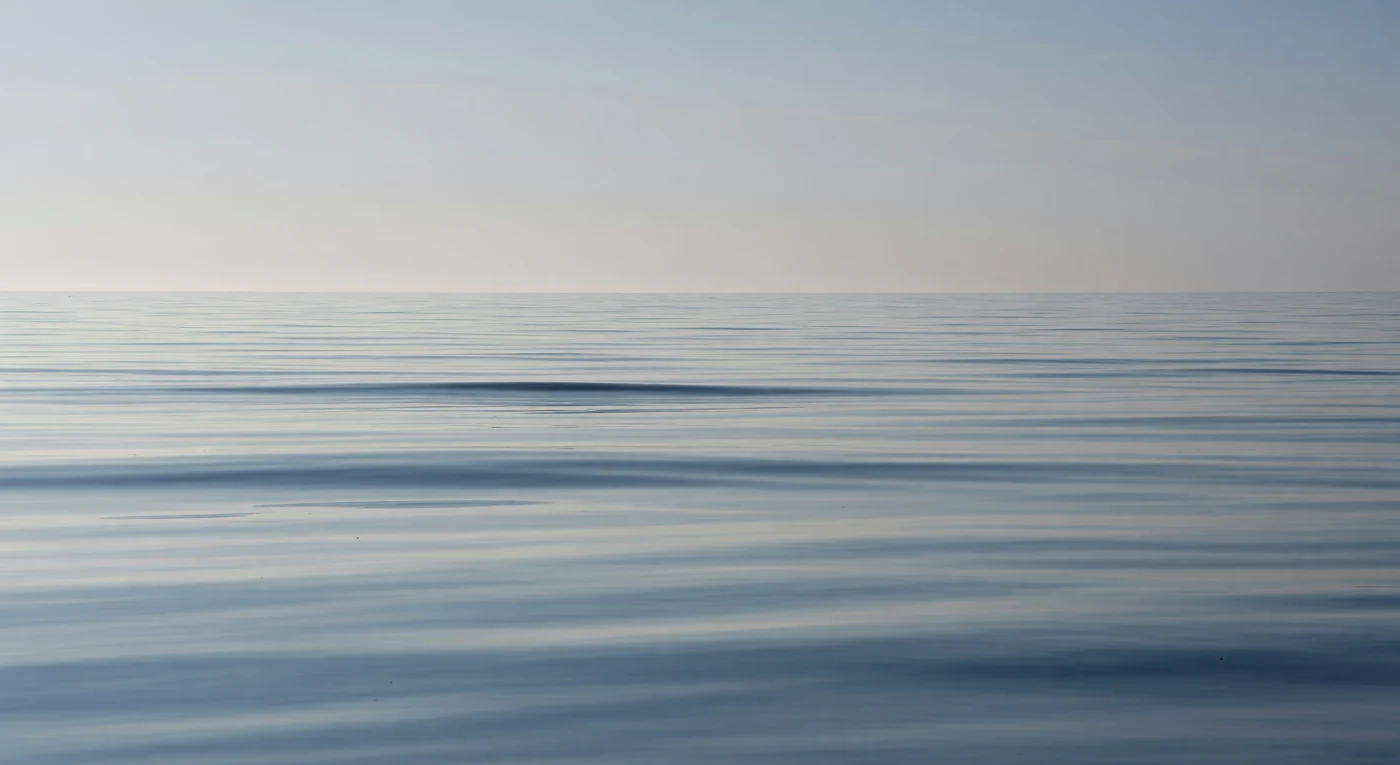
At the boundary where ocean meets atmosphere, the sea surface under near-zero wind becomes one of the most scientifically intricate interfaces on Earth — a skin measured in micrometers yet governing the exchange of carbon dioxide, heat, and oxygen between two planetary reservoirs. This is the sea-surface microlayer, a film thinner than a human hair yet chemically and biologically distinct from the water immediately below, enriched with lipids, surfactants, and the transparent exopolymers secreted by phytoplankton, which themselves drift as faint specks in the cold, transparent upper meters of a water column whose temperature here, at dawn, suppresses convective mixing and holds the surface in glassy equilibrium. Long swell lines generated by distant storms hundreds or thousands of kilometers away propagate through this stillness as slow gravitational waves, their energy carrying information about weather systems on the far side of an ocean, their crests momentarily thinning the microlayer and allowing cold dawn light to refract into the uppermost cobalt blue before the surface reforms, smooth and silver-gray, reflecting a high, empty sky with a fidelity that only Beaufort 0 to 1 conditions permit. Beneath the polished surface, the photic zone begins — that luminous upper stratum where solar radiation still penetrates, sustaining the base of the marine food web and fixing carbon on a scale that shapes the chemistry of the entire atmosphere above — yet here, in this windless dawn moment, the ocean simply rests, vast and indifferent, a world complete and continuous in itself.