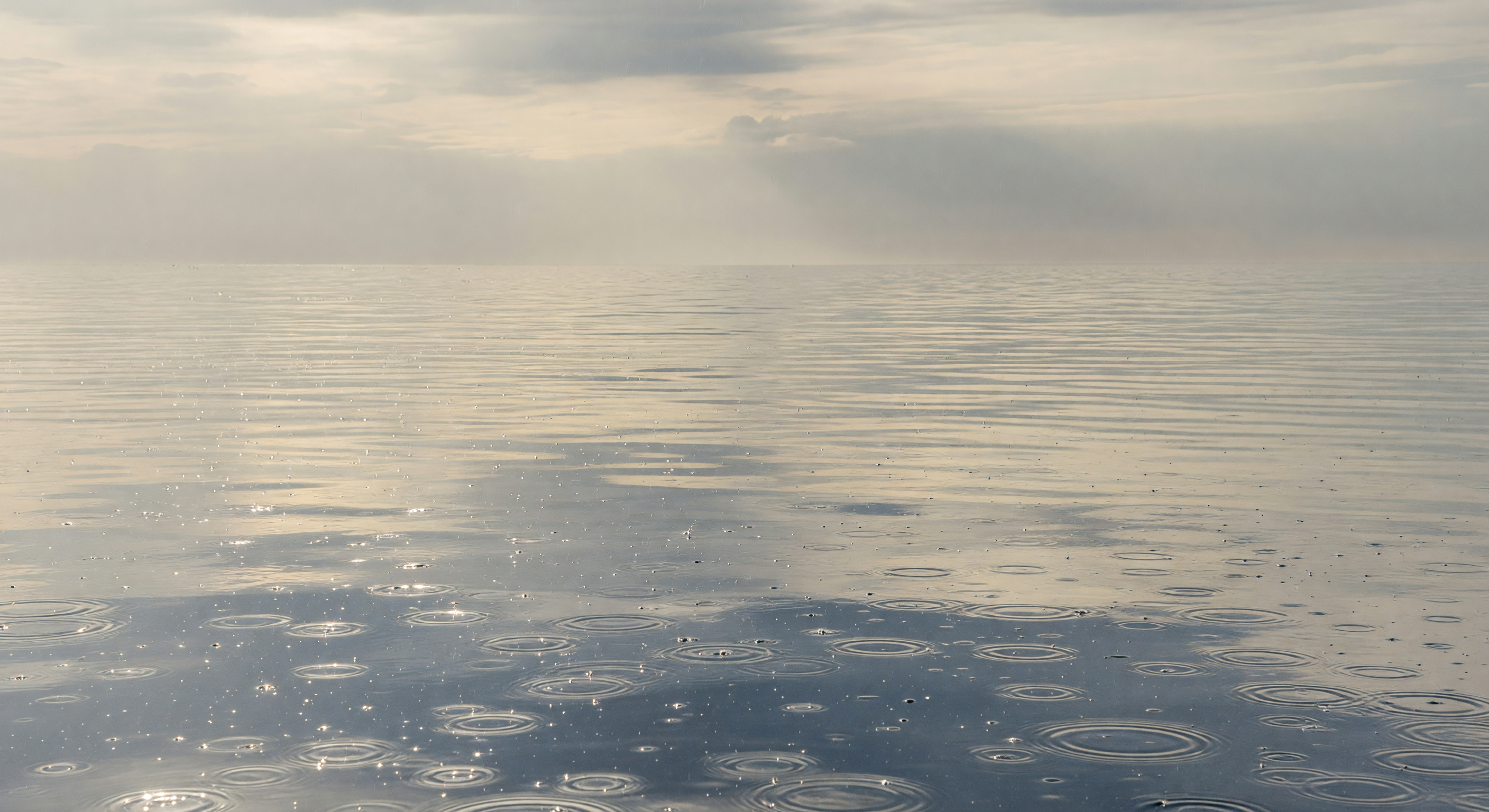
At the boundary where atmosphere meets ocean, the sea-surface microlayer — a film mere micrometers thick yet chemically and biologically distinct from the water below — trembles under a warm overcast sky as fine rain stipples its oil-smooth expanse into an ever-shifting geometry of concentric rings. Each raindrop's impact momentarily disrupts this uppermost skin of the ocean: surface tension fractures into transient crown splashes, capillary wavelets radiate outward, and fleeting microbubbles carry trace gases briefly into solution before dissolving into the diffuse silver-gray light filtering through cloud cover. This microlayer is among the most biologically concentrated habitats on Earth — enriched with dissolved organic carbon, lipids, bacteria, phytoplankton cells, and neuston organisms that spend their entire lives suspended at this precise threshold between air and water, their existence shaped by Beaufort-calm conditions where vertical mixing is minimal and the interface remains intact. Beneath the trembling skin, the upper meters of open ocean appear as clear blue-gray translucence, dense with suspended marine particulate and photosynthetically active plankton drifting in a water column where pressure is negligible, light is abundant, and the slow pulse of distant swell tilts the reflective plain in long, unhurried rhythms. Here at the surface — serene, pressureless, and immense — the ocean exists as its own complete world, rain writing temporary mathematics onto glass, the horizon clean and distant, the silence broken only by the soft percussion of water meeting water.
Calm surface