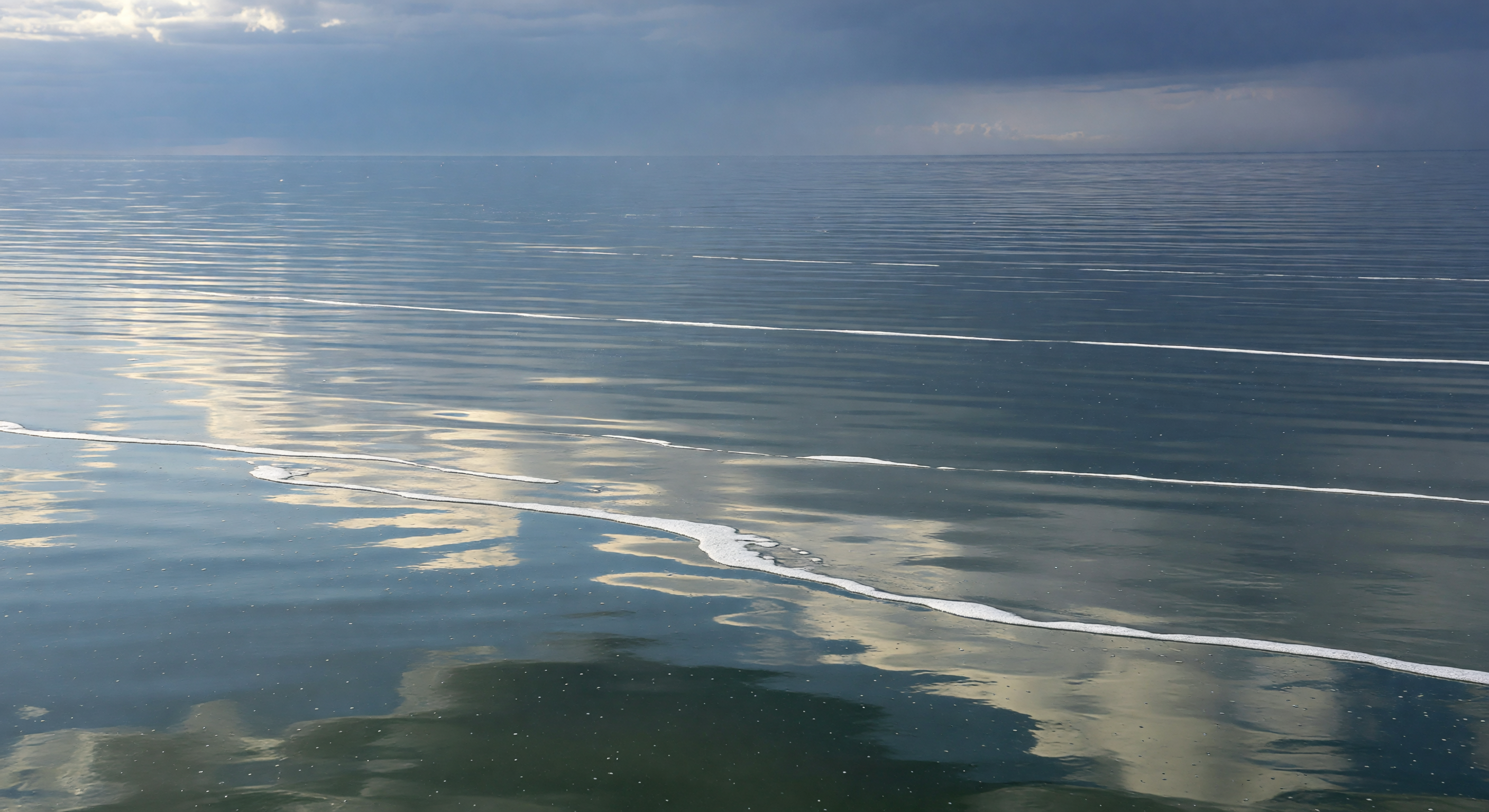
Where ocean and atmosphere press against each other in the quietest of negotiations, the sea surface after a passing squall settles into a state that oceanographers call a mer d'huile — a sea of oil — governed by Beaufort conditions barely registering above zero. The sea-surface microlayer, a film measuring only micrometers to fractions of a millimeter in thickness, concentrates dissolved organic compounds, lipids, and sparse living cells into a biochemically dense skin that subtly alters how light bends and scatters at the interface, smoothing capillary waves into the faint corrugations visible across glassy slick bands. Where Langmuir circulation and residual convergence lines from the squall's departing winds have organized the uppermost water column into parallel rolling cells, surfactants and foam aggregate into those pale, tapering seams that drift without turbulence toward the rain-dark horizon, brightening softly against the deeper steel-blue of undisturbed surface water. Broken sunlight crossing through moist post-storm air lays silver and pale blue across the reflective patches, each cloud gap igniting a shifting mirror of sky in the upper centimeters of extraordinarily clear water where sparse suspended particulate and dissipating microbubbles drift freely, unhurried. This is the ocean as it has always been between storms — self-organizing, chemically alive at scales invisible to ordinary sight, and entirely indifferent to any witness.
Other languages
- Français: Lignes de mousse convergentes
- Español: Líneas de espuma convergentes
- Português: Linhas de espuma convergentes
- Deutsch: Schaumlinien am Horizont
- العربية: خطوط الرغوة المتقاربة
- हिन्दी: झाग की मिलती रेखाएं
- 日本語: 泡沫の収束線
- 한국어: 거품 수렴선
- Italiano: Linee di schiuma convergenti
- Nederlands: Samenkomende schuimlijnen