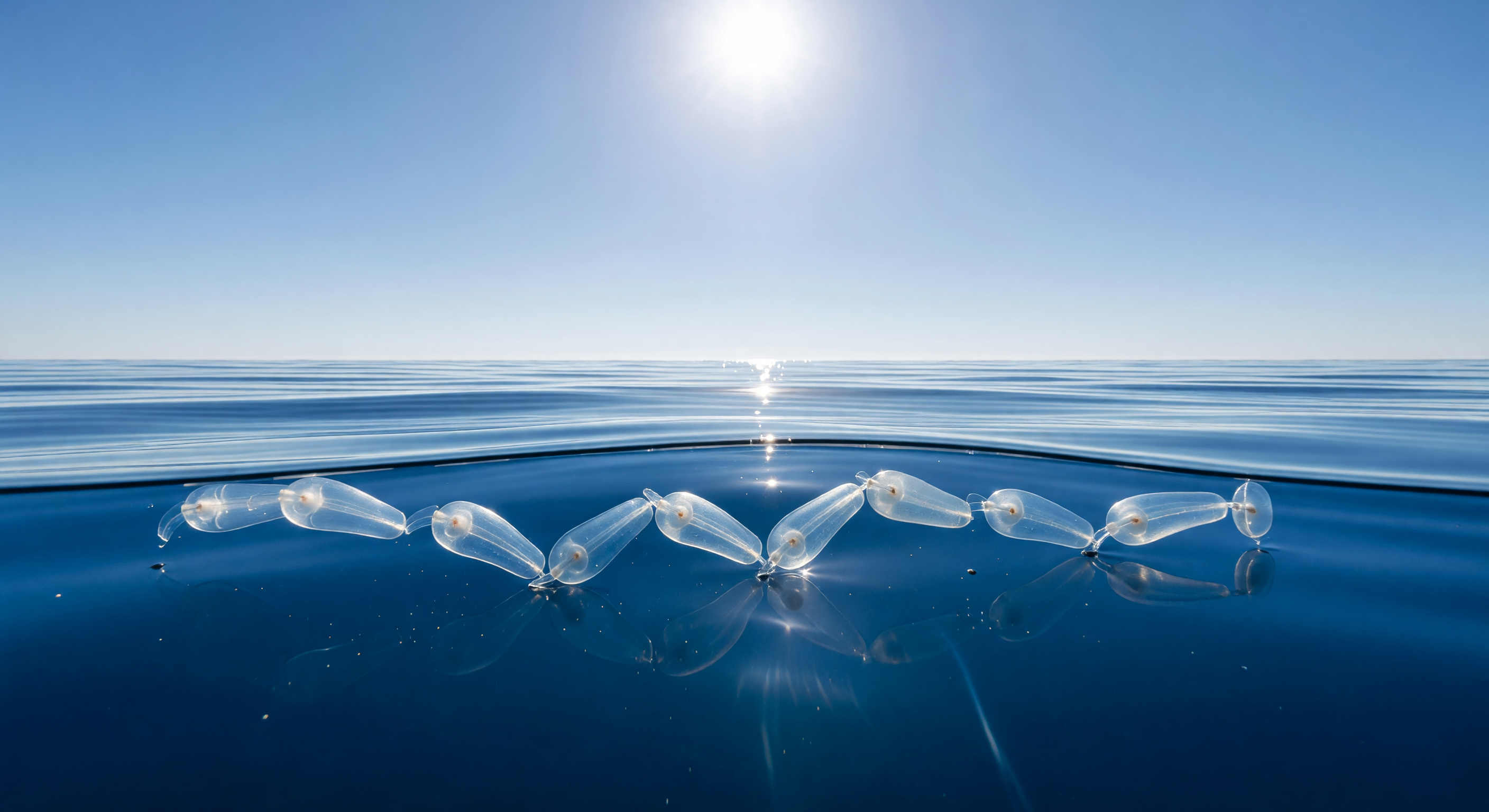
Beneath the mirror of a windless open ocean at solar noon, a chain of salps drifts motionless in the uppermost meter of water, their colonial bodies strung together in a translucent garland that neither rises nor sinks, suspended in perfect gravitational equilibrium. These barrel-shaped tunicates — members of the class Thaliacea — are among the most efficient filter feeders in the pelagic realm, each individual rhythmically pulsing seawater through fine mucous nets to harvest phytoplankton and bacterial particles invisible to any ordinary eye. At this sunlit interface, solar irradiance penetrates with almost no attenuation, bathing the salp chain in vertical white light that refracts along their curved gelatinous walls and catches the amber glow of their digestive organs, while soft caustic patterns trace across the surrounding water like the projections of a living lens. The sea-surface microlayer just above — a film measured in micrometers yet chemically and biologically distinct from the bulk water beneath — holds its own invisible community of neuston organisms, lipid films, and dissolved organic aggregates enriched by upward diffusion and bubble scavenging. Here at Beaufort 0, under a cobalt sky and an undisturbed horizon, the ocean exists entirely in its own terms: a vast, silent, productive system cycling carbon and nutrients without witness, the salps quietly repackaging the photosynthetic wealth of the sunlit world into dense fecal pellets that will eventually carry fixed carbon down into the permanent dark below.
Calm surface