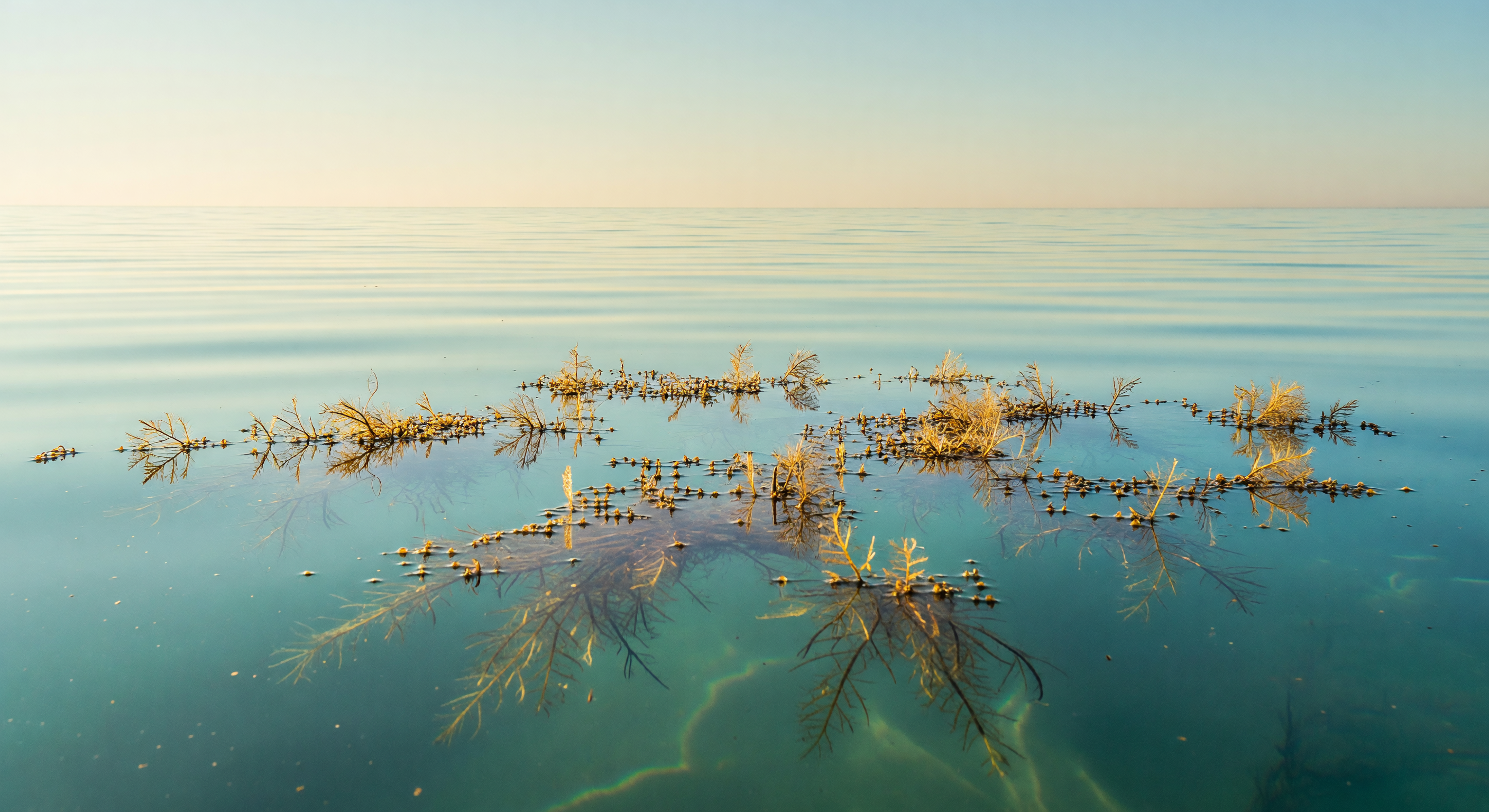
Beneath the slow, glassy interface of a Beaufort 0 sea, the uppermost meter of the open Atlantic unfolds in crystalline stillness — a thin, luminous world where low morning sunlight skims the surface and refracts into soft caustic ribbons that dance across drifting Sargassum fronds. This pelagic macroalgae, *Sargassum natans* and *S. fluitans*, forms the structural foundation of a floating ecosystem unique to the North Atlantic Subtropical Gyre, where converging surface currents concentrate buoyant material into loose golden rafts that can persist for weeks. Each hollow pneumatocyst — the small round air bladder evolved to keep fronds aloft — catches the light from above while casting a gentle brown shadow into the transparent blue-green column below, the water itself shifting from pale luminous turquoise at the air-sea interface to richer cyan within the first few decimeters, the color gradient a direct expression of differential light absorption across wavelengths. The sea-surface microlayer here, a film just micrometers thick, is biologically and chemically distinct from the water beneath — enriched in dissolved organic compounds, microbial neuston, and the eggs of creatures that exploit this sun-warmed boundary zone. Without a breath of local wind to disturb it, this mer d'huile holds a rare and transient equilibrium: a mirror held up to the open sky, alive with invisible biological exchange, indifferent to any witness.
Other languages
- Français: Radeau Doré de Sargasses
- Español: Balsa Matutina de Sargazo
- Português: Jangada de Sargaço Dourado
- Deutsch: Goldenes Sargassumtreiben
- العربية: طوف عشب البحر الصباحي
- हिन्दी: सुबह का सारगासम बेड़ा
- 日本語: 黄金の朝のホンダワラ
- 한국어: 아침 모자반 뗏목
- Italiano: Zattera di Sargassi al Mattino
- Nederlands: Gouden Sargassum Vlot