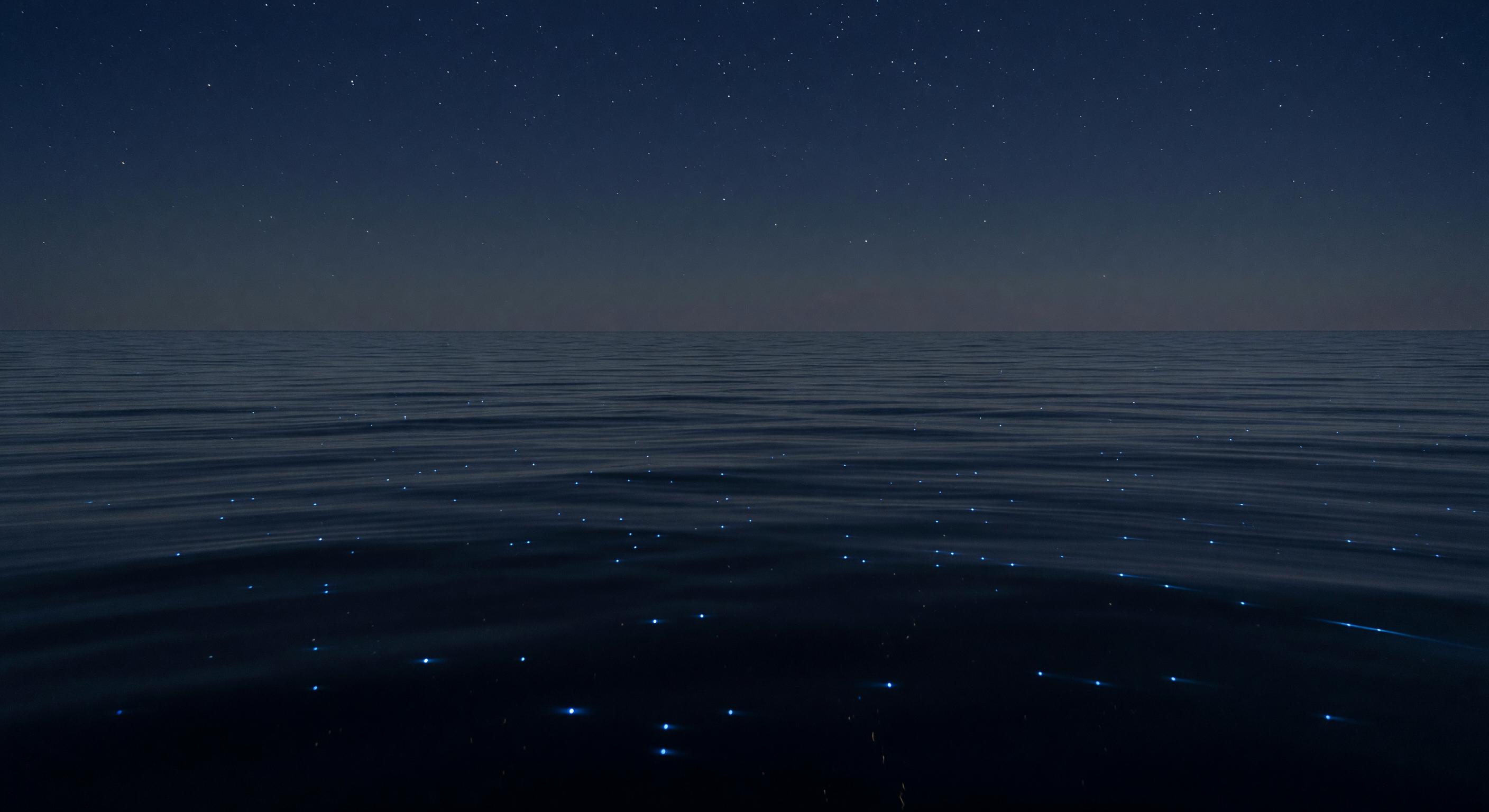
At the outermost boundary where ocean and atmosphere press silently against one another, the sea-surface microlayer — a film measuring mere micrometers in thickness — concentrates organic compounds, lipids, and living cells into a biochemically dense world invisible to any casual glance. Here, within the uppermost millimeter of a tropical ocean running at Beaufort 0 to 1, dinoflagellates such as *Noctiluca scintillans* and *Pyrocystis* species respond to the faint mechanical stress of passing capillary waves with bursts of cold blue light, a calcium-triggered luciferin-luciferase reaction that costs the organism almost nothing yet illuminates the night in scattered sapphire constellations. The ocean beneath this reflective skin is exceptionally oligotrophic, warm, and stratified, its upper thermocline acting as a lid that traps heat and limits the upwelling of nutrients, which is why the bioluminescent sparks appear sparse rather than continuous — each flash a solitary metabolic event set against vast, unlit darkness. Starlight, attenuated by water vapor in a humid tropical atmosphere, barely penetrates the first few centimeters before being absorbed, leaving the deep column beneath the interface in absolute blackness that the surface film briefly, electrically interrupts. This is the ocean as it has always been on moonless nights: complete, self-lit in places, indifferent to observation, and immeasurably old.
Calm surface