At the very boundary where atmosphere meets ocean, the air–sea interface under Beaufort 0–1 conditions becomes one of the most physically intricate surfaces on Earth, yet one of the most serene to behold. The sea-surface microlayer — a film measurable in micrometers — concentrates dissolved organic compounds, lipids, and surfactants secreted by phytoplankton blooms far below, and it is precisely this biological chemistry that suppresses capillary waves and produces the glassy, oil-like stillness of a true mer d'huile. Beneath that skin, the upper centimeters of exceptionally clear oceanic water carry minute suspended particles — transparent exopolymer particles, diatom frustules, copepod eggs drifting in near-neutral buoyancy — invisible to any ordinary eye but present in extraordinary abundance, forming the base of a sunlit food web that begins here and extends downward through the entire photic zone. The pale turquoise transparency that occasionally thins the mirror is not an optical illusion but a real consequence of low-angle solar penetration through shallow water of minimal particulate load, where the Rayleigh-like scattering of pure seawater briefly overwhelms reflectance. This surface exists in silence, indifferent and ancient, exchanging gases with the atmosphere, absorbing solar energy, seeding clouds with sea-salt aerosols, regulating planetary heat — a world measured in microns yet governing an ocean measured in kilometers.
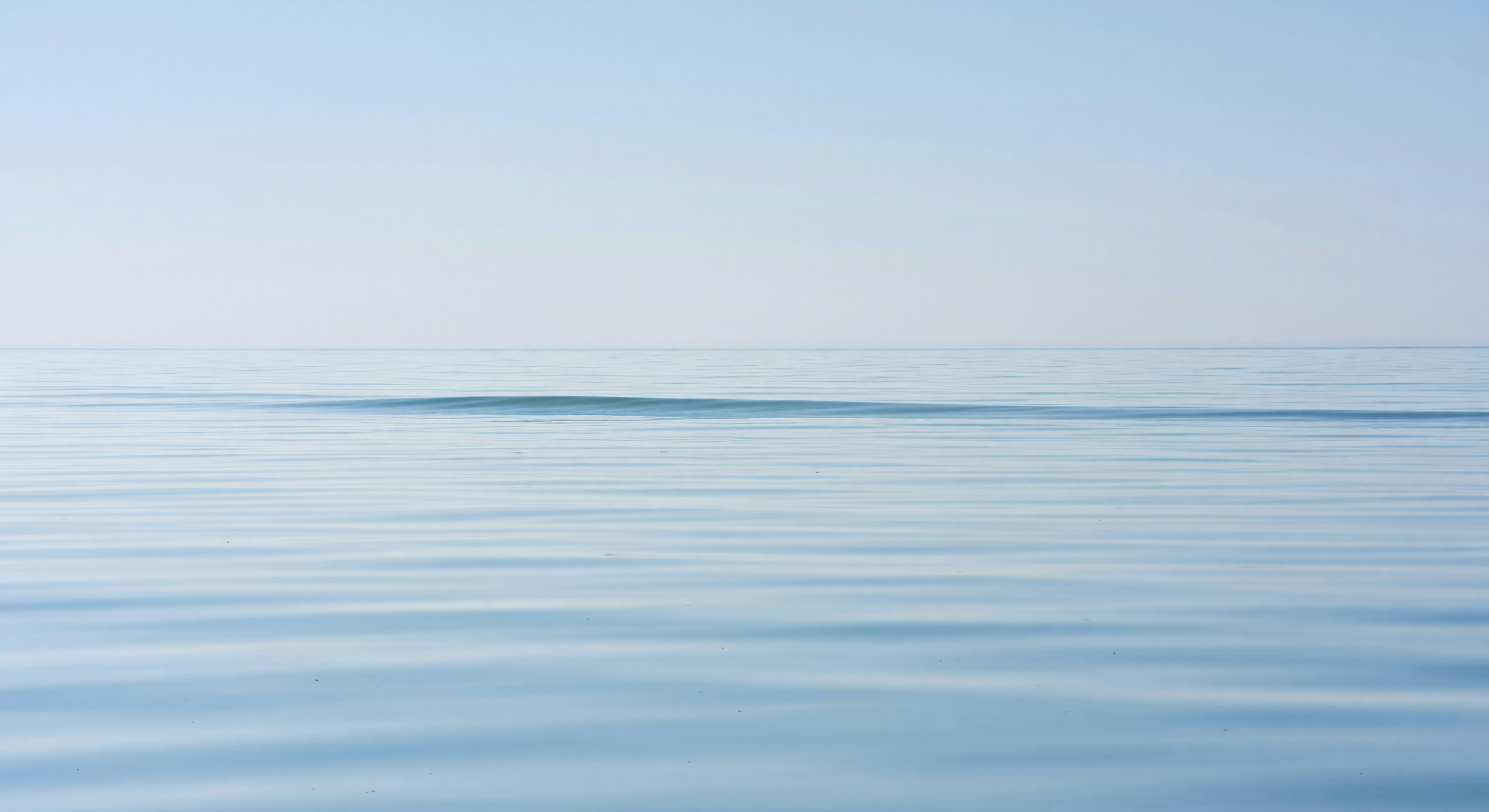
Calm surface