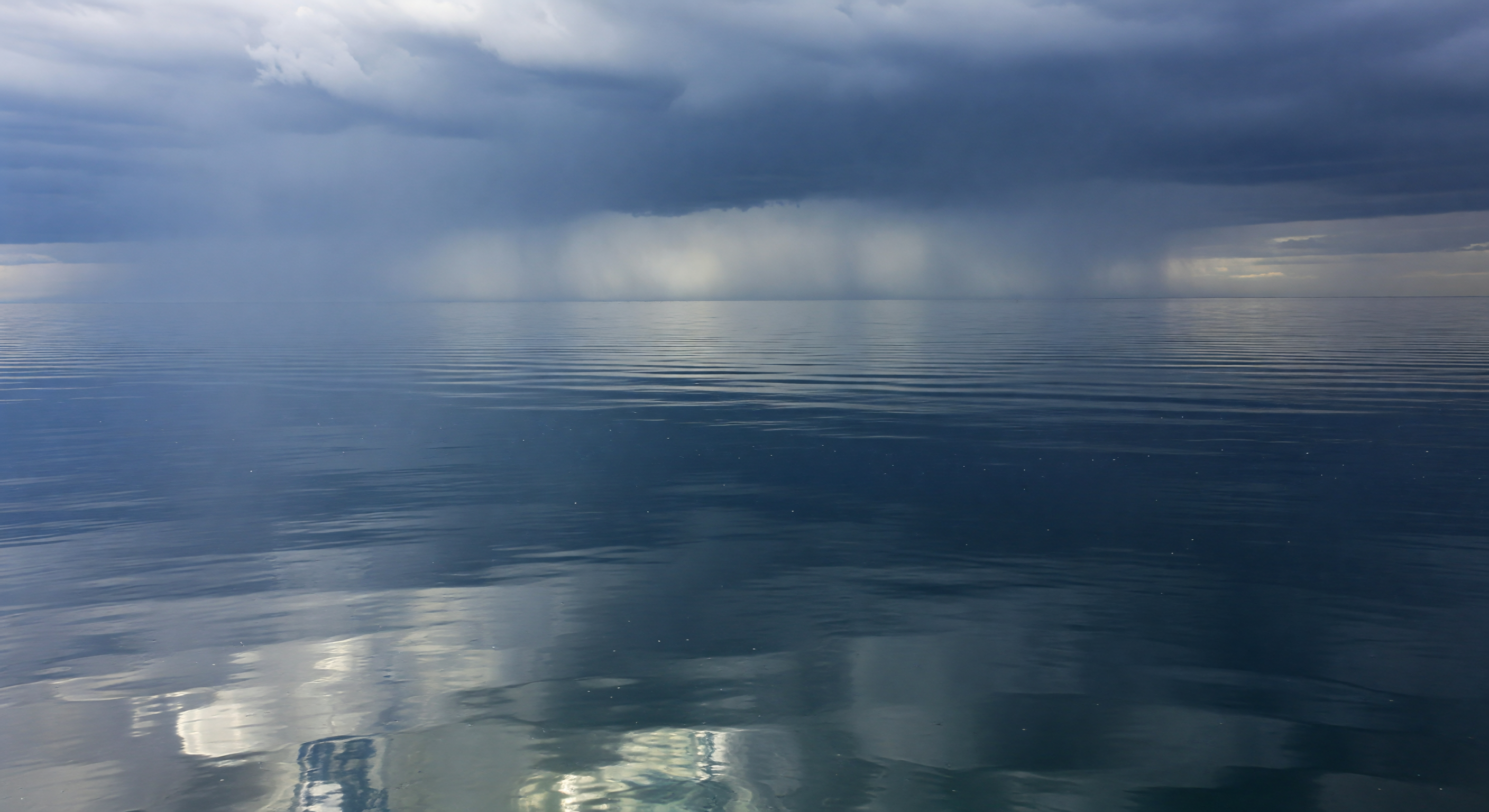
At the boundary where ocean meets sky, the sea-surface microlayer stretches as a luminous, near-perfect mirror — a film only micrometers thick yet chemically and biologically distinct from the water below, enriched with lipids, proteins, and dissolved organic compounds concentrated by surface tension and slow molecular diffusion. Under Beaufort 0–1 conditions, capillary wave generation is suppressed almost entirely, allowing this gelatinous skin to remain intact as a coherent optical surface, reflecting the underside of a convective storm system with extraordinary fidelity while a distant precipitation curtain slowly alters the far-field atmospheric pressure gradient that will eventually shatter the calm. Beneath this glassy film, the uppermost centimeters of the water column hold the neuston — a sparse community of organisms uniquely adapted to life at the interface, including sea skaters, siphonophore floats, and the violet snail Janthina, which suspends itself from a self-secreted bubble raft, grazing the boundary between two worlds. Deeper still, within the photic zone's upper stratum, diffuse daylight penetrates at oblique angles through dense overcast, scattering weakly against the finest suspended particulate — marine snow in its earliest aggregation, transparent zooplankton rising in the dying afternoon — while the long-period swell, generated days ago by the same distant storm whose rain curtain now blurs the horizon, passes beneath the surface without breaking it, a slow pneumatic breathing entirely indifferent to witness.
Calm surface