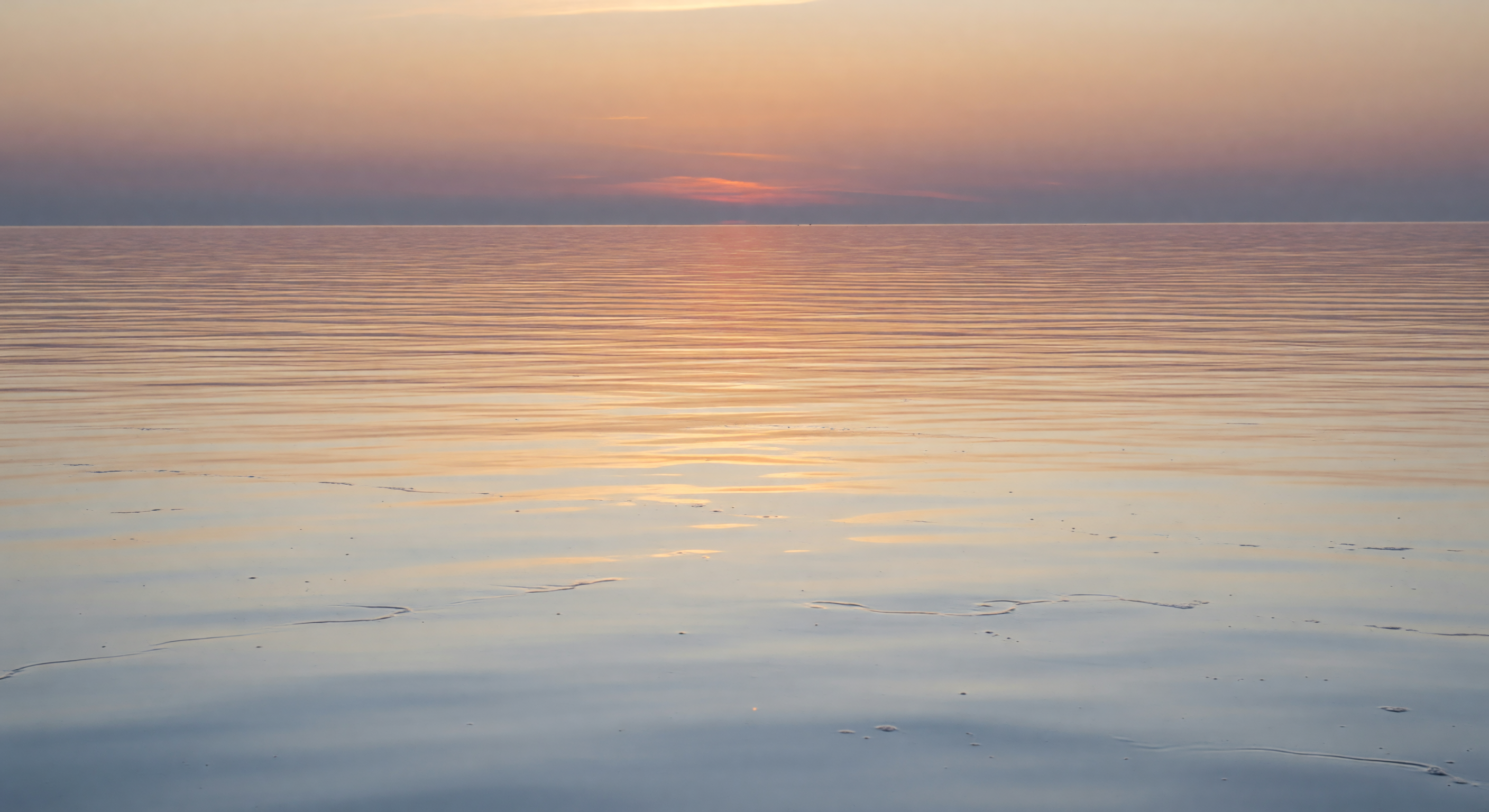
At the ocean's skin — a boundary measured not in fathoms but in micrometers — the air and sea negotiate their exchange across a film thinner than a human hair. Here, where wind stress has nearly vanished under a Beaufort 0 sky, surface tension governs everything: the sea-surface microlayer, a gel-rich lens of lipids, transparent exopolymers, and dissolved organics, stretches unbroken across the water, compressing the dusk light into long specular bands of copper and rose-gold that slide over undulations barely tall enough to cast a shadow. Beneath this luminous skin, the uppermost meters of the water column hold their own quiet world — neuston organisms, the larvae of countless pelagic species, and colonies of bacteria exploiting the microlayer's chemical richness, all suspended in a blue-gray transparency where the day's final photons still reach. The physics of gas exchange — carbon dioxide, oxygen, water vapor moving between ocean and atmosphere — slow almost to a standstill when wind speed drops this low, turning this glassy interface into a temporary seal between two vast reservoirs. Nothing breaks the stillness; the planet breathes in near-silence, the sea folding light back into sky as if the two have no clear boundary between them.
Other languages
- Français: Sentier de Cuivre au Crépuscule
- Español: Sendero de Cobre al Atardecer
- Português: Caminho de Cobre ao Entardecer
- Deutsch: Kupferpfad in der Dämmerung
- العربية: درب النحاس عند الغسق
- हिन्दी: सांझ में तांबे की राह
- 日本語: 夕暮れの銅色の道
- 한국어: 황혼의 구리빛 길
- Italiano: Sentiero di Rame al Tramonto
- Nederlands: Koperen Pad bij Schemering