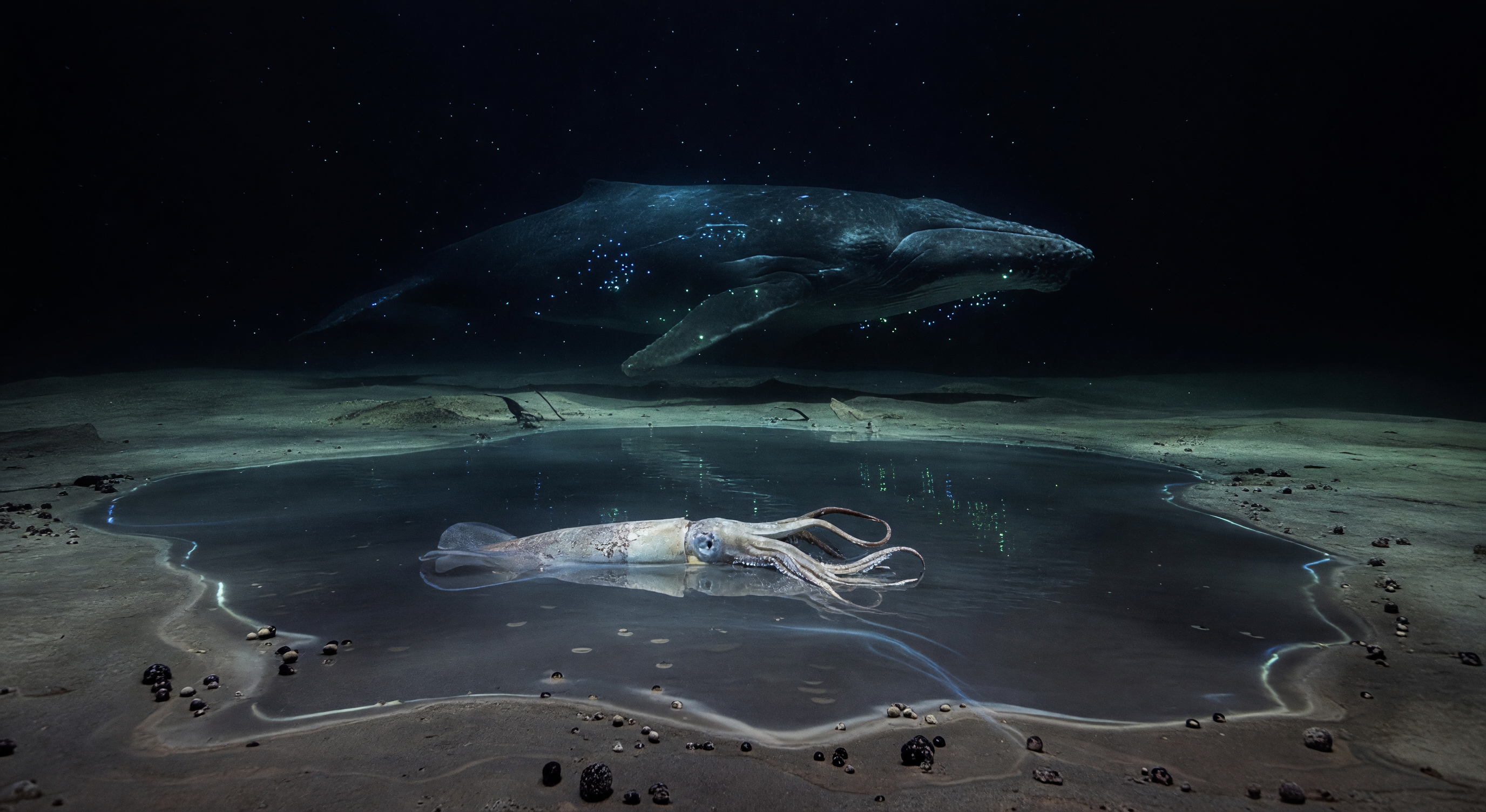
At roughly four to six thousand metres below the surface, where pressure crushes at four hundred atmospheres or more and the water temperature hovers near two degrees Celsius, a brine pool sits inset into the grey-brown abyssal sediment like a still, metallic mirror — its hypersaline water so dense that it forms a stable liquid-within-liquid interface, traced at its margins by pale bacterial films and scattered manganese nodules accreted over millennia. Just centimetres above this shimmering halocline, a wounded colossal squid (*Mesonychoteuthis hamiltoni*) drifts in suspension, its scarred mantle pallid against the black water column, long tentacles loosened and curling to expose rows of hooked suckers — the biological record of an encounter written in flesh. Ribbons of cyan and green bioluminescence cling to the disturbed density boundary, produced by the chemosynthetic microbial communities thriving along the basin rim and by the squid's own disrupted tissues, their cold light the only illumination across an otherwise lightless plain. Beyond the brine shore, a sperm whale (*Physeter macrocephalus*) turns in silent profile through the water column, its wrinkled flank marked with fresh circular sucker scars, its massive echolocating head having already swept these depths with focused acoustic pulses in pursuit of prey that retreats toward the abyss. Marine snow drifts freely in all directions through water that has not seen sunlight since it sank centuries ago, and the sediment edge beyond dissolves into absolute darkness — a world of immense pressure, biological light, and predatory silence that requires no witness to persist.
Sperm whales and giant squids