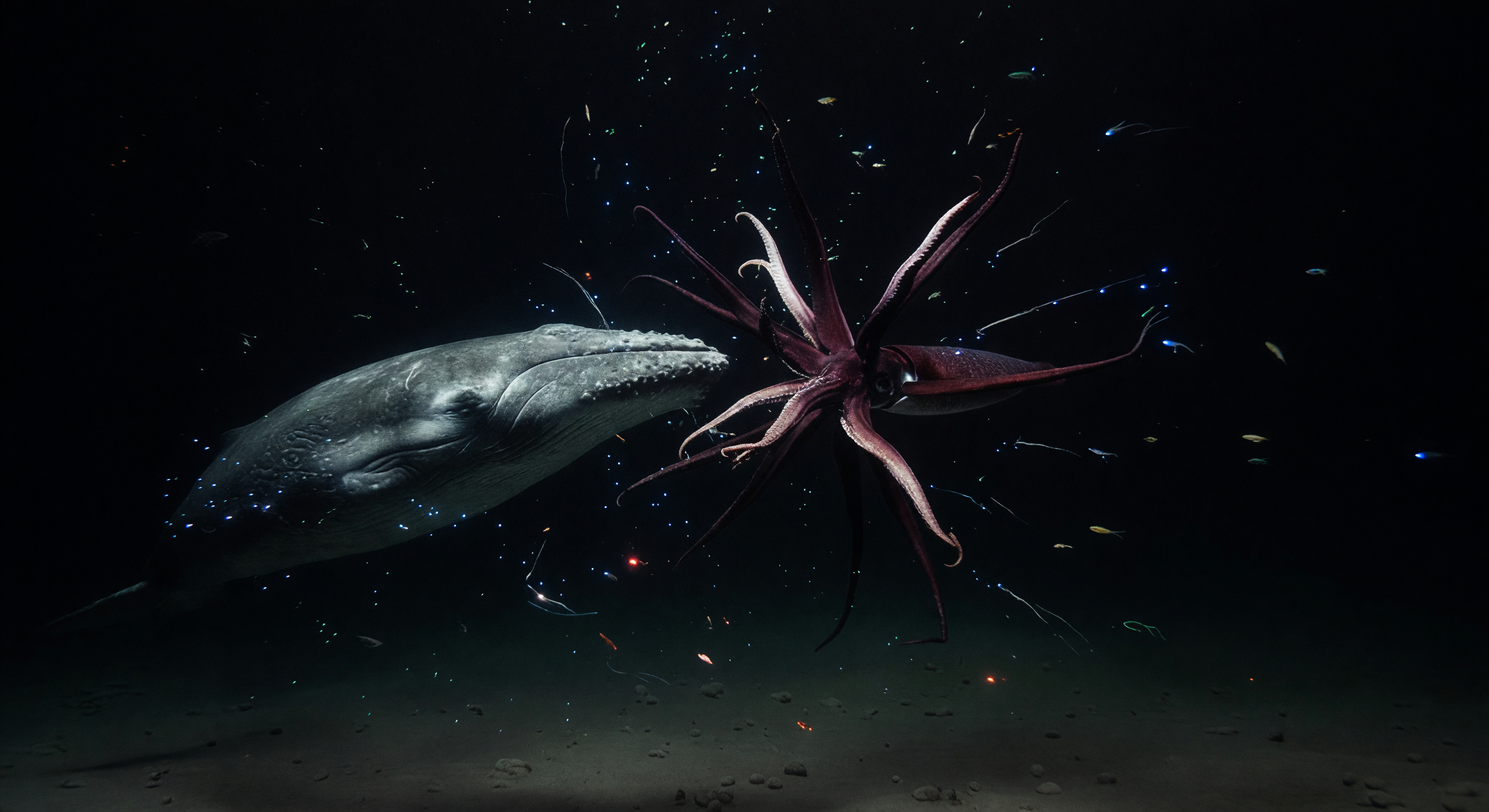
In the sunless water column hanging kilometers above a barely-perceptible abyssal plain, two of the ocean's most formidable animals meet in total darkness, their encounter illuminated only by the fragmented bioluminescent panic of disturbed deep-sea shrimps whose blue-cyan alarm flashes strobe across swiveling hooks and scarred cetacean skin. *Mesonychoteuthis hamiltoni*, the colossal squid, is the largest invertebrate on Earth by mass, its muscular mantle capable of rapid chromatophore expansion into wine-dark defensive displays, its feeding clubs armed with rotating toothed hooks that leave the distinctive circular scars etched across the slate-grey flanks of *Physeter macrocephalus* — scars that researchers study at the surface as the only lasting testimony of battles never directly witnessed. At these abyssopelagic depths, pressure exceeds 400 atmospheres and water temperatures hover near 1–2 °C, conditions that demand extraordinary physiological adaptation: the sperm whale descends on a single breath, its flexible ribcage yielding to compression, its myoglobin-rich tissues sustaining a dive that may last over an hour, while the squid navigates the same crushing cold through pressure-tolerant coelomic fluid and neutrally buoyant ammonium-rich tissues. Marine snow drifts through the scene without reference to any surface world, a continuous slow fall of organic particles that traces the invisible architecture of the water column, and the faint haze of manganese-nodule-scattered seafloor far below exists as a geological patience measured in millions of years — indifferent to the explosive, hook-lined negotiation unfolding in the black water above it.
Other languages
- Français: Floraison Défensive du Calmar Colossal
- Español: Explosión Defensiva del Calamar Colosal
- Português: Explosão Defensiva da Lula Colossal
- Deutsch: Riesiger Tintenfisch Abwehrblüte
- العربية: انتشار دفاعي للحبار العملاق
- हिन्दी: विशालकाय स्क्विड का सुरक्षात्मक प्रस्फुटन
- 日本語: ダイオウイカの防御的開花
- 한국어: 대왕오징어 방어적 개화
- Italiano: Fioritura Difensiva del Calamaro Colossale
- Nederlands: Kolossale Inktvis Verdedigingsbloei