In the lightless water column suspended thousands of meters above the abyssal sediment, one of the ocean's most ancient predatory exchanges unfolds in absolute cold and crushing pressure. *Physeter macrocephalus*, the largest toothed predator on Earth, descends into the abyssopelagic realm on a single breath held for over an hour, guided by the most powerful biological sonar known — a click train capable of resolving soft-bodied prey in featureless black water — while *Architeuthis dux*, the giant squid, attempts escape by jetting backward through water dense with slowly settling marine snow, each particle a fragment of biological material drifting down from the sunlit world far above. The violence of their acceleration mechanically disturbs the surrounding planktonic organisms and displaces bioluminescent dinoflagellates and small gelatinous forms, releasing brief cascades of blue-green light that trace the geometry of pursuit like luminous wreckage — the squid's trailing arms briefly outlined in cold fire, the whale's scarred rostrum and wrinkled skin emerging from darkness in the same fleeting glow before the water reseals into blackness. At these depths, hydrostatic pressure exceeds 400 atmospheres, temperatures hover near 2 °C, and the biochemistry of both animals is built for exactly this extreme: sperm whale blood carries extraordinary oxygen reserves, while the squid's ammonium-rich tissues provide near-neutral buoyancy in water that has not seen sunlight in centuries. Far below, the abyssal plain extends as a vast flat expanse of foraminiferal ooze scattered with manganese nodules — a seafloor that records nothing of the struggle above, only the eventual slow arrival of organic particles from a world it will never witness directly.
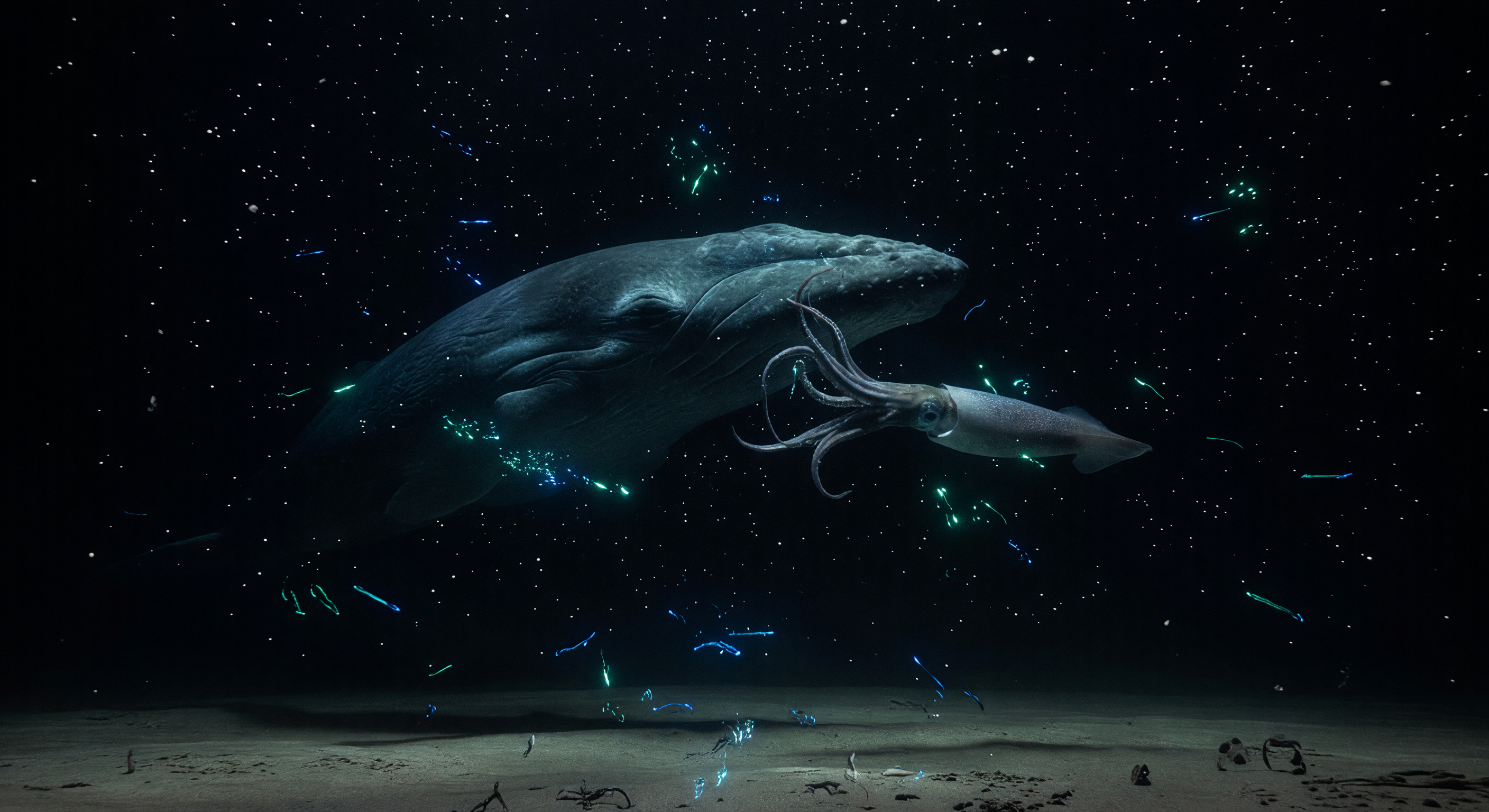
Sperm whales and giant squids