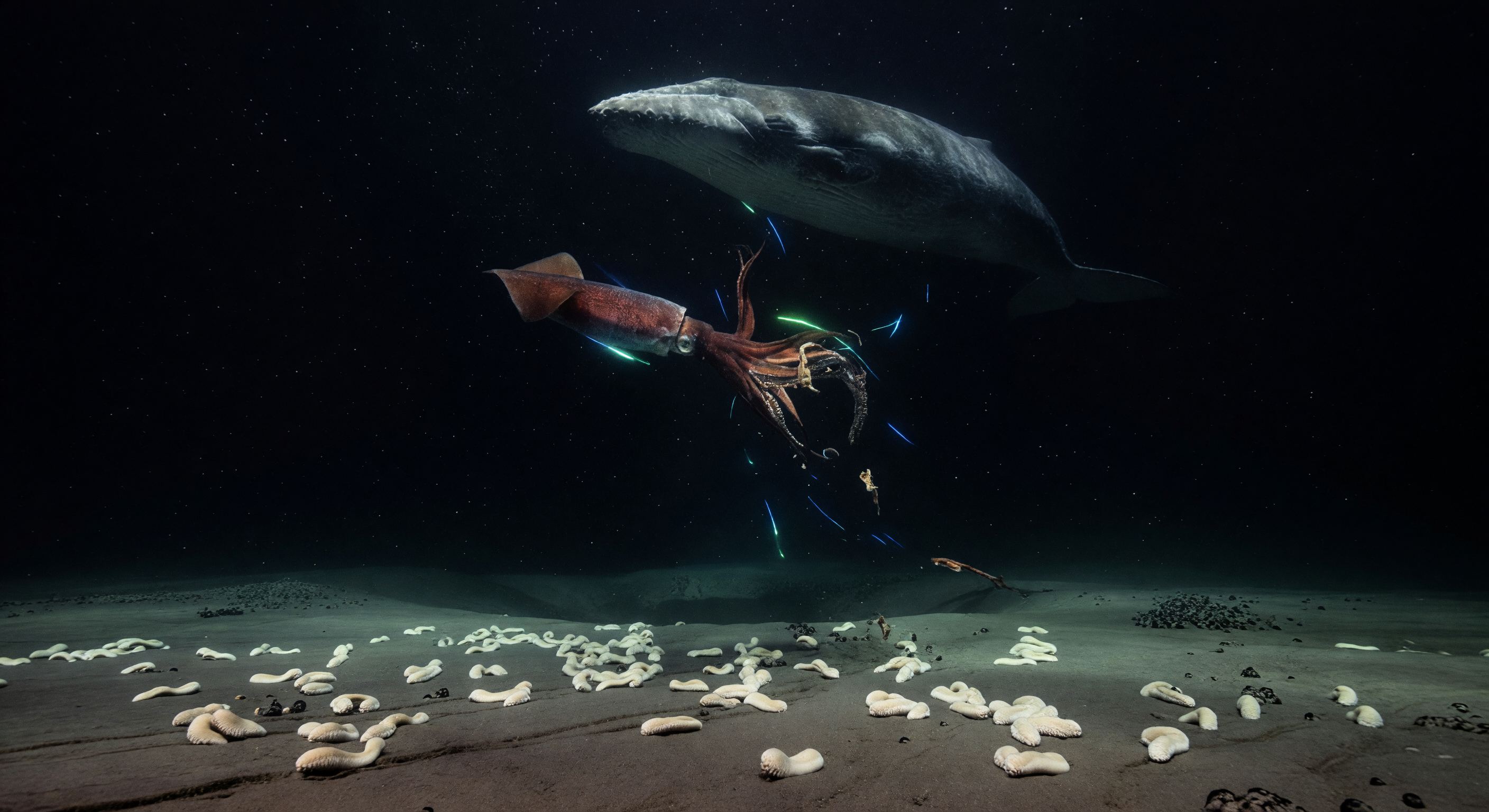
At crushing pressures where four hundred or more atmospheres compress the cold water column to near-solid stillness, the abyssal plain stretches in every direction as a vast, nearly level expanse of grey-brown sediment dimpled with the tracks of slow-moving fauna and studded with black manganese nodules that have been accumulating for millions of years. Across this quiet terrain, pale holothurians — sea cucumbers built for oligotrophic patience — graze the microbial films and settling organic matter that drifts down from the sunlit world far above, their bodies translucent and unhurried in water barely above freezing, the community so sparse and the plain so enormous that each individual seems to exist in its own private silence. High above this benthic congregation, invisible in the absolute blackness of the water column, something violent is happening: a sperm whale — *Physeter macrocephalus*, the deepest-diving of all large toothed whales, capable of suspending breath and metabolism for over an hour — has seized a giant squid (*Architeuthis dux*) and is driving it laterally through the dark, the struggle announced not by any light from without but by the bioluminescent chemistry of disturbed dinoflagellates and agitated tissue, smearing cyan arcs across the black water as the squid's hooked suckers rake the whale's scarred rostrum and arms splay wide under tearing tension. Fragments of tissue and organic debris spiral slowly downward from the clash, beginning the long fall toward the holothurian garden below, destined to become part of the marine snow that sustains this entire hidden ecosystem — a closed loop of predation, death, and recycling that has operated without witness across geological time.
Other languages
- Français: Passage sous jardin d'holothuries
- Español: Sotopaso del jardín de holotúreas
- Português: Passagem do jardim de holotúrias
- Deutsch: Holothurien Garten Unterführung
- العربية: ممر حديقة الخيار البحري
- हिन्दी: समुद्री ककड़ी उद्यान मार्ग
- 日本語: ナマコ園の海底回廊
- 한국어: 해삼 정원 해저 통로
- Italiano: Sottopasso del giardino di oloturie
- Nederlands: Holothurie tuin doorgang