Across an abyssal plain lying under roughly four hundred to six hundred atmospheres of cold, still water, a sperm whale moves as a massive shadowed form just above a sediment field colonized by xenophyophores — single-celled giants, each an enormous protist lattice of branching agglutinated tubes rising from the mud like frost tracery on dark glass, filtering particles from water that has not seen sunlight in centuries. At this depth the only illumination is biological: cold cyan and blue-green pinpricks ignite and fade where disturbed plankton respond to the pressure waves of the whale's passage, and descending fragments of giant squid — torn mantle ribbons, a severed arm still bearing hooked suckers, translucent tissue curling slowly under gravity — trail faint bioluminescent smears as they sink through the nepheloid haze above the bottom, momentarily mapping the turbulence of a hunt concluded somewhere far above. The whale's pale skin carries the permanent record of that hunting life in deep circular suction scars, each mark left by an Architeuthis arm during some earlier struggle in waters that were already completely dark, and its slow drift across the xenophyophore field displaces bottom water in gentle billows that cause the fragile protist structures to tremble without breaking, their gossamer forms persisting as they have for years of patient accumulation on sediment that receives perhaps one milligram of organic carbon per square centimeter per year. Here, where water temperature holds near two degrees Celsius and the pressure compresses every cubic centimeter of the surrounding sea, life proceeds without reference to any surface world — the whale breathing its last stored oxygen before a rise it has already calculated, the squid remains continuing their weeks-long descent toward the benthos, and the xenophyophores simply enduring, drawing their living matter from the dark, cold, almost empty water that is the permanent condition of the deep ocean plain.
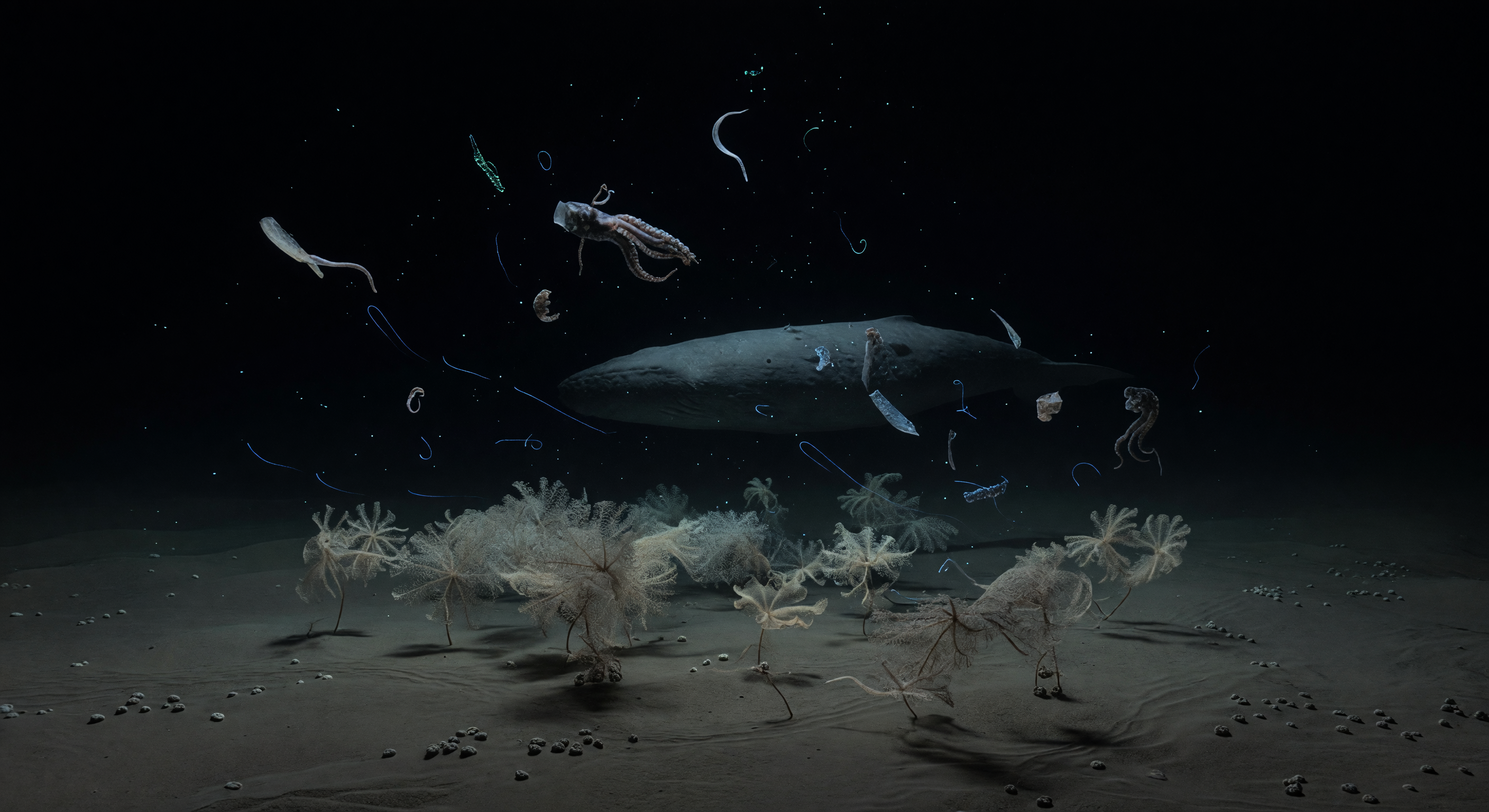
Sperm whales and giant squids