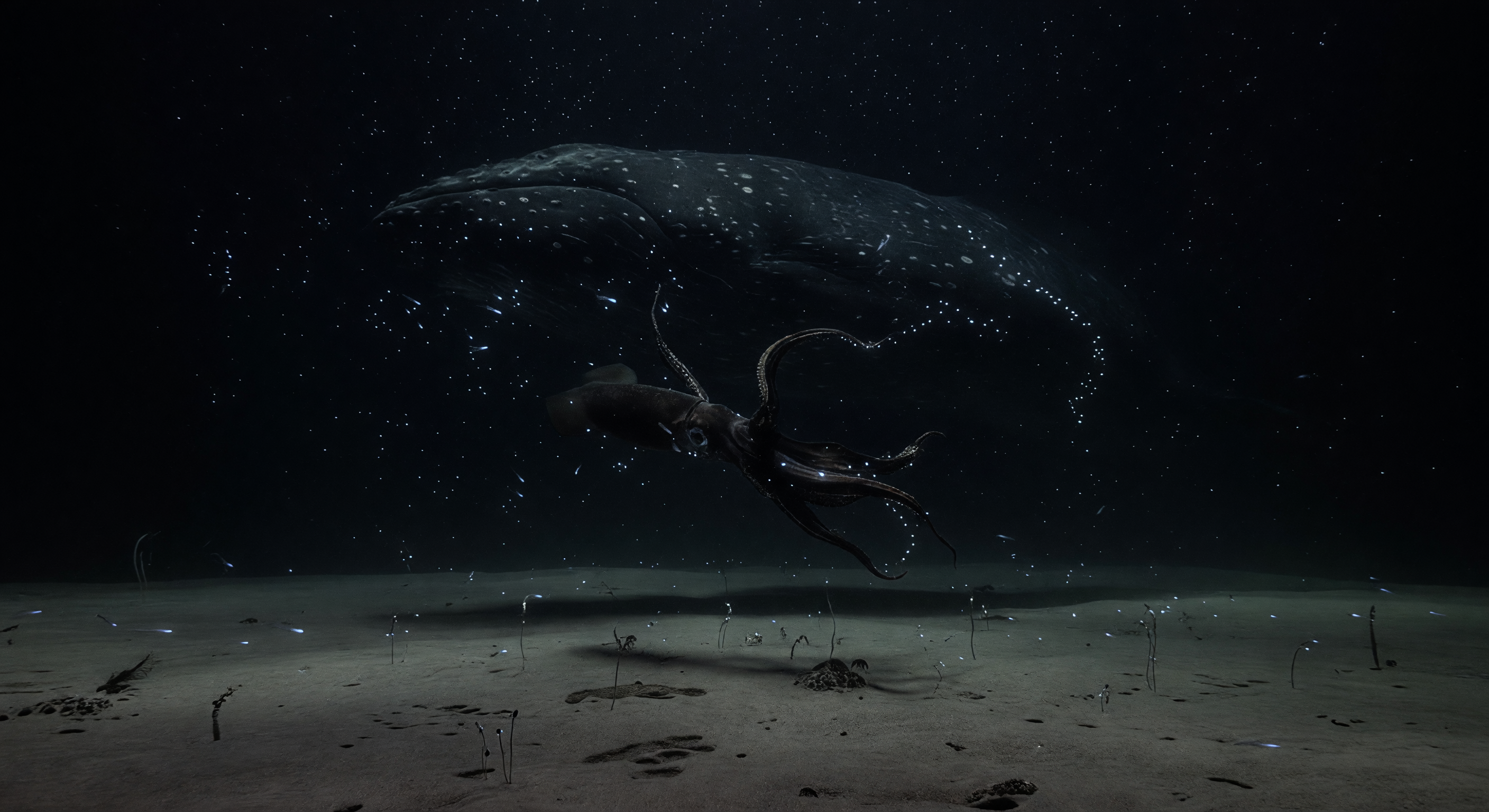
At roughly 4,000 to 6,000 metres beneath the surface, where pressure exceeds 400 atmospheres and temperature barely clears 1 °C, a sperm whale (*Physeter macrocephalus*) descends through absolute darkness like a living mountain, its skin mapped with pale circular scars — the healed signatures of countless prior encounters with animals exactly like the one now recoiling beneath it. The giant squid (*Architeuthis dux*) throws its long feeding tentacles wide, the hook-ringed suckers along their clubs momentarily catching cold blue flashes from gelatinous drifters disturbed by the violence of the confrontation, each brief bioluminescent pulse the only illumination in a world that has never known sunlight. Sperm whales are among the deepest-diving air-breathing vertebrates on Earth, their clicks and codas propagating for kilometres through frigid water while specialized wax-filled organs in their enormous heads act as acoustic lenses for echolocation, allowing them to detect soft-bodied prey in conditions of total darkness that would render any other sensory system useless. Below this suspended battle, the abyssal plain lies patient and indifferent — fine grey-brown silt textured by slow-moving holothurians and polychaetes, scattered manganese nodules accreted over millions of years at the rate of a few millimetres per millennium, and stalked crinoids rising like ancient candlesticks from the sediment, filter-feeding the marine snow that drifts ceaselessly downward as a fine rain of organic particles from the sunlit world impossibly far above. This is a place that has existed, and will continue to exist, in complete sovereign indifference — a cold, crushing, biologically dense darkness that needs no witness to be fully, violently alive.
Other languages
- Français: Plaine de crinoïdes sous bataille
- Español: Llanura de crinoides bajo batalla
- Português: Planície de crinoides sob batalha
- Deutsch: Krinoiden-Ebene unter dem Kampf
- العربية: سهل الكرينويد تحت المعركة
- हिन्दी: क्रिनॉइड मैदान युद्ध के नीचे
- 日本語: 海百合平原の深海の戦い
- 한국어: 바다나리 평원의 전투
- Italiano: Pianura di crinoidi sotto battaglia
- Nederlands: Crinoïdenvlakte onder gevecht