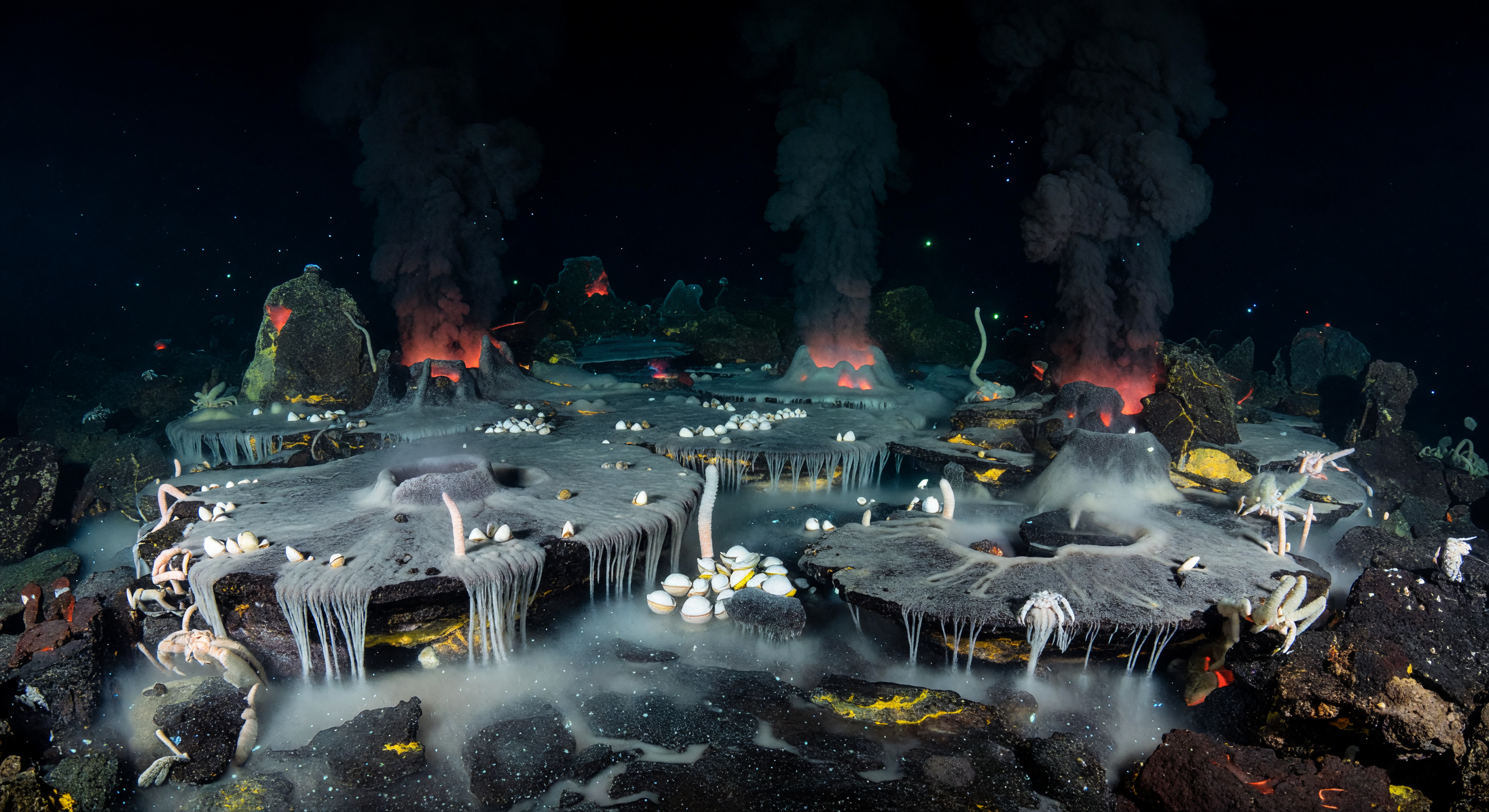
At depths where pressure exceeds two hundred atmospheres and the last trace of solar radiation vanished kilometers above, stepped terraces of fresh basalt host one of the ocean's most improbable ecosystems. Diffuse venting breathes warm, mineral-laden fluid upward through cracks and fissures, sustaining thick white microbial mats that drape each volcanic ledge like sodden silk, their fringed margins trembling in a pearly haze of precipitating silica and anhydrite. Chemolithoautotrophic bacteria at the base of this food web oxidize hydrogen sulfide to fix carbon in total darkness, feeding dense aggregations of white Calyptogena clams wedged between mat-covered ledges, pale Riftia pachyptila tube worms rising stiffly from fissures, and Yeti crabs — Kiwaidae — crowding the warmer margins of the terrace, their feathery chelipeds harvesting the microbial film. Farther across the field, low chimneys exhale shimmering plumes whose turbulent edges glow with the faint orange-red chemiluminescence generated by superheated fluid meeting cold seawater, while newly fractured basalt carries a thermal ember of its own, and scattered cyan-blue-green points of bioluminescence pulse from pressure-adapted organisms drifting in the near-bottom water. This entire world — geological, chemical, and biological — runs on heat from the planet's interior alone, indifferent to the surface, sustaining itself in permanent night.
Other languages
- Français: Terrasse au Voile Bactérien
- Español: Terraza de Velo Bacteriano
- Português: Terraço do Véu Bacteriano
- Deutsch: Bakterieller Schleier Terrasse
- العربية: مصطبة الحجاب البكتيري
- हिन्दी: जीवाणु आवरण सोपान
- 日本語: 菌膜のテラス
- 한국어: 박테리아 베일 테라스
- Italiano: Terrazza del Velo Batterico
- Nederlands: Bacterieel Sluisterras