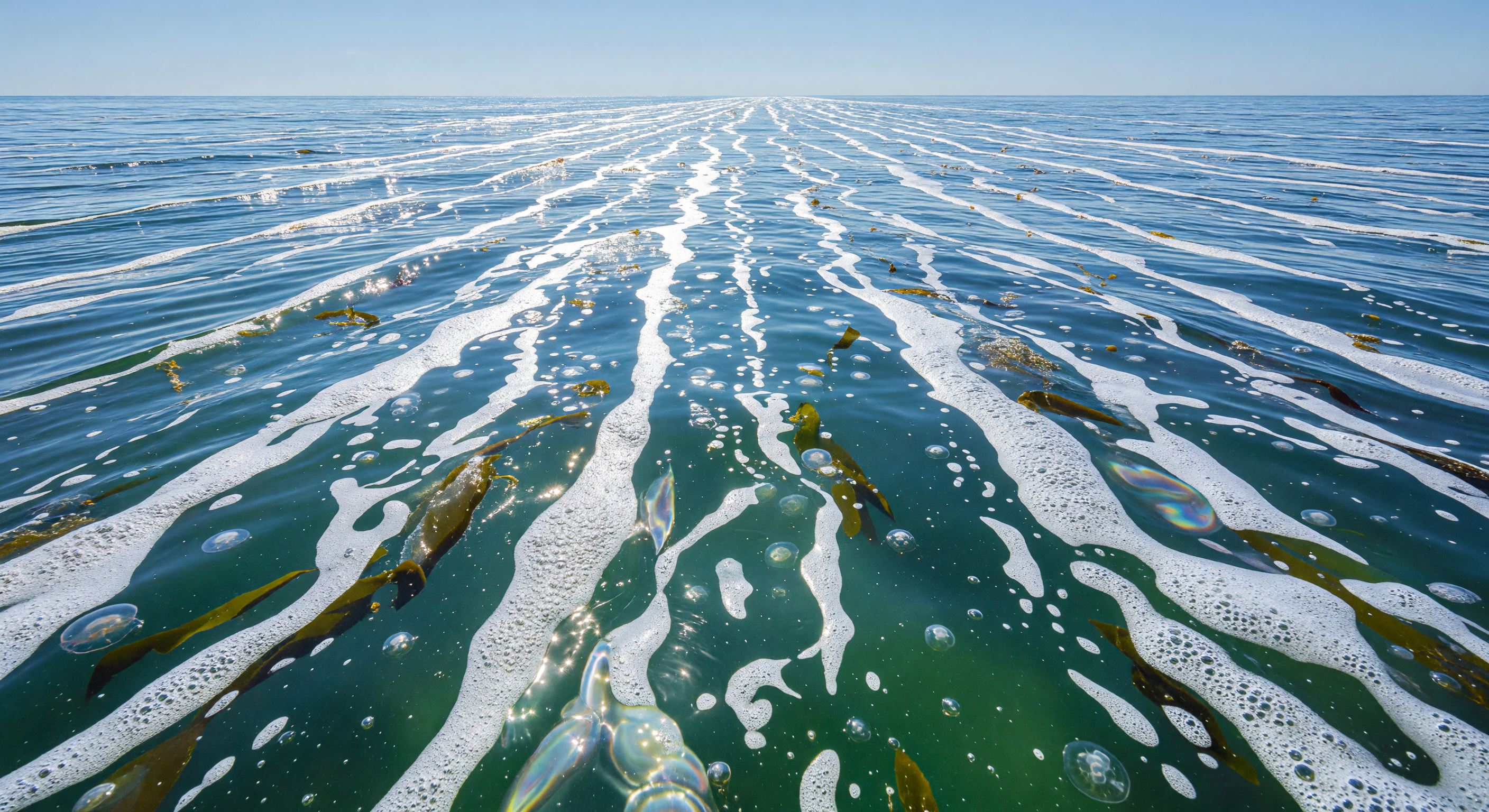
Skimming just thirty centimeters above the choppy surface of a temperate continental shelf, the AUV's camera resolves the sea into a living mosaic of parallel Langmuir convergence lines — wind-driven helical circulation cells that methodically sweep the surface layer, concentrating buoyant material into these long, orderly windrows of foam, froth, and biological debris. Between the pearlescent bubble rafts, translucent moon jellies drift half-submerged, their bells mirroring the hard noon sky, while torn olive kelp fronds and microbe-rich brown slicks of polysaccharide gel mark where dissolved organic matter and bacterial films have accumulated at concentrations orders of magnitude higher than the water a meter below. This is the sea-surface microlayer — a zone measured in micrometers to millimeters, yet disproportionately important: it governs the exchange of carbon dioxide, oxygen, and volatile organic compounds between ocean and atmosphere, hosts specialized neuston communities adapted to life at the very boundary of two fluid worlds, and generates the marine aerosols that seed distant clouds. The foam itself is no simple by-product of turbulence but a stabilized matrix of surfactant-coated bubbles that scatter sunlight into pearly, iridescent filaments, each thin film a temporary window into the intense photochemistry and gas dynamics occurring where ocean and atmosphere are, for a brief and brilliant moment, the same thing.
Other languages
- Français: Percée sur les stries de Langmuir
- Español: Emergiendo sobre líneas de Langmuir
- Português: Emergindo sobre linhas de Langmuir
- Deutsch: Auftauchen über Langmuir-Streifen
- العربية: اختراق خطوط لانغموير
- हिन्दी: लैंगमुइर रेखाओं के ऊपर उभरना
- 日本語: ラングミュア筋を超えて浮上
- 한국어: 랭뮤어 선 위로 부상
- Italiano: Emergendo sulle linee di Langmuir
- Nederlands: Opstijgen boven Langmuir-strepen