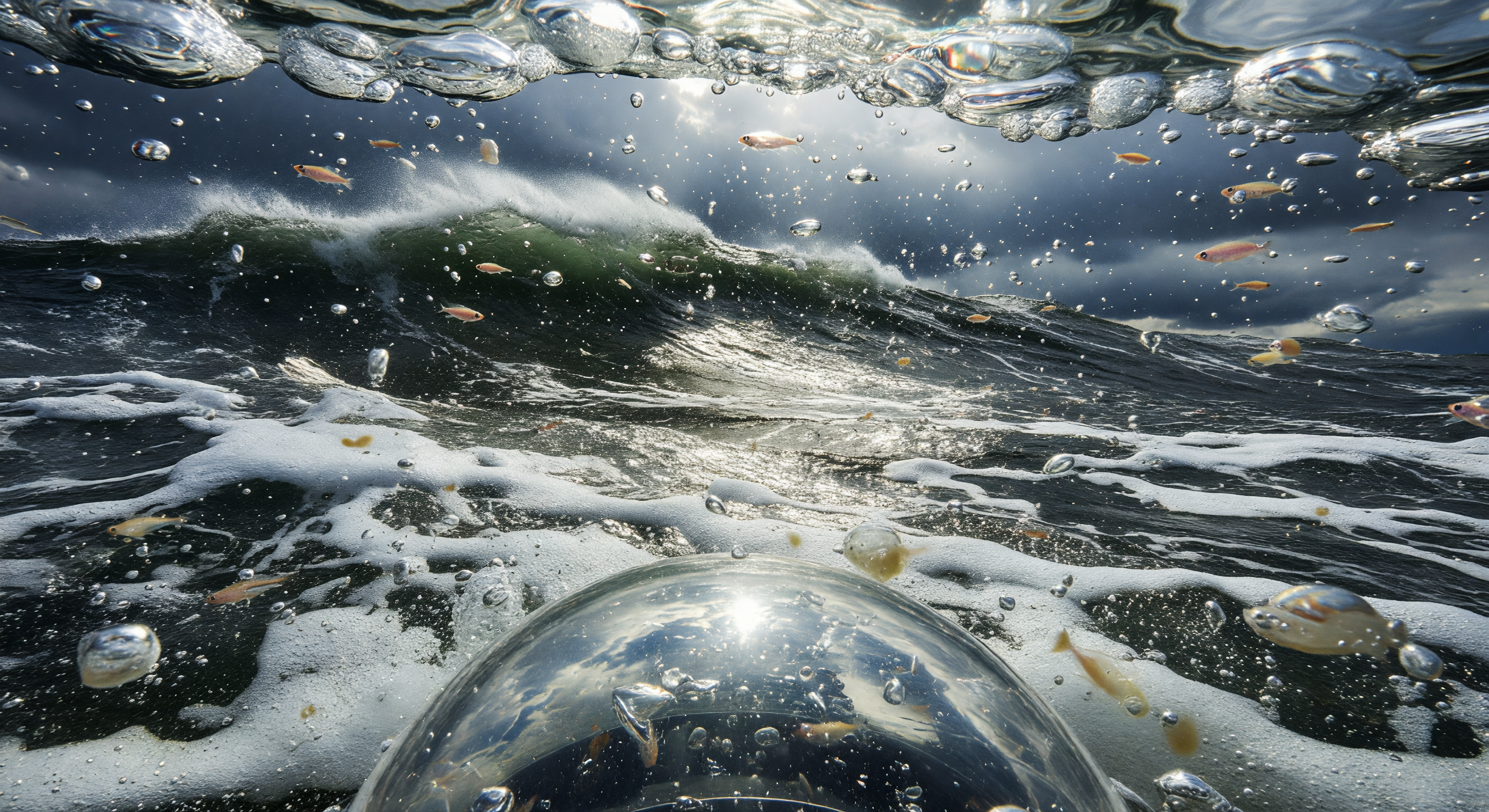
The submersible's forward viewport plunges through a churning architecture of breaking crests, its acrylic dome barely clearing the torn green-black wave faces as horizontal spume lashes across the frame and elongated foam lanes race past at arm's length. This is the ocean's most chemically and biologically active frontier — the sea-surface microlayer, a film measured in micrometers yet disproportionately enriched with surfactant proteins, lipopolysaccharides, and microbial films that stabilize each bubble wall into a pearlescent, rainbow-fringed membrane before it collapses back into the churning mass. Beneath the glowing ceiling of backscattered silver light, swarms of krill hang suspended in the upper meter, their amber-pink bodies and reflective black eyes sharp against the bottle-green void, feeding opportunistically on the organic matter concentrated by wave-driven Langmuir circulation into these same luminous froth lanes. At Beaufort 9, breaking waves inject dense microbubble plumes meters deep, dramatically accelerating air-sea gas exchange — CO₂, oxygen, dimethyl sulfide — and the acoustic roar of collapsing bubble clouds would be audible through the hull even as the viewport frames this cold, fractured, silver-white matrix of light diffraction, organic slicks, and living storm chemistry pressing intimately against the glass.
Other languages
- Français: Écume de Tempête Frontale
- Español: Espuma de Tormenta Frontal
- Português: Espuma da Tempestade à Frente
- Deutsch: Sturmgischt von Vorne
- العربية: رغوة العاصفة الأمامية
- हिन्दी: आगे से तूफानी झाग
- 日本語: 嵐の飛沫が迫る
- 한국어: 폭풍 물거품 정면
- Italiano: Schiuma di Tempesta Frontale
- Nederlands: Stormschuim van Voren