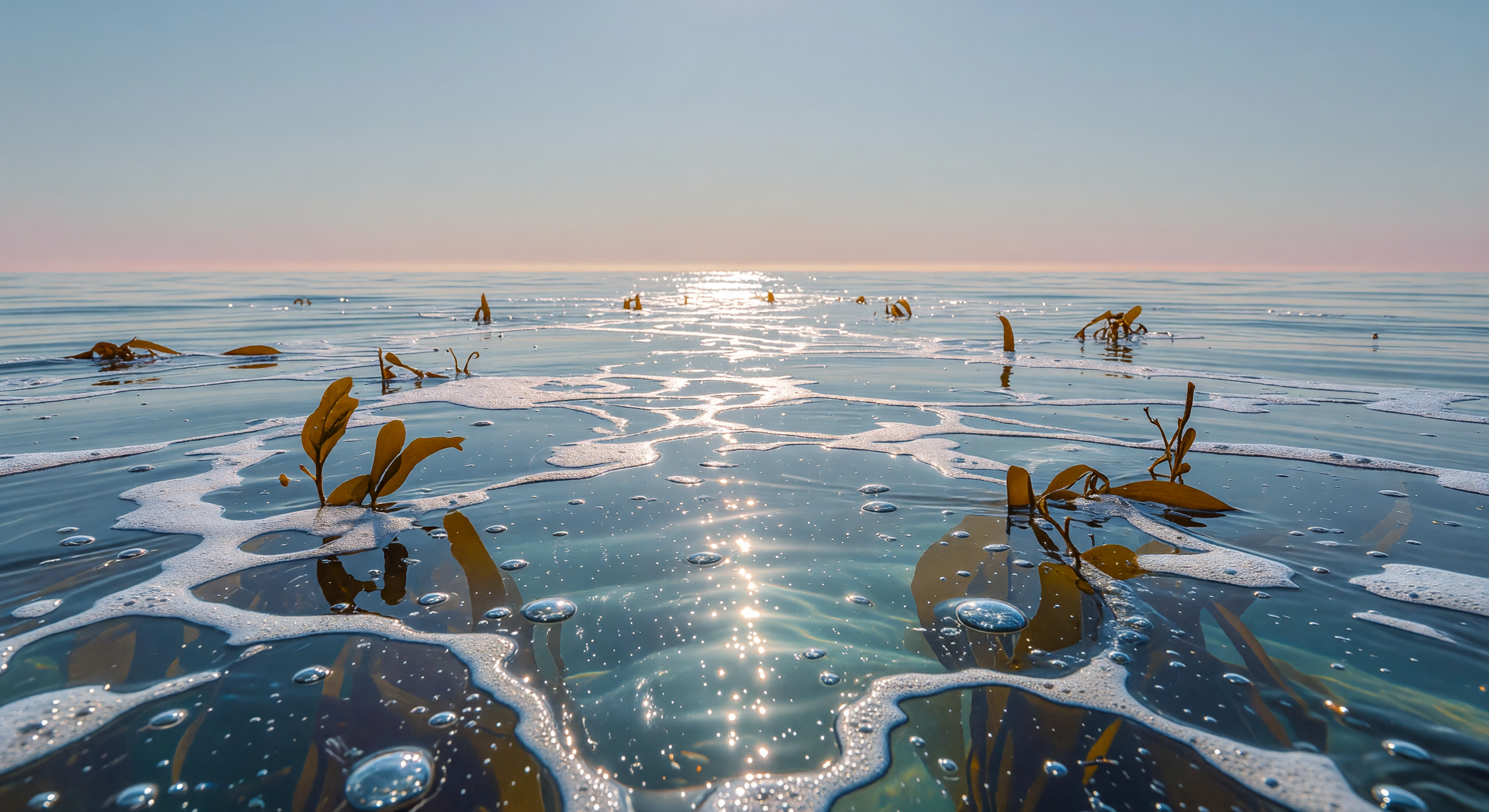
At chin level with the glassy kelp cove, the snorkeler floats suspended between two worlds — above, a rose-and-steel dawn sky reflects perfectly in the undisturbed sea skin, while drifting foam polygons catch the first oblique sunlight and fracture it into pearlescent white highlights and cool blue shadows, each thin bubble film occasionally shimmering with faint iridescence where dissolved organic surfactants — proteins, lipids, and transparent exopolymer particles secreted by phytoplankton and bacteria — have concentrated within the sea-surface microlayer to densities orders of magnitude above the water column below. Below the interface, the uppermost ten to fifty centimeters are anything but empty: amber Macrocystis fronds rise through water visibly alive with copepods threading between diatom-rich films, microbubbles clinging to organic particles and slowly rising to reinforce the foam raft overhead, the whole assemblage backlit by a luminous cone of Snell's window where low-angle sunlight diffracts through the froth into caustic tracery and pearly scatter. This is the ocean's thinnest yet most biochemically concentrated habitat — a place where atmospheric gases are absorbed and released, where primary production and microbial respiration overlap within a layer thinner than a fingernail, and where bubble dynamics operating under only the faintest pressure gradient above ambient atmosphere mediate the exchange of dimethyl sulfide, carbon dioxide, and sea-spray aerosols that ultimately influence regional climate. To hover here at dawn, eyes exactly at the interface, is to occupy the precise boundary where ocean becomes atmosphere.
Other languages
- Français: Dentelle Mousse Algues Aube
- Español: Encaje Espuma Alga Alba
- Português: Renda Espuma Alga Aurora
- Deutsch: Morgen Kelp Schaum Spitze
- العربية: دانتيل زبد عشب الفجر
- हिन्दी: भोर केल्प झाग जाल
- 日本語: 夜明け昆布泡レース
- 한국어: 새벽 다시마 거품 레이스
- Italiano: Pizzo Schiuma Alga Alba
- Nederlands: Dageraad Kelp Schuim Kant