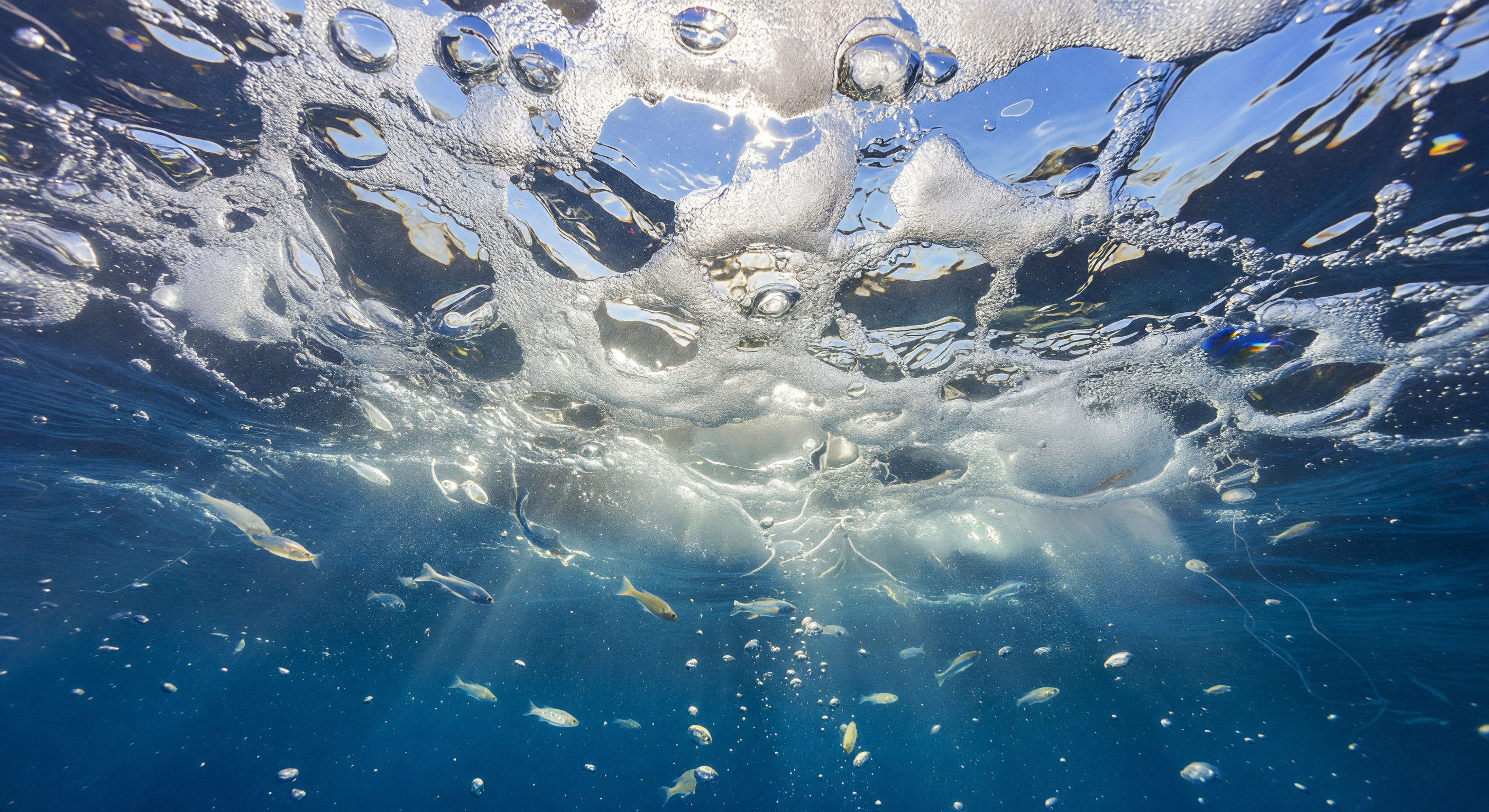
Suspended just half a meter beneath the open ocean's surface, you look straight up into one of the most electrically alive interfaces on Earth: a trembling, polydisperse ceiling of fresh froth where wave-breaking turbulence has folded atmosphere into ocean, producing a bubble matrix so dense it glows milky white with backscattered sunlight. This is the sea-surface microlayer and its immediate sub-surface plume — not a depth but a boundary state, where gas exchange is furious, where surfactant-rich organic films concentrate bacterial mats, transparent exopolymer particles, and photosynthetically active dissolved organics into a chemistry utterly unlike the clear pelagic water just a meter below you. The pressure on your body has barely shifted from what you felt at the surface, yet the optical environment is extraordinary: hard, high sun fractures through gaps in the foam into sharp caustic nets and slanted white shafts, while Snell's window opens like a bright, distorted lens amid a cobalt-dark mirror ceiling, and millions of micro-bubbles drift downward trailing iridescent thin-film halos as they shrink and dissolve, releasing their captured atmospheric gases back into solution. Translucent salps pulse silently through the light columns, their gelatinous bodies nearly invisible except where refracted edges and faint internal organs catch the angle, and larval fish hover rim-lit in the backscatter haze, using this bubble-rich, organically concentrated upper stratum as both a feeding ground and a sensory shelter. The foam overhead is not merely beautiful; it is a site of planetary-scale gas flux, aerosol production, and microbial metabolism — a membrane barely thicker than your hand that mediates a significant fraction of the ocean's conversation with the atmosphere.
Foam and froth