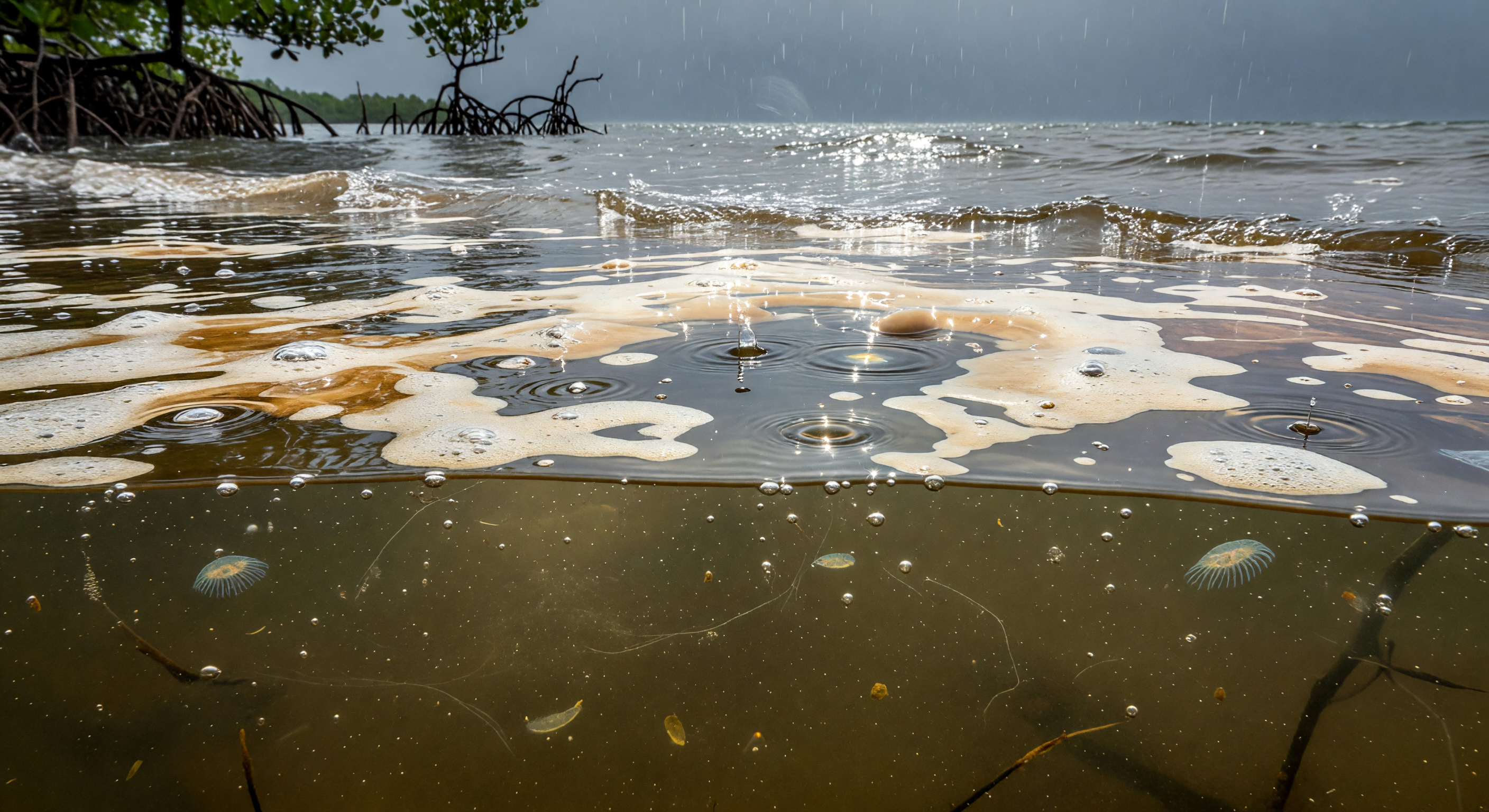
The camera hangs suspended at the precise boundary where rain-pocked estuary meets pewter sky, the horizon a raw seam just centimeters away, every raindrop detonating into a brief coronet of fresher water before the river's organic surfactants knit the foam back into amber and cream rafts. Below the half-submerged lens, tannin-stained water glows olive-brown for a shallow breath of depth, then dissolves into a luminous bacterioplankton fog threaded with transparent exopolymer strands and colloidal particles — the sea-surface microlayer here is not empty space but a chemically saturated living film where gas exchange, microbial activity, and photochemistry occur at rates far exceeding those of the open water column beneath. The underside of the foam reads as a broken milky ceiling, its bubble walls acting as tiny lenses that scatter the last diffuse daylight into pearly polygons and faint caustic flickers, the surface tension of each film holding a concentrated archive of dissolved organics, lipids, and microbial biofilms enriched tenfold over the water below. Translucent ctenophores drift beyond the foam edge, their comb rows igniting in brief iridescent pulses, while mangrove root shadows press inward and the bacterioplankton haze swallows distance entirely, collapsing depth into intimacy. This is the ocean's most volatile threshold — a membrane measured in micrometers that mediates the exchange of gases, heat, and biology between two vast atmospheric systems.
Other languages
- Français: Pluie sur l'écume d'estuaire
- Español: Lluvia sobre espuma estuarina
- Português: Chuva sobre espuma do estuário
- Deutsch: Regen über Ästuar-Schaum
- العربية: مطر فوق رغوة المصب
- हिन्दी: ज्वारनदमुख झाग पर वर्षा
- 日本語: 河口の泡に降る雨
- 한국어: 하구 거품 위의 비
- Italiano: Pioggia sulla schiuma dell'estuario
- Nederlands: Regen over estuariumschuim