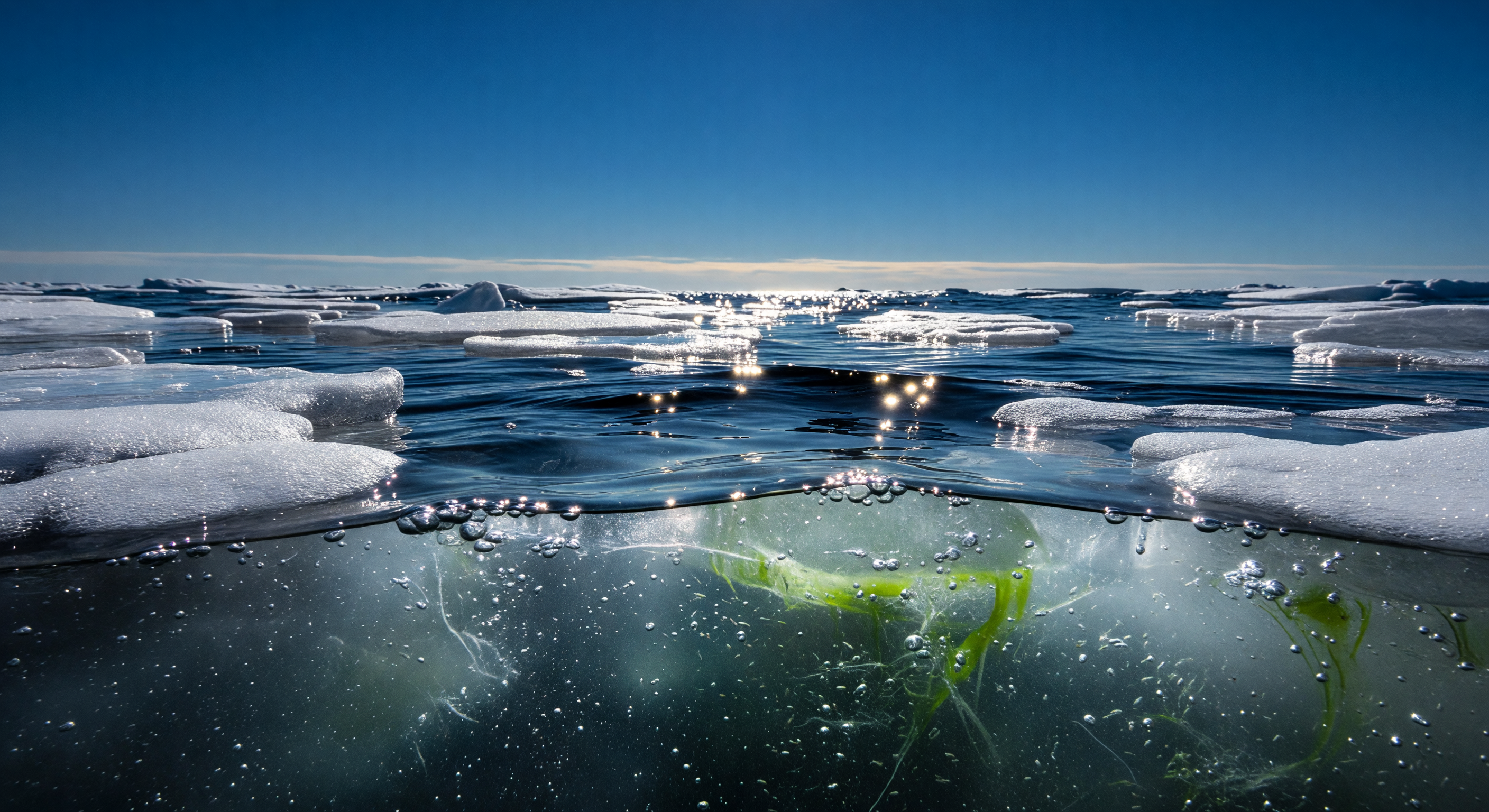
The snorkeler's face barely breaks the surface as a raft of creamy, surfactant-stiffened foam presses against the pancake ice, its thinnest bubble films refracting the polar twilight into fleeting violet and magenta arcs before collapsing in slow, silent succession. Above the waterline, the sky burns a deep cobalt rimmed with the last pale amber of a sun that never fully rises here, while below, the upper half-meter of water is luminous and strange — milked with microbubbles and exopolymer threads, the underside of nearby ice glowing blue-green where thin curtains of sympagic algae have colonized the frozen ceiling, drawing in every photon the atmosphere allows. Copepods hang suspended among drifting marine snow, their translucent bodies catching caustic glints as Snell's window fractures the surface into bright polygons and mirrored voids above. This extreme air-sea interface is one of the most chemically and biologically productive skins on the planet — concentrated with surface-active organic matter, microbial films, and dissolved gases exchanging furiously between water and atmosphere — yet pressure here is barely a whisper above one atmosphere, and the only cold that registers is absolute, the seawater held just above its own freezing point by salt. To hover at this threshold is to occupy the planet's own breath, the exact boundary where ocean becomes sky.
Other languages
- Français: Frange d'écume polaire
- Español: Franja de espuma polar
- Português: Franja de espuma polar
- Deutsch: Polares Dämmerlicht Schaumrand
- العربية: هامش زبد القطب الشفقي
- हिन्दी: ध्रुवीय संध्या झाग किनारा
- 日本語: 極夜の氷縁泡沫
- 한국어: 극지 황혼 거품 가장자리
- Italiano: Frangia di schiuma polare
- Nederlands: Polair schemerschuimrand