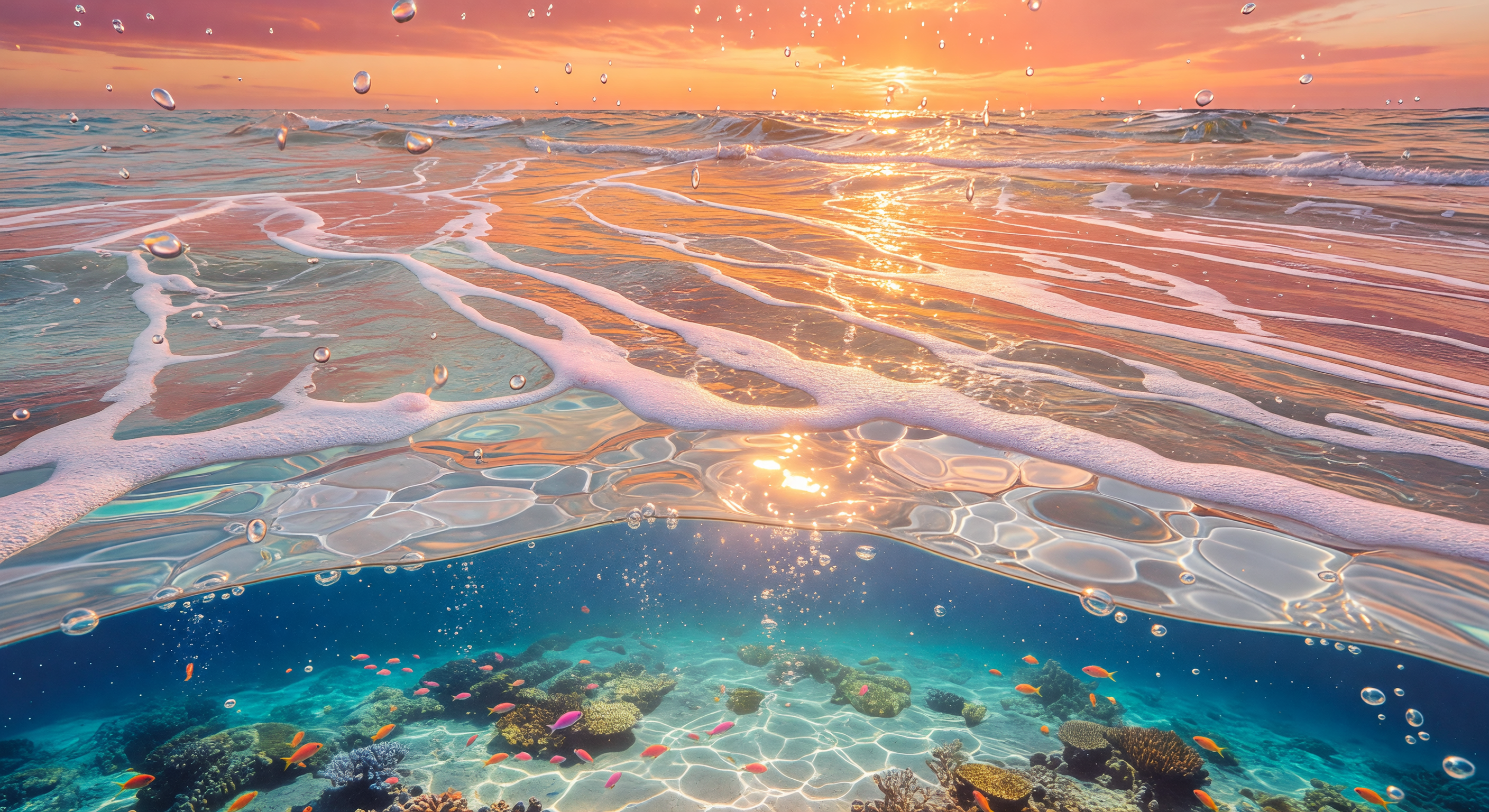
At the very skin of the sea, where ocean and atmosphere negotiate in sheets of pink-gold light, the snorkeler hangs suspended in a world measured not in fathoms but in millimeters—mask lens bisecting the air-water interface as trade winds herd long windrows of surfactant-rich froth toward a blazing horizon. Above, pearly bubble rafts and lace-like streaks of spume drift in converging lines known as Langmuir circulation cells, where wind-driven surface currents spiral downward in shallow helical rolls, concentrating buoyant organic matter, neuston organisms, and sea-surface microlayer films into these luminous corridors. Below the wavering meniscus, the upper meter glows with warm turquoise backscatter, microbubbles catching the oblique sunset light as they migrate upward through the water column, each one a tiny gas-exchange reactor transferring oxygen and carbon dioxide between ocean and atmosphere at rates that scale globally to influence climate itself. Snell's window opens warm and wide on the horizon side of the view, its circular portal framing the blazing sky while caustic light nets slide over coral rubble and the atoll's upper slope, and tight flashes of orange-pink anthias pulse beneath the foam ceiling—fish exploiting the turbulent productivity that breaks at this luminous, evanescent frontier between worlds. Here, at a depth that can be measured in centimeters rather than meters, the ocean is at its most chemically active, biologically dense at the microbial scale, and visually electric—a threshold zone of extraordinary consequence dressed in iridescent soap-film beauty.
Other languages
- Français: Sillons dorés au lagon
- Español: Espumas del atoll al ocaso
- Português: Redemoinhos no atol ao pôr do sol
- Deutsch: Atoll-Abendröte Schaumstreifen
- العربية: خطوط الرغوة عند الغروب
- हिन्दी: प्रवाल द्वीप सूर्यास्त लहरें
- 日本語: 環礁の夕暮れ泡筋
- 한국어: 환초 노을 물결줄기
- Italiano: Scie di schiuma al tramonto
- Nederlands: Atol zonsondergang schuimrijen