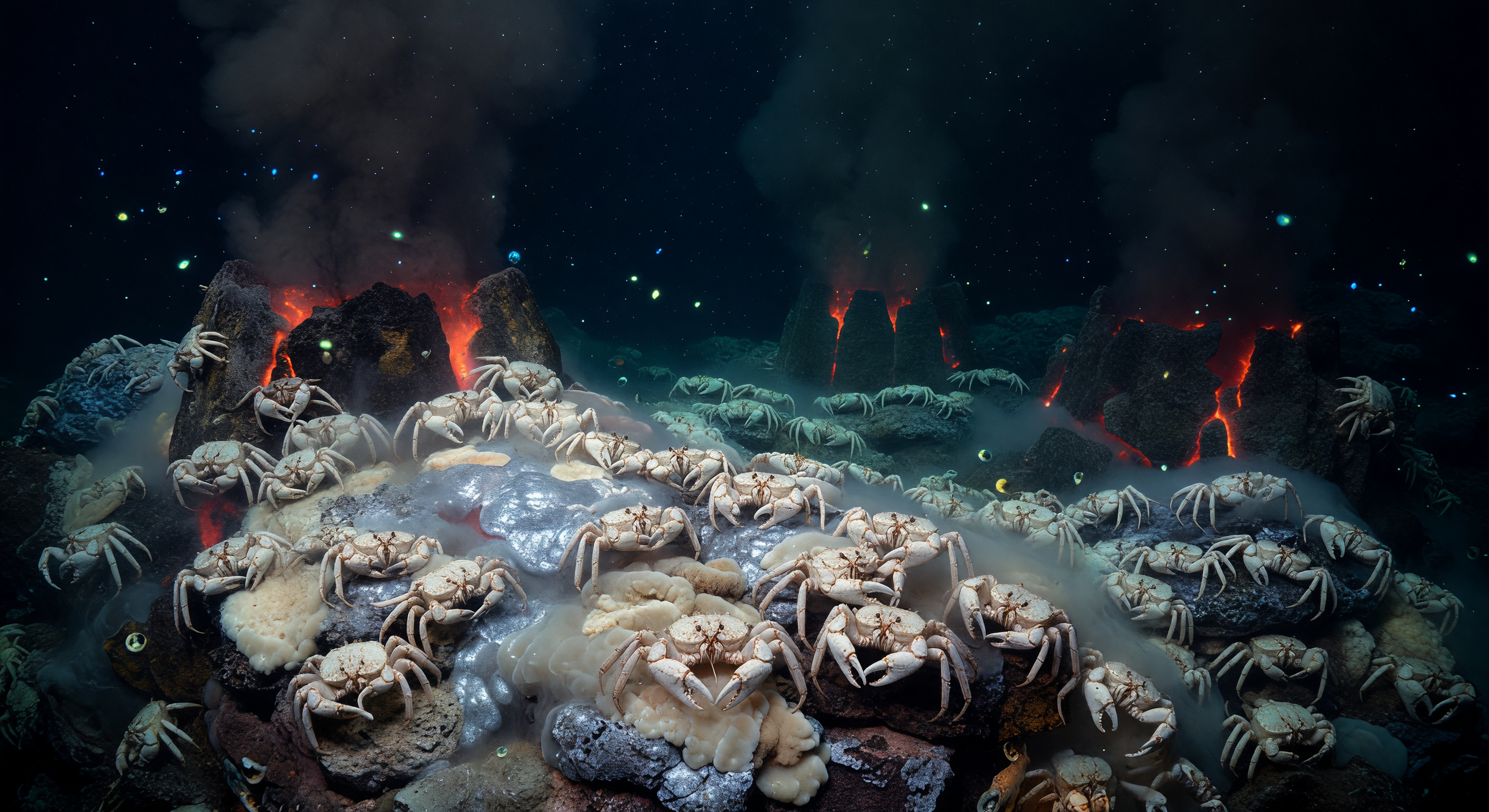
At depths where crushing pressure renders sunlight a distant memory, a sulfide buttress rises from fractured basalt along a mid-ocean ridge spreading center, its surfaces alive with hundreds of yeti crabs — *Kiwa* species — packed flank to flank in the warmest corridors of vent effluent. Their elongated setae, dense with episymbiotic bacteria, sweep continuously through mineral-laden water, a behavior that amounts to agriculture in the dark: cultivating chemolithotrophic microbes that oxidize hydrogen sulfide and fix carbon where no photon has penetrated for millions of years. The rock itself is layered in silver-white bacterial mats and pale mineral crusts — anhydrite, pyrite, barite — their crystalline surfaces softly luminous beneath the ember-orange chemiluminescence bleeding from nearby black smoker columns, where superheated fluid at several hundred degrees Celsius meets near-freezing abyssal water and precipitates a perpetual dark storm of metal sulfides. Scattered cyan-green bioluminescent pinpoints from peripheral fauna punctuate the gloom beyond the vent field, where marine snow and fine hydrothermal particulates drift in absolute silence through water pressing inward at three hundred atmospheres or more. This community exists entirely on chemical energy drawn from Earth's interior — a self-contained biosphere unconnected to the sun, older in its metabolic logic than almost any ecosystem we know, and complete in itself long before anything observed it.
Hydrothermal vents