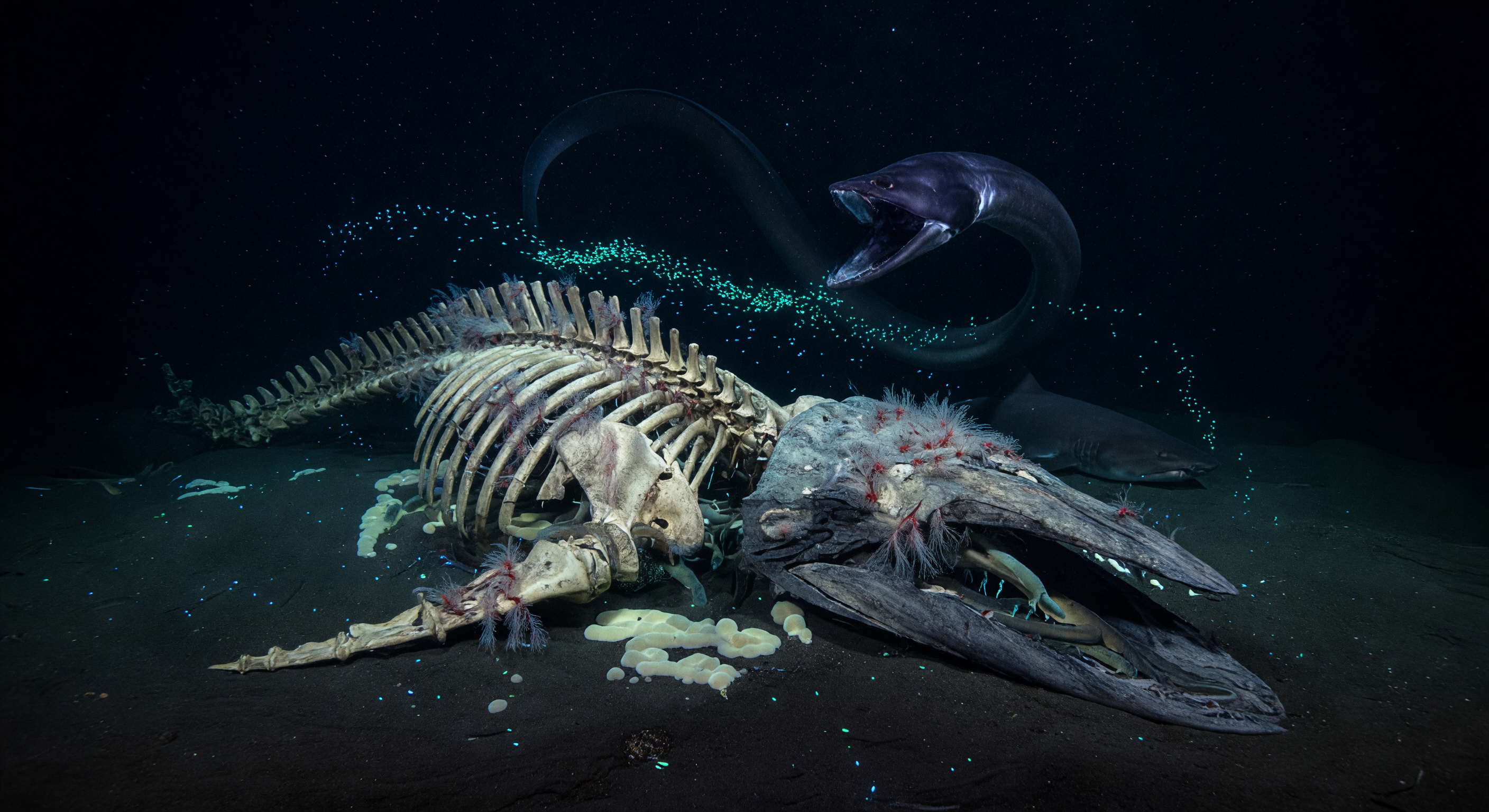
At 2,500 metres beneath the surface, where pressure exceeds 250 atmospheres and no photon of sunlight has ever reached, a whale skeleton lies half-swallowed by the soft black silt of the abyssal plain, its great ribs arching upward like the nave of a drowned cathedral. The bones are deep in their third and final successional stage — the sulfophilic phase — carpeted in velvety chemosynthetic bacterial mats that harvest hydrogen sulfide seeping from lipid-rich marrow, hosting dense colonies of Osedax bone-worms whose feathery red and white plumes probe every surface with root-like rhizoids that dissolve the very matrix of the skeleton. A gulper eel — Eurypharynx pelecanoides — sweeps through the water column above in a slow arc, its body nearly dissolved into the darkness, only the vast unfurled membrane of its jaw catching form as a drifting cloud of ostracod bioluminescence detonates across the frame: hundreds of Conchoecia releasing simultaneous cyan sparks in a defensive cascade, briefly painting the silt ripples, the Osedax plumes, and the eel's translucent sail in cold turquoise fire. Hagfishes thread silently through the orbital cavities of the skull, and at the far margin of the fall the blunt silhouette of a sleeper shark idles with metabolic patience, its slow-oxidising biochemistry perfectly suited to a world where meals are separated by weeks and darkness is total, permanent, and immense.