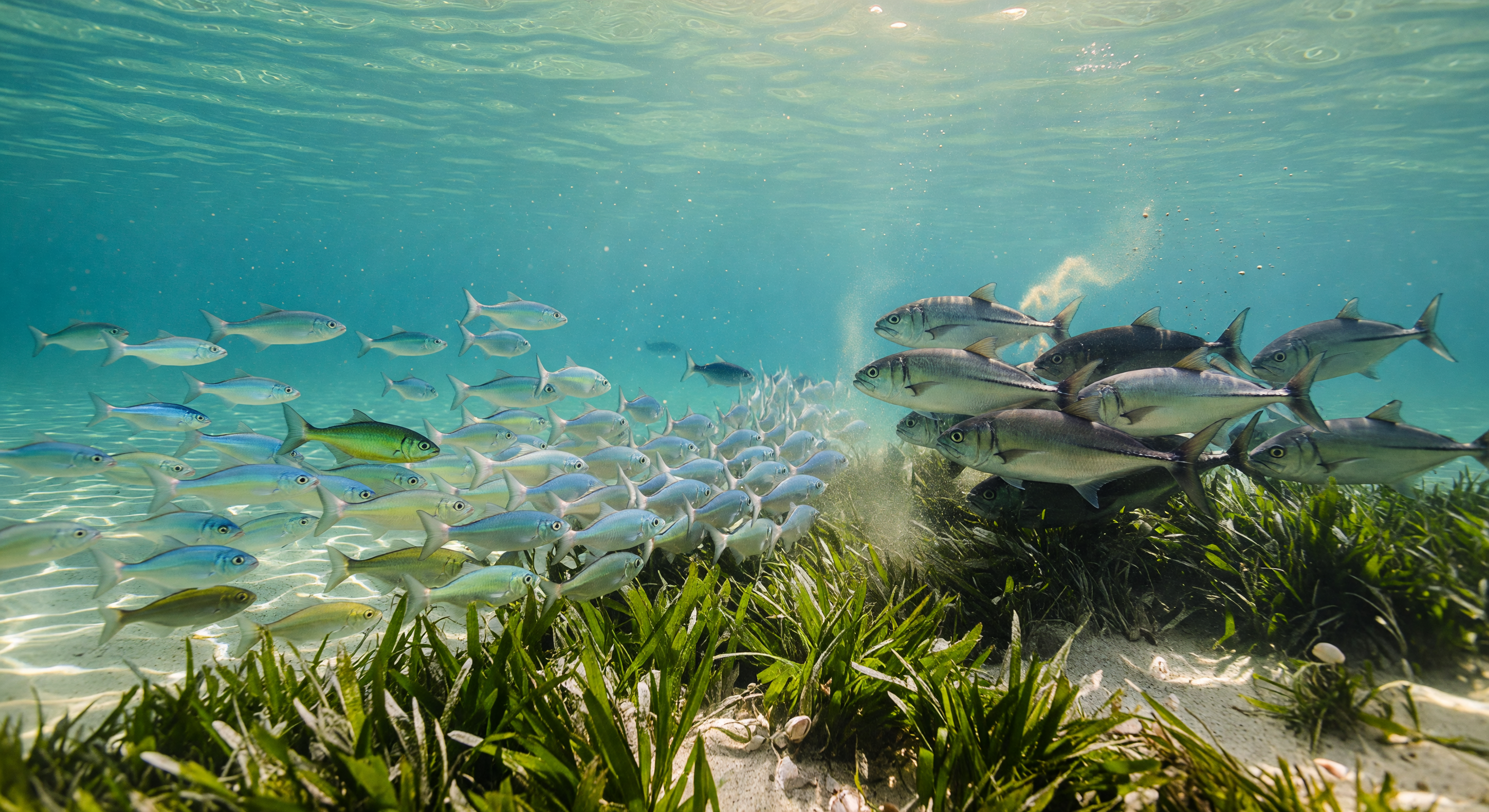
The water here is warm, alive, and almost weightless — barely a metre of sun-drenched column separates the snorkeler's mask from a seagrass meadow whose olive-green blades sway in the gentle surge, anchoring sediment, sheltering invertebrates, and exhaling oxygen into the illuminated shallows. Without warning the loose shoal of juvenile mullet ahead undergoes a phase transition, each fish abandoning individual movement to join a single polarised entity: thousands of bodies align in milliseconds, scales flashing chrome and pale blue as the group collapses into a dense, mirror-bright ribbon — a collective anti-predator response known as flash expansion and compression that confuses a predator's ability to single out one target. The trigger is already visible: two giant trevally (*Caranx ignobilis*) erupt from the darker meadow edge in a coordinated ambush burst, their torpedo-shaped, slow-twitch and fast-twitch muscle architecture optimised for exactly this explosive acceleration, metallic charcoal backs catching the caustic light as displaced sediment wisps drift upward like pale smoke. At this negligible depth, pressure is barely above atmospheric, sunlight still peaks above 400 µmol photons m⁻² s⁻¹, and the water column functions as a transparent arena where visual predation dominates — every refracted god ray, every suspended sand mote, every flicker of silver scale is both beauty and mortal information.
Other languages
- Français: Embuscade en Herbier Marin
- Español: Emboscada en Praderas Marinas
- Português: Emboscada nas Ervas Marinhas
- Deutsch: Hinterhalt im Seegrasfeld
- العربية: كمين الكارانكس في الأعشاب
- हिन्दी: समुद्री घास में घात
- 日本語: 海草原のギンガメアジ待伏
- 한국어: 해초밭 전갱이 매복
- Italiano: Agguato tra le Fanerogame Marine
- Nederlands: Hinderlaag in Zeegras