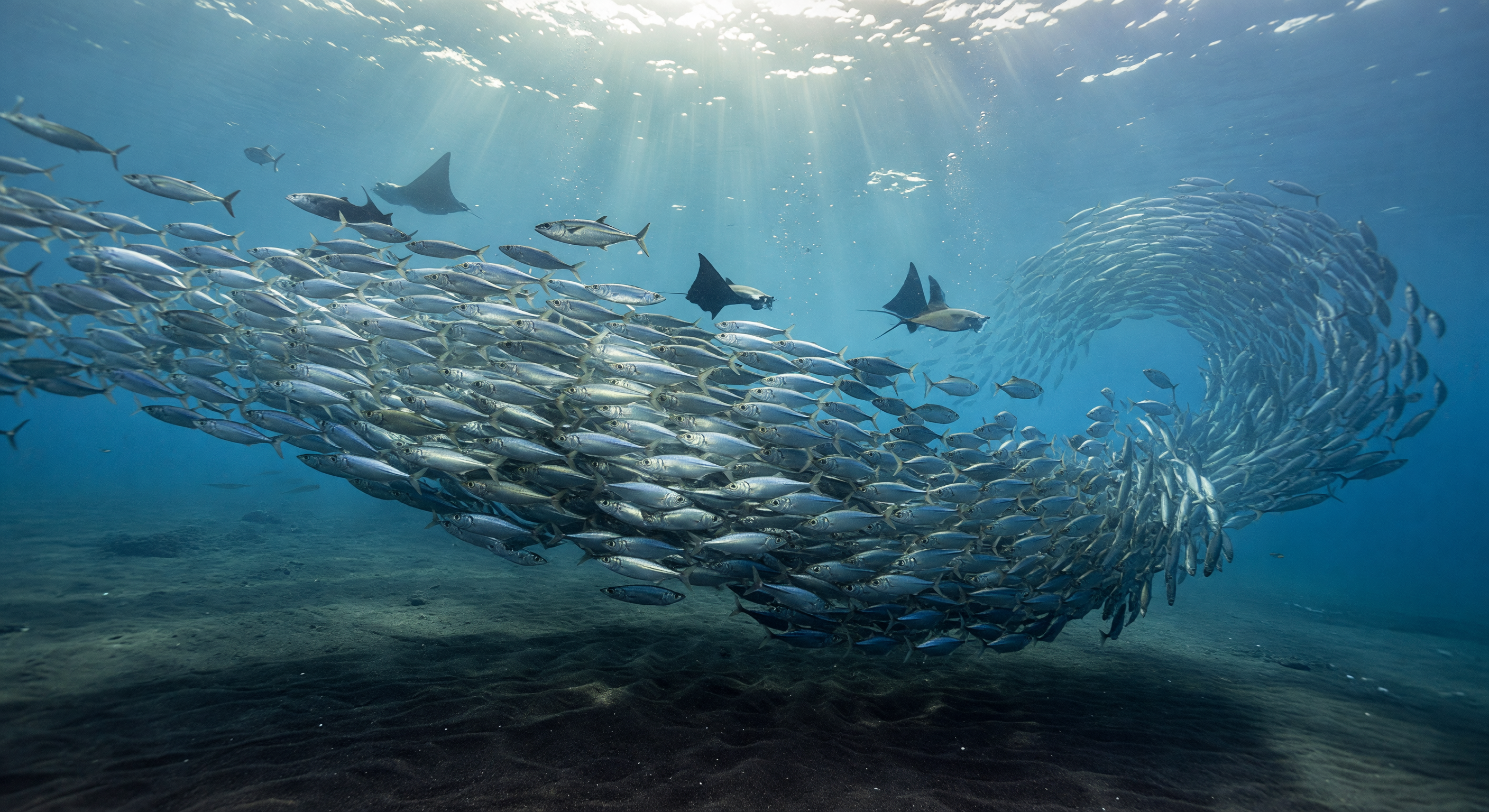
The living wall hits you before you register it — a curtain of sardines, thousands strong, sweeping past your mask in sheets of hammered silver, each scale and lateral line crisp in the slanting god rays that knife down through the blue-green column above the volcanic slope. At this depth the sun still commands the water; visibility stretches tens of meters, and the light that reaches you is warm enough to ignite the bait ball from within, each individual fish a flashing mirror against the matte black lava rubble and current-rippled basalt sand anchoring the scene below. This is open-water biology at its most theatrical: the sardines are not here by accident but are aggregating in response to upwelling nutrients and plankton-rich currents, their schooling reflex — thousands of nervous systems acting as one fluid intelligence — shaped by exactly the predation pressure now arriving from above, where mobula rays spiral and cartwheel through the column in elegant parabolas, winnowing the edges of the mass. Yellowfin tuna punch in from the open blue in short, brutal accelerations, and every impact compresses the school into a tightening vortex, the formation bending and folding like liquid metal as it attempts to absorb the strike, a phenomenon ecologists call the *vacuole response*. Suspended plankton glitters in the god rays around you, the pressure at this depth still shallow enough that your ears barely register the dive, yet the sheer biological density of the water — predators above, volcanic geology below, a million silver bodies churning the column between — carries its own quiet, immersive weight.
Other languages
- Français: Sardines sur Sable Noir
- Español: Sardinas en Arena Negra
- Português: Sardinhas na Areia Negra
- Deutsch: Sardinen auf Schwarzem Sand
- العربية: سردين على الرمال السوداء
- हिन्दी: काली रेत पर सार्डिन
- 日本語: 黒砂のイワシ群
- 한국어: 검은 모래 위의 정어리
- Italiano: Sardine sulla Sabbia Nera
- Nederlands: Sardines op Zwart Zand