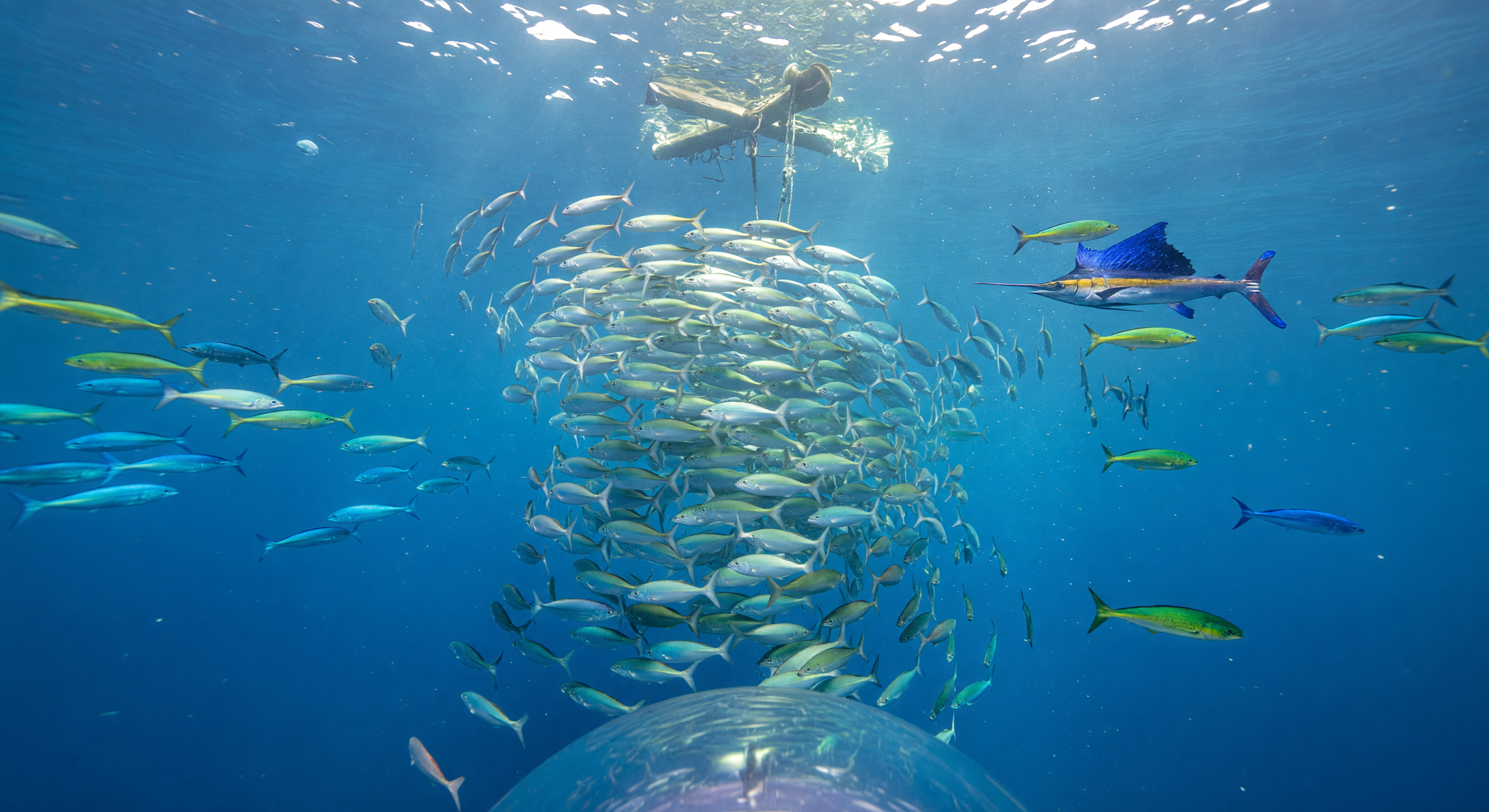
Suspended just beneath the buoy's latticed shadow, the submersible's acrylic dome frames a living spectacle that few humans have ever witnessed at this intimate range: a towering cylinder of juvenile triggerfish and baitfish spiraling in perfect, eerie synchrony, their collective flanks flashing silver, glass-pale blue, and olive as tropical sunlight fractures through the FAD's trailing ropes into cascading caustic bands and god rays. This is the epipelagic zone at its most theatrical — water temperatures hovering near 28°C, pressure still mild, and photosynthetically active radiation penetrating deep enough to power the entire food web radiating outward from this drifting artificial reef, which acts as a floating island of structure in an otherwise featureless open-ocean desert, concentrating life across multiple trophic levels through mechanisms oceanographers call the *meeting-point hypothesis* and *prey-aggregation effect*. At the shoal's glittering perimeter, neon mahi-mahi (*Coryphaena hippurus*) slash inward on iridescent green-gold bodies that can sprint beyond 90 km/h, while a sailfish (*Istiophorus platypterus*) lances through with its retractable bill, compressing the baitball into tighter, brighter ribbons of reflected light — a predator-prey interaction that generates the polarized flash-expansion responses observable only when a school cohesion threshold collapses under simultaneous multi-directional attack. Fine marine snow drifts through the sunbeams below, marking the invisible boundary where light begins its long, exponential fade into ultramarine silence, and the open water column yawns beneath the dome with the particular, vertiginous weight of knowing there is no bottom in sight — only pressure, distance, and the immense blue architecture of the pelagic realm.
Pelagic shoal