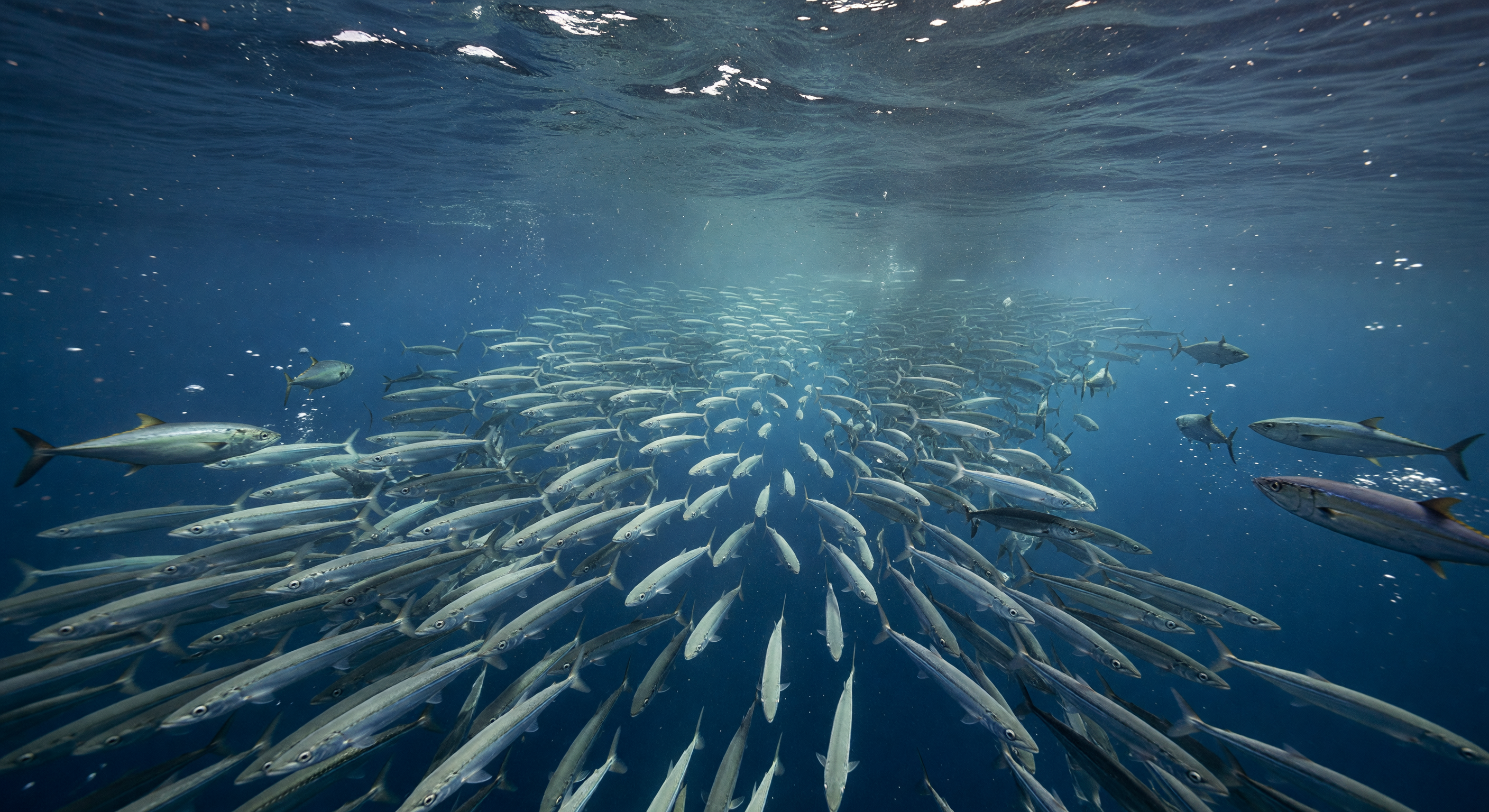
The AUV pushes into the living mass head-on, surrounded on all sides by saury — thousands of needle-bodied fish whose silver flanks catch the storm-filtered daylight in rolling, synchronized flashes, each scale a wet blade momentarily lit before the shoal folds and shifts around the intrusion. Above, the surface is a dark, wind-torn ceiling of chop through which narrow god rays descend in cool silver-blue bands, attenuating rapidly into open cobalt as depth swallows the light, while fine particulate and micro-bubbles from the squall still drift through the shafts like suspended static. This is the epipelagic open ocean at its most kinetic: a mobile biological structure numbering in the tens of thousands, the individual saury responding to neighbors and to predator pressure through hydrodynamic coupling and lateral-line sensing, the school itself functioning as a distributed organism capable of reorganizing in milliseconds. From both flanks, skipjack tuna carve sudden lanes through the formation — compact, warm-blooded, ram-ventilating hunters whose burst speed can exceed ten body lengths per second, each pass scattering a corridor of saury that immediately closes behind them. There is no seafloor reference here, no substrate, only the immense three-dimensional openness of the upper water column pressing in from every direction, the pressure still gentle at this depth but the silence and scale of the event absolute.
Pelagic shoal