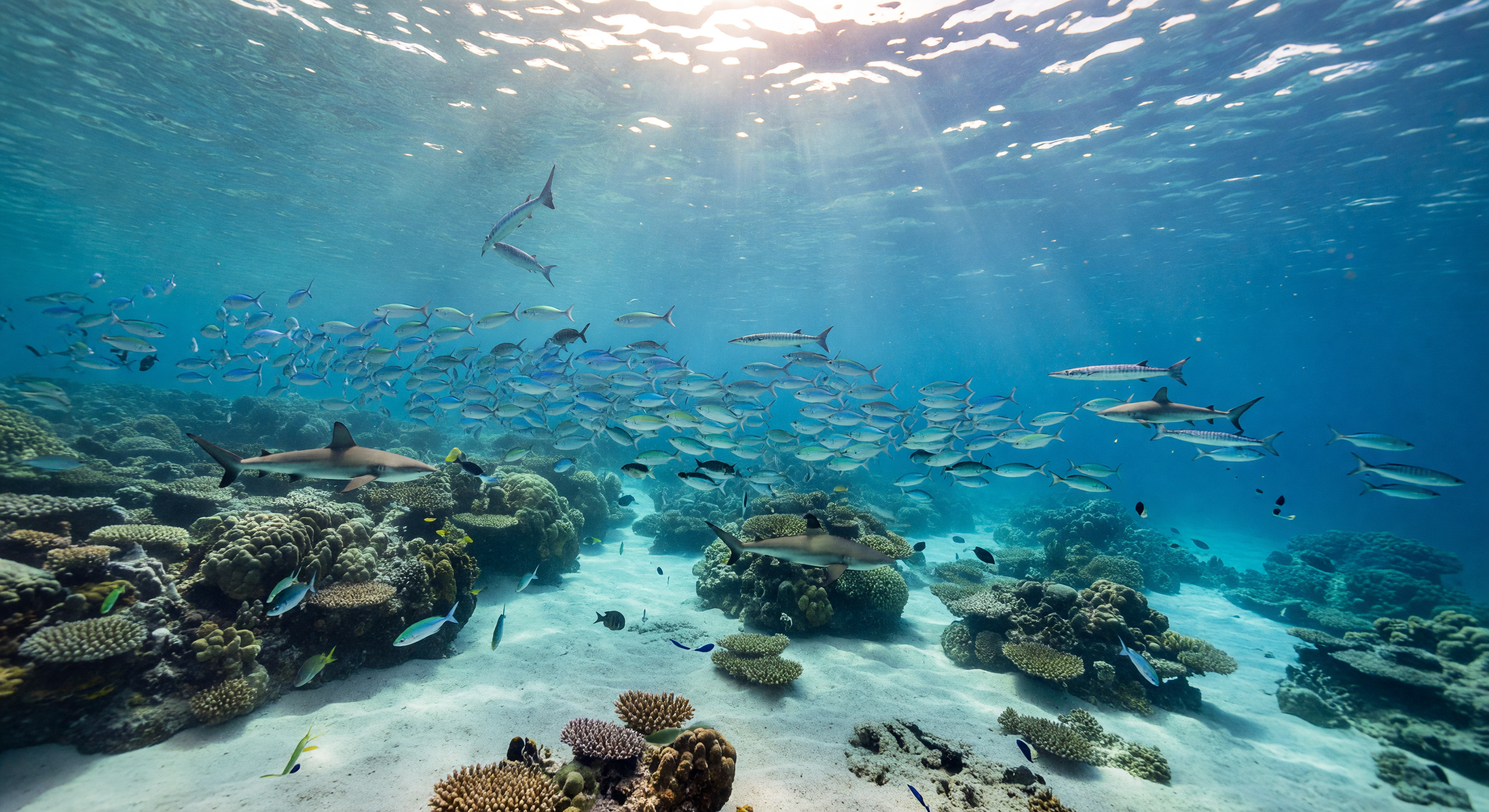
Suspended just beneath the sun-dappled surface, the snorkeler drifts over a mosaic of coral bommies rising from pale sand gullies, as a living river of fusiliers — thousands strong — surges and bends in perfect synchrony, their metallic-blue flanks catching every shaft of light like scattered mirrors. This is the epipelagic ocean at its most dynamic: water temperatures hover near 28 °C, salinity is oceanic, and photosynthetically active radiation still reaches the reef with enough intensity to drive the symbiotic zooxanthellae within the hard coral colonies below. The fusiliers form a classic pelagic shoal, a fluid biological structure in which collective motion, governed by lateral-line sensing and visual cueing across thousands of individuals simultaneously, creates an emergent organism that confuses predators — yet the system is failing at its edges, where two blacktip reef sharks sweep the reef slope in low, economical arcs and a line of barracuda hangs motionless above like polished blades, compressing the school against the coral structure with precision that only apex predators refined over millions of years can manage. The sand channels between bommies channel the school into ribbons, funneling prey and predator alike through corridors of extraordinary clarity, the caustic light lattices rippling across coral heads and darting bodies in patterns that belong as much to physics as to biology. In this shallow, oxygen-rich, pressure-gentle world — barely half an atmosphere above the surface — life is dense, fast, and luminous.
Other languages
- Français: Fusiliers sur les Coraux
- Español: Fusileros sobre Corales
- Português: Fusileiros sobre Bommies de Coral
- Deutsch: Füsiliere über Korallenblöcken
- العربية: أسماك فوق الشعاب المرجانية
- हिन्दी: मूंगे के ऊपर मछलियाँ
- 日本語: サンゴ礁を泳ぐフエダイ
- 한국어: 산호 위의 열대어 떼
- Italiano: Fusilier sui Coralli
- Nederlands: Fusiliers over Koraalblokken