At roughly 2,500 meters beneath the surface, where sunlight has been absent for centuries and the water presses down at pressures exceeding 250 atmospheres, a cathedral of bleached bone rises from the soft abyssal sediment — all that remains of a great whale that sank months or years ago. The skeleton is thick with life: pale bacterial sulfide mats spread across the vertebrae like frost, Osedax worms bore silently into the lipid-rich bone matrix with root-like extensions, and hagfish coil through marrow cavities in slow, deliberate loops, while Greenland sleeper sharks circle the outer ribs with the measured patience of animals shaped by millions of years of cold and pressure. Above the skeleton, comb jellies and hydromedusae drift in loose spirals through the marine snow — fragments of organic matter sinking from the world far above — their iridescent ctene rows and pulsing bells casting cobalt and violet halos that briefly illuminate the arc of each rib before fading back into absolute darkness. The only light in this scene is biological: living animals advertising, hunting, and existing in a darkness so complete that the bones themselves seem to glow faintly only where microbial films catch the ambient bioluminescence. This carcass functions as an ecological island, a chemosynthetic oasis that concentrates biomass and biodiversity across a succession spanning decades, connecting the ocean's great productive surface to its most lightless, pressure-crushed floor through the slow chemistry of decay.
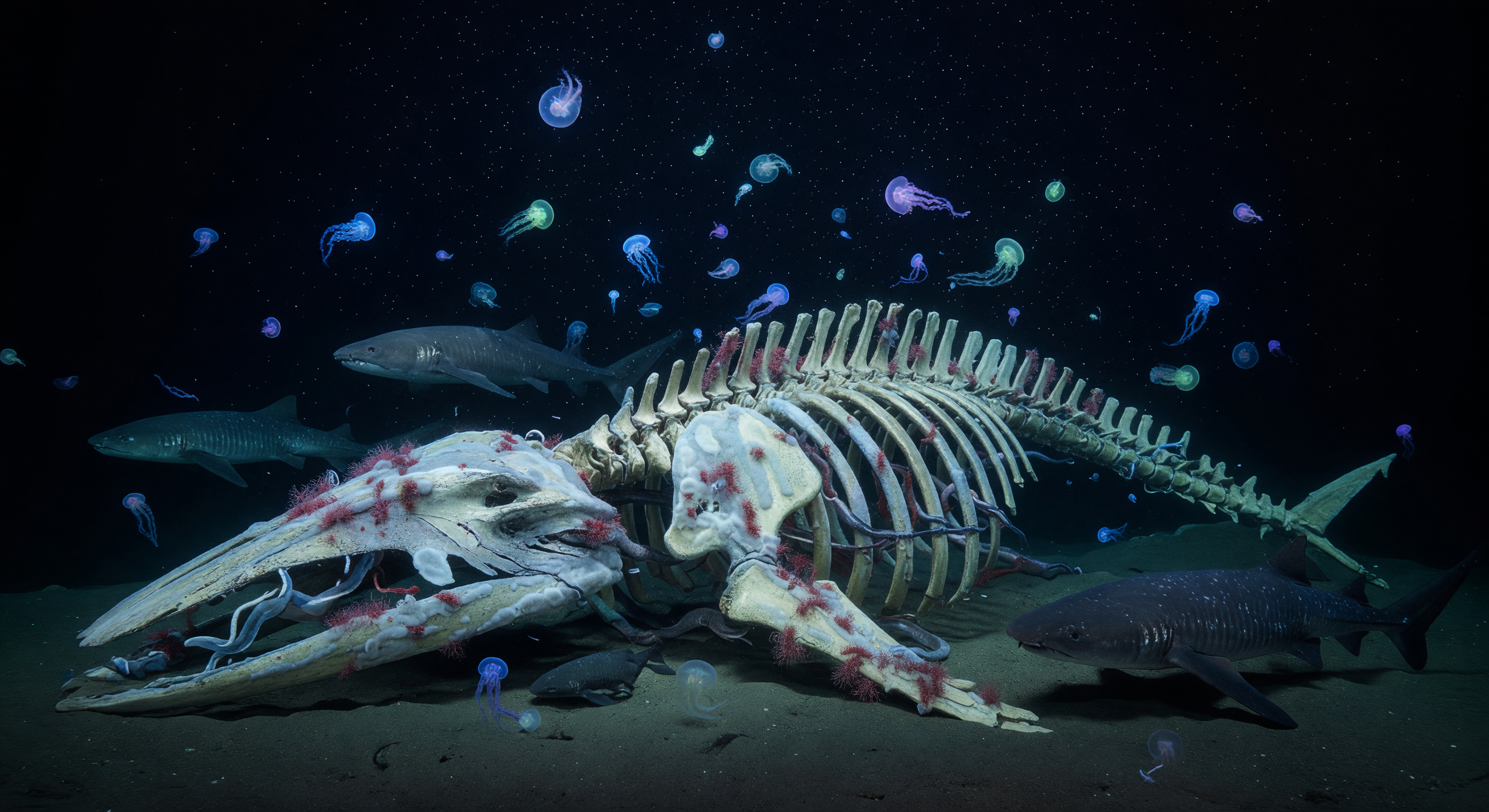
Whale fall