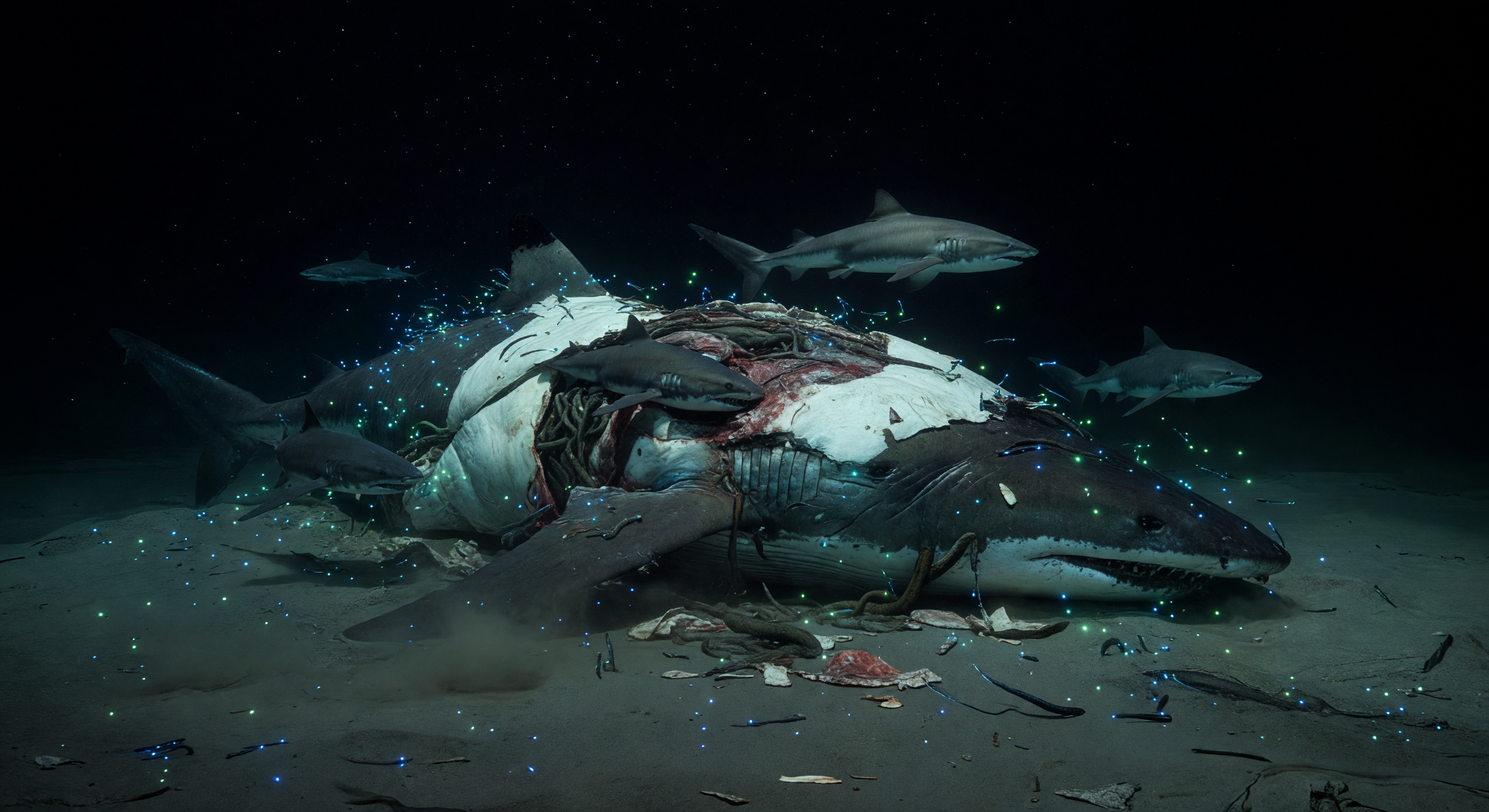
At roughly 2,500 metres below the surface, where pressure exceeds 250 atmospheres and the last photon of sunlight faded thousands of metres above, a freshly sunken whale transforms a barren silt plain into one of the ocean's most violent feasts. The carcass sprawls immense on the seafloor, its torn flanks exposing ivory slabs of blubber and deep crimson muscle, and the surrounding water erupts in cold cyan-blue bioluminescence wherever disturbed scavengers collide with flesh and sediment — each flash briefly tracing the waxy folds of skin, the gouged sediment, the writhing knots of hagfishes burrowing deep into the wounds. Sleeper sharks, heavy-bodied and scarred, wheel through the darkness in slow arcs, their slate-gray mass emerging and dissolving at the edges of the living light as they tear strips from the exposed flank, their biology tuned to extreme cold and near-zero oxygen metabolism. Clouds of fine silt drift upward from the churned seafloor, merging with the perpetual marine snow descending from the water column above, as countless smaller scavengers boil across the carcass edge, each disturbance triggering another pulse of bioluminescent light that maps the scene and then retreats into absolute black. This is the first stage of a succession that will bind this patch of seafloor for decades — the mobile-scavenger feast that precedes enrichment, bacterial mats, and eventually a chemosynthetic reef built on the mineral architecture of the bones themselves.
Whale fall