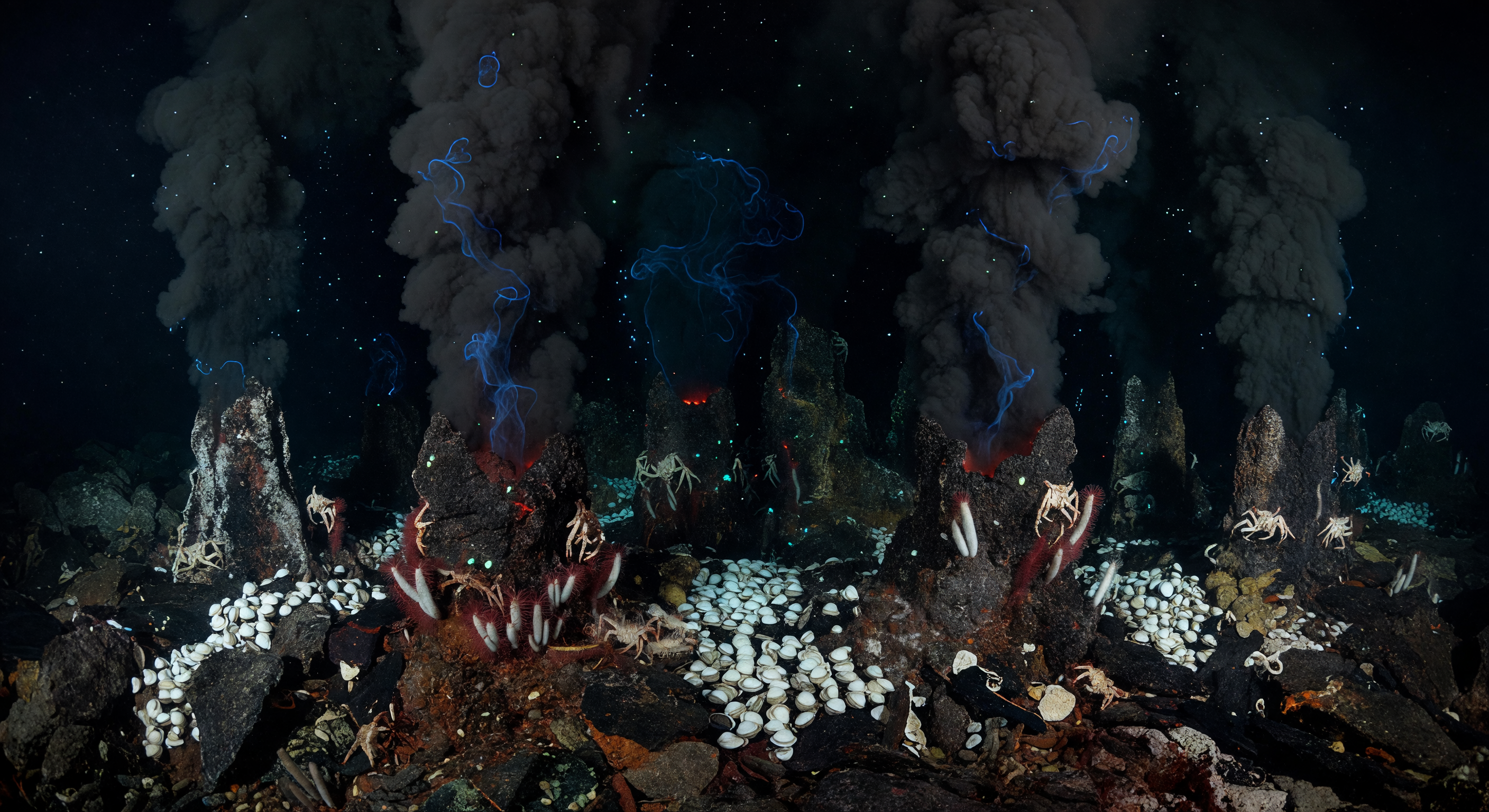
At depths where pressure exceeds 250 atmospheres and the last photon of sunlight faded kilometers above, the seafloor fractures open along a mid-ocean ridge, and the planet breathes. Towering sulfide chimneys — some rising ten meters or more from the basalt — exhale superheated fluid at 350°C, a temperature that would flash to steam at the surface but here remains liquid under crushing hydrostatic force, the black plumes billowing upward in roiling convection columns through water of near-freezing stillness. Along the edges of the most turbulent eddies, faint copper-blue chemiluminescence traces chemical oxidation reactions between the mineral-laden fluid and the surrounding seawater, the only light this world has ever known. At the base of the spires, white clams of the genus *Calyptogena* spread across fractured basalt in dense beds, their hemoglobin-rich tissues adapted to bind hydrogen sulfide and ferry it to endosymbiotic bacteria that fix carbon without a single ray of sunlight — a food web sealed entirely within the chemistry of the Earth itself. *Riftia pachyptila* tubeworms anchor in the crevices nearby, and pale yeti crabs, *Kiwa* sp., press their setae-covered claws against warm ledges, farming the chemosynthetic microbial films that coat every surface in this silent, pressurized cathedral the planet built for itself, long before anything above the waves existed to witness it.
Other languages
- Français: Cathédrale des Fumeurs Noirs
- Español: Catedral de Fumadores Negros
- Português: Catedral dos Fumegantes Negros
- Deutsch: Schwarzraucher Kathedrale
- العربية: كاتدرائية المدخنة السوداء
- हिन्दी: काले धुएँ का गिरजाघर
- 日本語: 黒煙突の大聖堂
- 한국어: 검은 분출구 대성당
- Italiano: Cattedrale dei Fumatori Neri
- Nederlands: Zwarte Roker Kathedraal