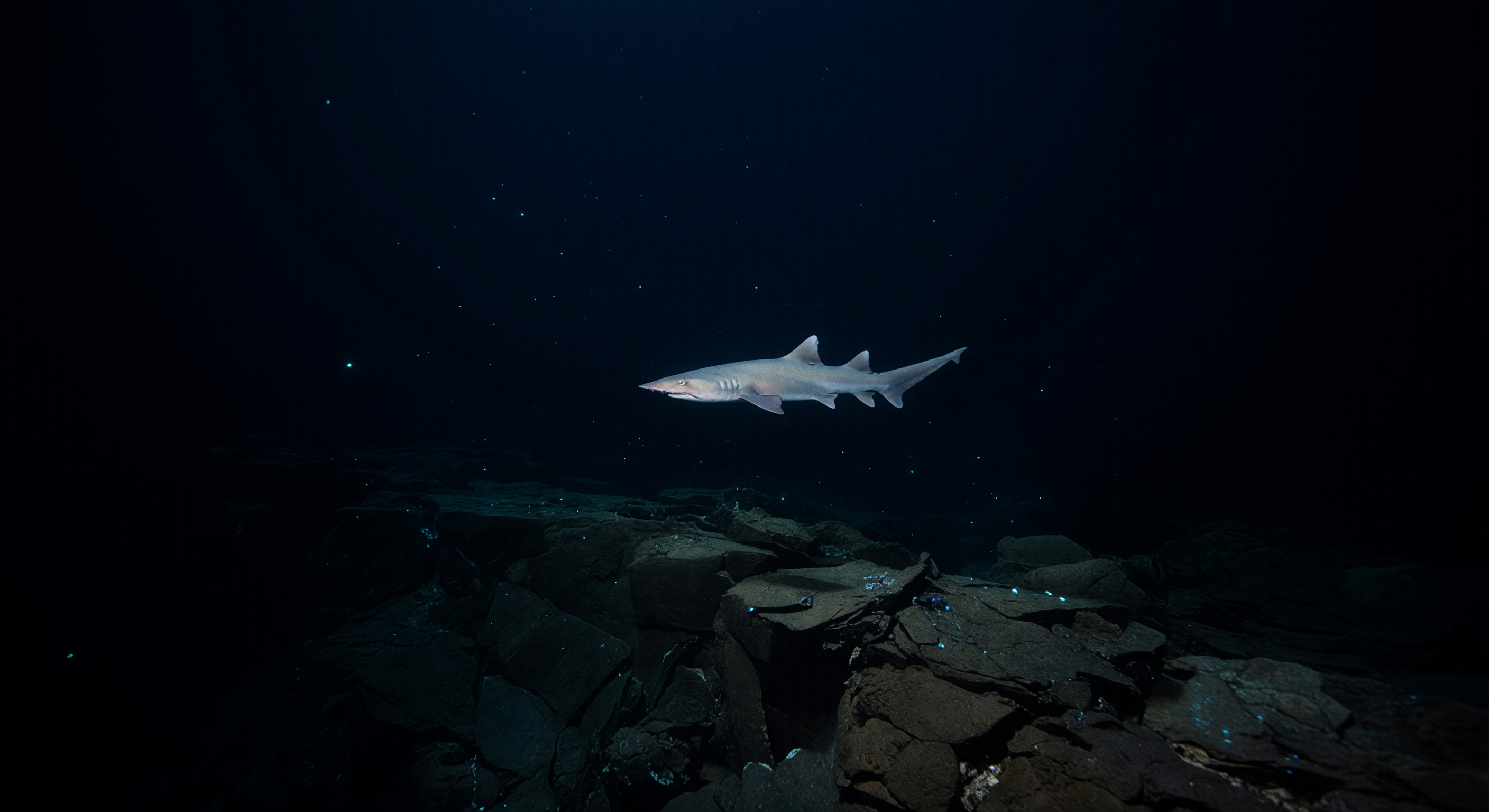
At the upper margin of the midnight zone, a goblin shark (*Mitsukurina owstoni*) drifts in near-total darkness above a fractured basalt escarpment, its elongated rostrum and pallid, pressure-softened body suspended between an almost imperceptible remnant of deep blue descending from hundreds of meters above and the absolute black of the water column below. Here, at pressures approaching one hundred atmospheres, sunlight has long since ceased to exist as a meaningful quantity, leaving only bioluminescence — scattered cyan and blue-green pinpoints from unseen planktonic organisms drifting like cold embers through the dark — as the only illumination this world knows. The goblin shark's flabby, lightly mineralized body, adapted to the chemical and mechanical demands of the deep, hangs poised and slack in that silent way unique to predators that do not need to rush, their sensory systems finely tuned to detect the faintest pressure wave or electrochemical trace in cold, 3–4 °C water. Below, the basalt escarpment falls away in fractured volcanic ledges dusted with sparse mineral crusts, shaped by geological forces indifferent to the living world that slowly colonizes their shadows. Marine snow descends in all directions through the immense empty water column, tracing the invisible slow pulse of an ocean that has existed in this darkness, under this pressure, in this profound silence, entirely without witness.
Bathypelagic predators