At roughly 2,500 metres below the surface, where pressure exceeds 250 atmospheres and no photon of sunlight has ever penetrated, a sperm whale skeleton sprawls across cold, silty sediment like the ruins of an ancient cathedral — vertebrae half-swallowed by the mud, the great rib cage arching upward in silent geometry. The fall has long since passed through its mobile-scavenger stage and entered the sulfophilic phase: pale, waxy mats of chemoautotrophic bacteria spread across bone surfaces, drawing energy not from light but from hydrogen sulfide generated as lipid-rich bone marrow decomposes beneath them, while Osedax worms — their feathery plumes flushed cream and red — bore directly into the porous vertebrae, hosting endosymbiotic bacteria that digest collagen and fat locked within. Through the calcified ribs, a scatter of sapphire and cyan flashes betrays startled amphipods and isopods streaming away from disturbance, their bioluminescent escape signals illuminating wet bone texture and drifting marine snow for fractions of a second before darkness reclaims everything. Crossing the midwater above this chemosynthetic island, a viperfish — Chauliodus sloani — cuts a near-perfect silhouette, its needle profile and recurved fangs evolved for a world of ambush and darkness, its passage utterly indifferent to the slow sulfurous transformation unfolding on the seafloor below. Here, far beneath the reach of seasons or storms, a single carcass sustains an entire archipelago of life across decades, chemosynthesis standing in for sunlight, bone replacing basalt.
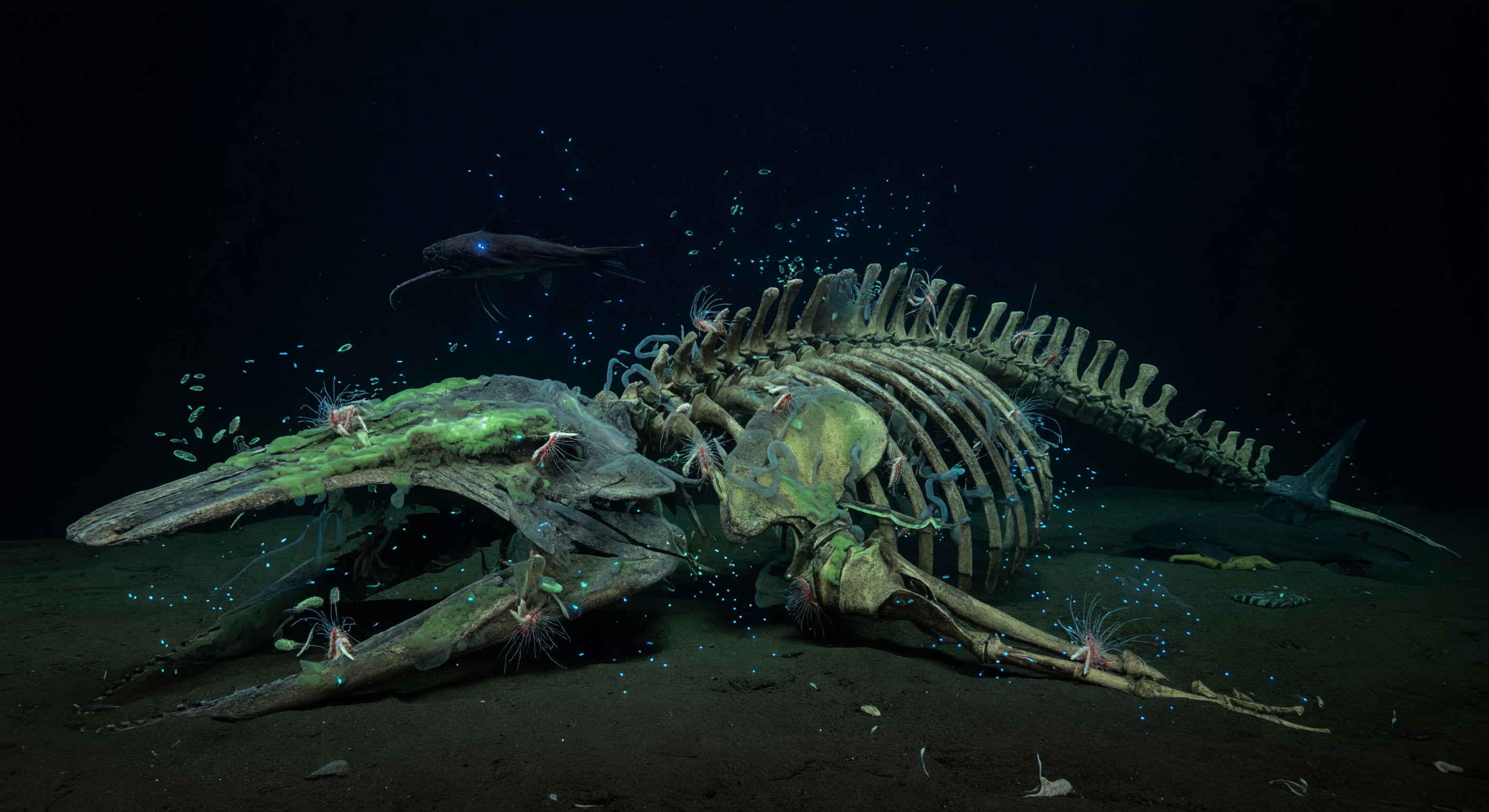
Whale fall