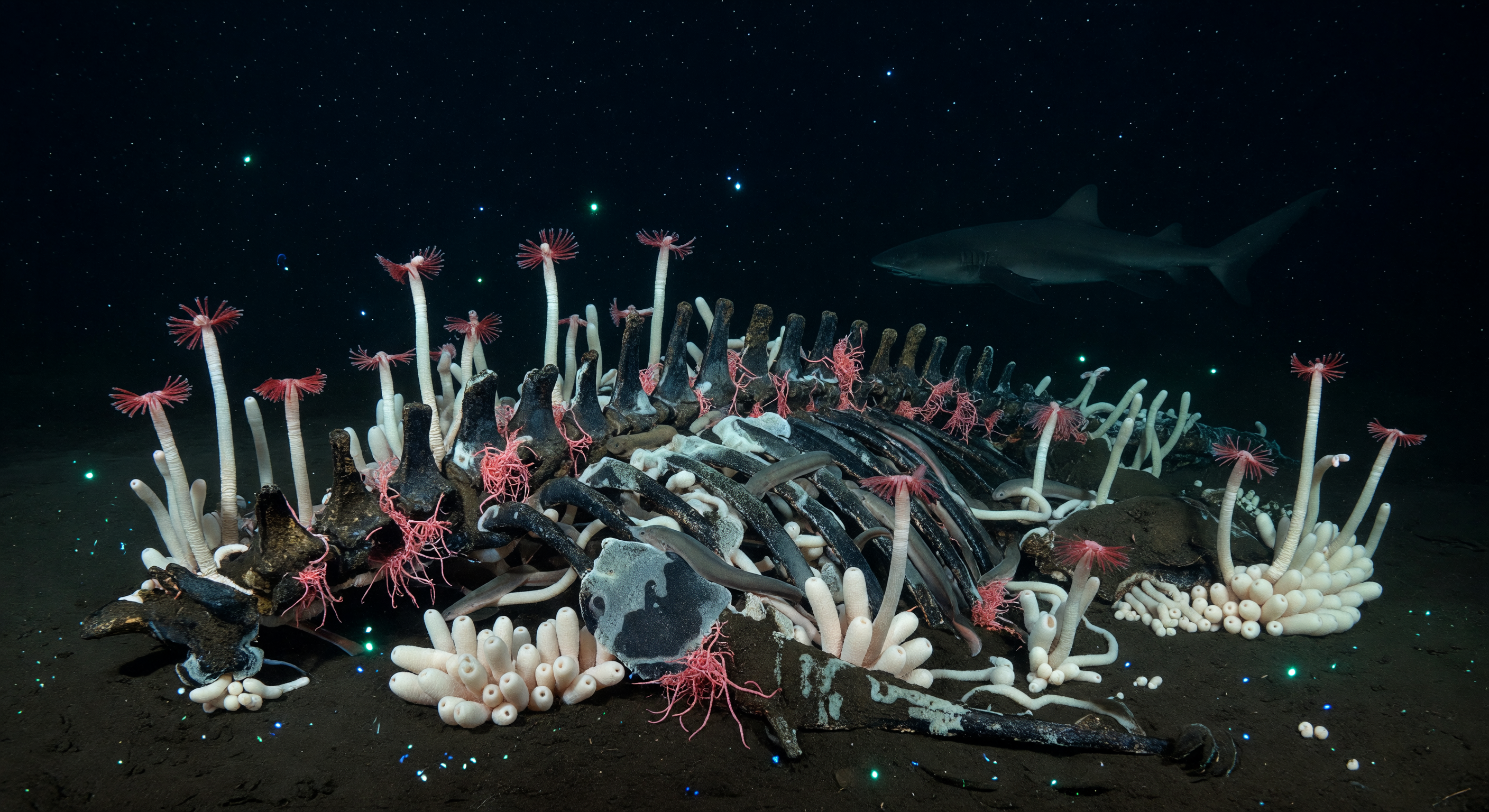
Where a great whale once drifted down through thousands of meters of darkness, its skeleton now anchors an entire world on the abyssal plain. At pressures exceeding 100 to 400 atmospheres and temperatures hovering near 2°C, the bones have become a chemical factory: anaerobic bacteria decompose lipid-saturated tissue within the vertebrae, generating hydrogen sulfide that diffuses upward through blackened sediment, feeding dense mats of sulfur-oxidizing microbes and sustaining a chemosynthetic garden that owes nothing to sunlight. From this sulfide-dark mud, ivory-sheathed tube worms rise in close-packed colonies, their crimson gill plumes — rich in hemoglobin specialized to bind both oxygen and hydrogen sulfide simultaneously — suspended motionless in water so cold and still it seems almost solid. Threadlike Osedax worms, the bone-devouring specialists discovered only in the early 2000s, bloom from exposed vertebral surfaces like pale rootlets, their digestive symbiont bacteria slowly dissolving the remaining skeletal matrix over years or decades. Intermittent pulses of cyan bioluminescence from drifting plankton wash briefly across wet bone and velvety bacterial film, then vanish, leaving this silent reducing ecosystem exactly as it has existed since the carcass settled — complete, indifferent, and entirely its own.
Other languages
- Français: Jardin Sulfuré de Vers
- Español: Jardín de Gusanos Sulfurosos
- Português: Jardim de Vermes Sulfurosos
- Deutsch: Schwefel Röhrenwurm Garten
- العربية: حديقة ديدان الكبريت
- हिन्दी: नलिका कृमि गंधक उद्यान
- 日本語: チューブワーム硫化庭園
- 한국어: 관벌레 황화물 정원
- Italiano: Giardino Sulfureo di Vermi
- Nederlands: Buisworm Sulfide Tuin