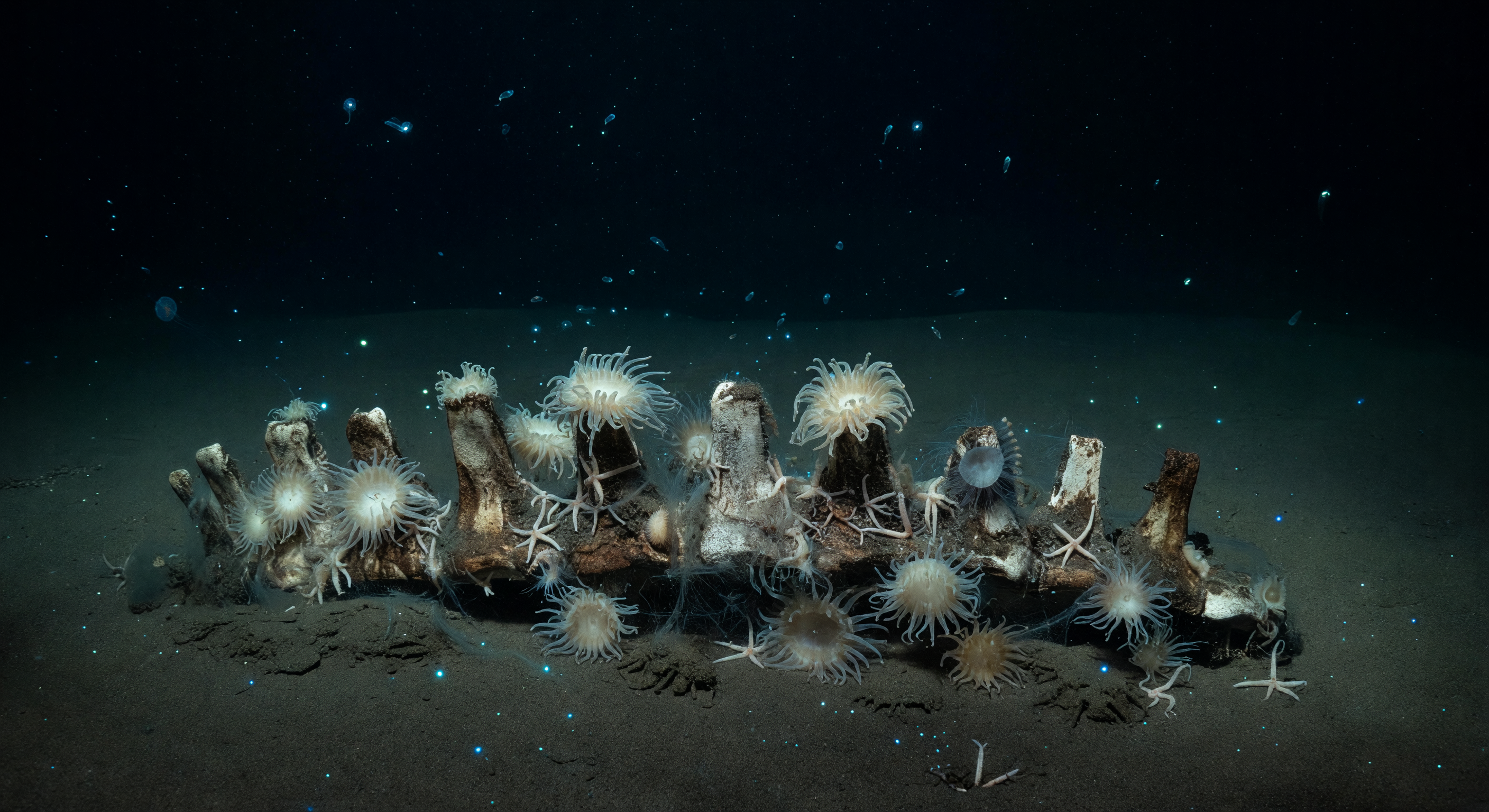
At roughly 2,500 metres below the surface, where pressure exceeds 250 atmospheres and the last trace of solar light has long since ceased to exist, a cluster of ancient whale vertebrae forms the only hard substrate for kilometres across an otherwise featureless abyssal silt plain. These bones — porous, mineral-stained, and slowly dissolving across decades — represent the terminal stage of the Smith & Baco succession model: the sulfophilic phase, in which bacterial mats of filamentous chemolithotrophs spread across organically enriched sediment, oxidising hydrogen sulfide released by anaerobic microbial degradation deep within the lipid-saturated bone matrix, sustaining a chemosynthetic oasis entirely independent of sunlight. Ivory-toned anemones anchor their pedal discs into crevices of the vertebral arches, while pale ophiuroids — brittle stars — drape their long articulated arms across the bone rims, sweeping suspended particles from water so cold it hovers near 2°C and carries dissolved oxygen only in modest concentrations. From the water column above, a siphonophore drifts past in a slow, colonial procession, its coordinated bioluminescent pulses emitting brief cyan sweeps that trace the contours of ancient bone and translucent tentacle alike before the darkness reclaims everything. This reef of the dead sustains the living without sunlight, without warmth, and without any witness but the deep ocean itself.
Other languages
- Français: Récif de Vieilles Vertèbres
- Español: Arrecife de Vértebras Antiguas
- Português: Recife de Vértebras Antigas
- Deutsch: Riff Alter Wirbel
- العربية: شعاب الفقرات القديمة
- हिन्दी: प्राचीन कशेरुकाओं की चट्टान
- 日本語: 古代脊椎の礁
- 한국어: 고대 척추의 암초
- Italiano: Scogliera di Vertebre Antiche
- Nederlands: Rif van Oude Wervels