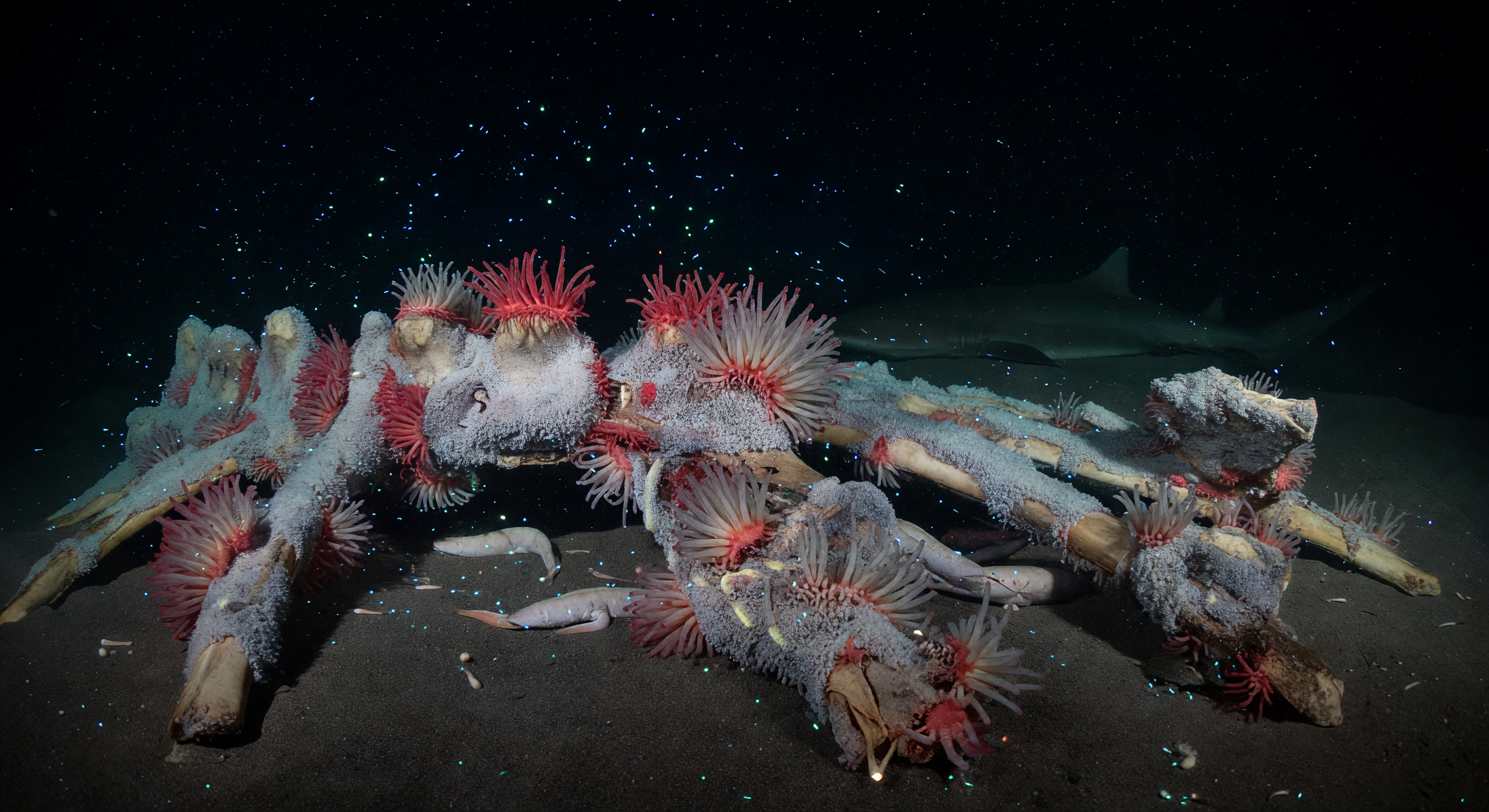
Where no sunlight has ever reached, a constellation of fractured vertebrae and arching ribs lies half-consumed by the seafloor itself, the bones bleached to chalk and furred with thick bacterial mats that glow with the faint, diffuse luminescence of sulfide-oxidizing microbial colonies. At roughly 2,500 meters, hydrostatic pressure exceeds 250 atmospheres, water temperature hovers near two degrees Celsius, and the chemical conditions within and around the decaying skeleton have shifted from aerobic decay to anaerobic sulfate reduction — a quiet geochemical revolution that transforms bone marrow into a hydrogen-sulfide factory sustaining an entire island ecosystem. From every crack and marrow channel, colonies of *Osedax* boneworms have anchored their colorless, root-like rhizoids deep into the lipid-saturated matrix, sending up hundreds of translucent stalks that bloom into vivid crimson gill plumes wavering motionlessly in the still, pressurized water, while white bacterial floc drifts free between the ribs like a perpetual slow snowfall. Hagfishes coil in the dark spaces between bones, their pale bodies slick against the sediment, and at the outermost edge of visibility a sleeper shark hangs suspended in the black water column, barely distinguishable from the void — a reminder that even in this most absolute of silences, the ocean's metabolism never stops.
Other languages
- Français: Vers osseux dans neige sulfurée
- Español: Gusanos óseos en nieve sulfúrea
- Português: Vermes ósseos em neve sulfurosa
- Deutsch: Knochenwürmer im Schwefelschnee
- العربية: ديدان العظام في ثلج كبريتي
- हिन्दी: सल्फाइड हिम में अस्थि-कृमि
- 日本語: 硫化雪の骨虫たち
- 한국어: 황화물 눈 속의 뼈벌레
- Italiano: Vermi ossei nella neve sulfurea
- Nederlands: Beenwormen in zwavelsneeuw