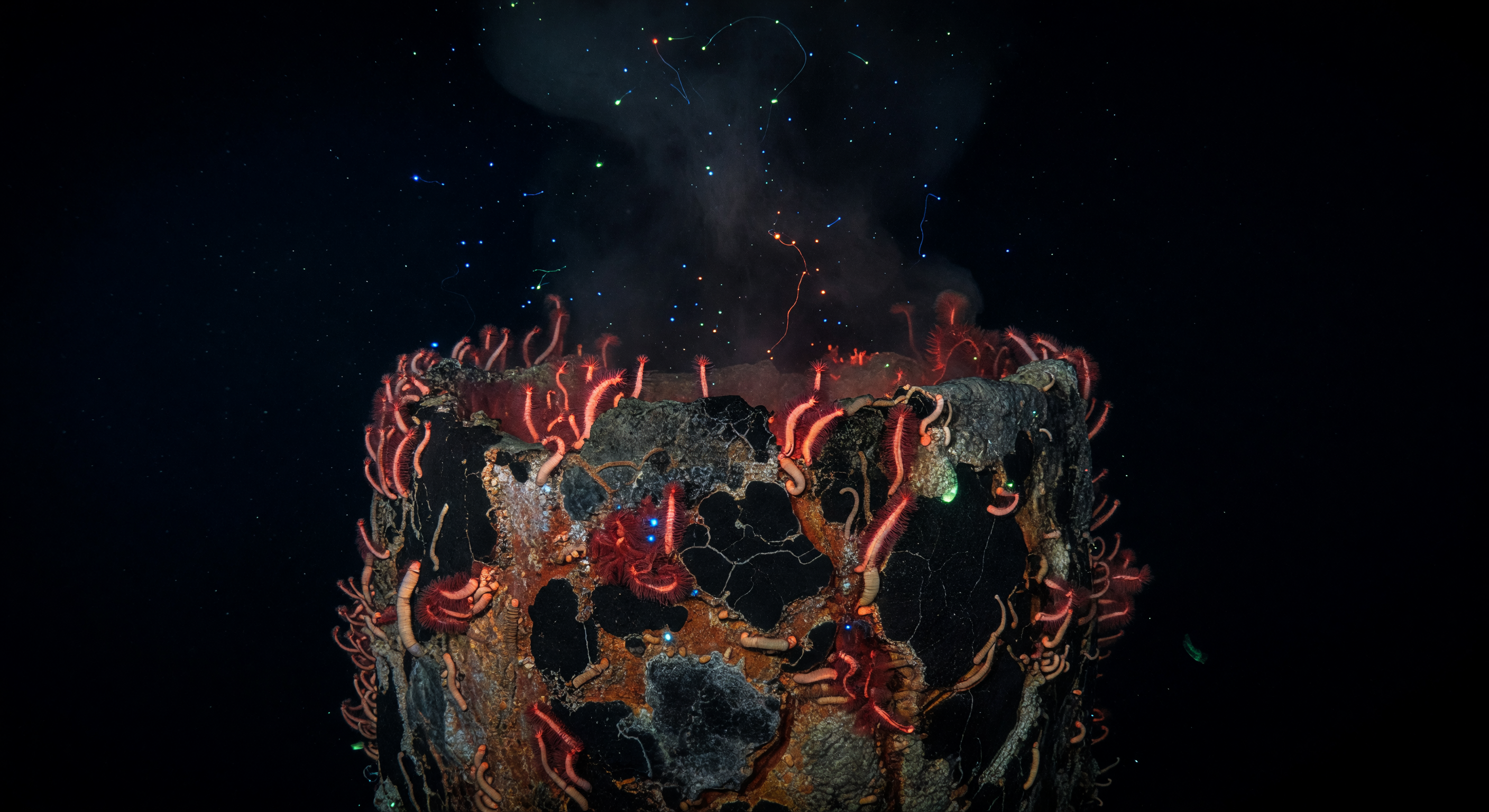
At depths where sunlight has long since been extinguished and pressures exceed two hundred atmospheres, a black smoker chimney rises from the seafloor like a monument to Earth's interior heat, its fractured sulfide walls radiating superheated fluid at over 350 degrees Celsius into water only a few degrees above freezing. The chimney face glows with a dim copper-orange chemiluminescence where mineral-rich fluid meets the cold ocean column, fresh anhydrite crusts catching a faint ember warmth along their edges while iron sulfide deposits blister and oxidize into rust-orange stains across the matte black rock. Dense colonies of Pompeii worms — Alvinella pompejana, among the most heat-tolerant animals known to science — pack every crevice and mineral tube along the chimney wall, their pale segmented bodies anchored deep within their papery tubes while feathery crimson gill plumes ripple in the turbulent vent effluent, hosting a coat of thermophilic bacteria that may itself insulate them from the extreme thermal gradient. Around them, sparse bioluminescent pinpricks of cyan and blue-green pulse from other vent-associated organisms, and a slow dark plume of mineral particulates drifts upward into absolute blackness, dispersing into a water column where chemosynthesis — not photosynthesis — underpins an entire food web independent of the sun. This is a world powered entirely from within the planet, alive and intricate, existing in complete, pressurized silence long before any eyes could witness it.
Hydrothermal vents