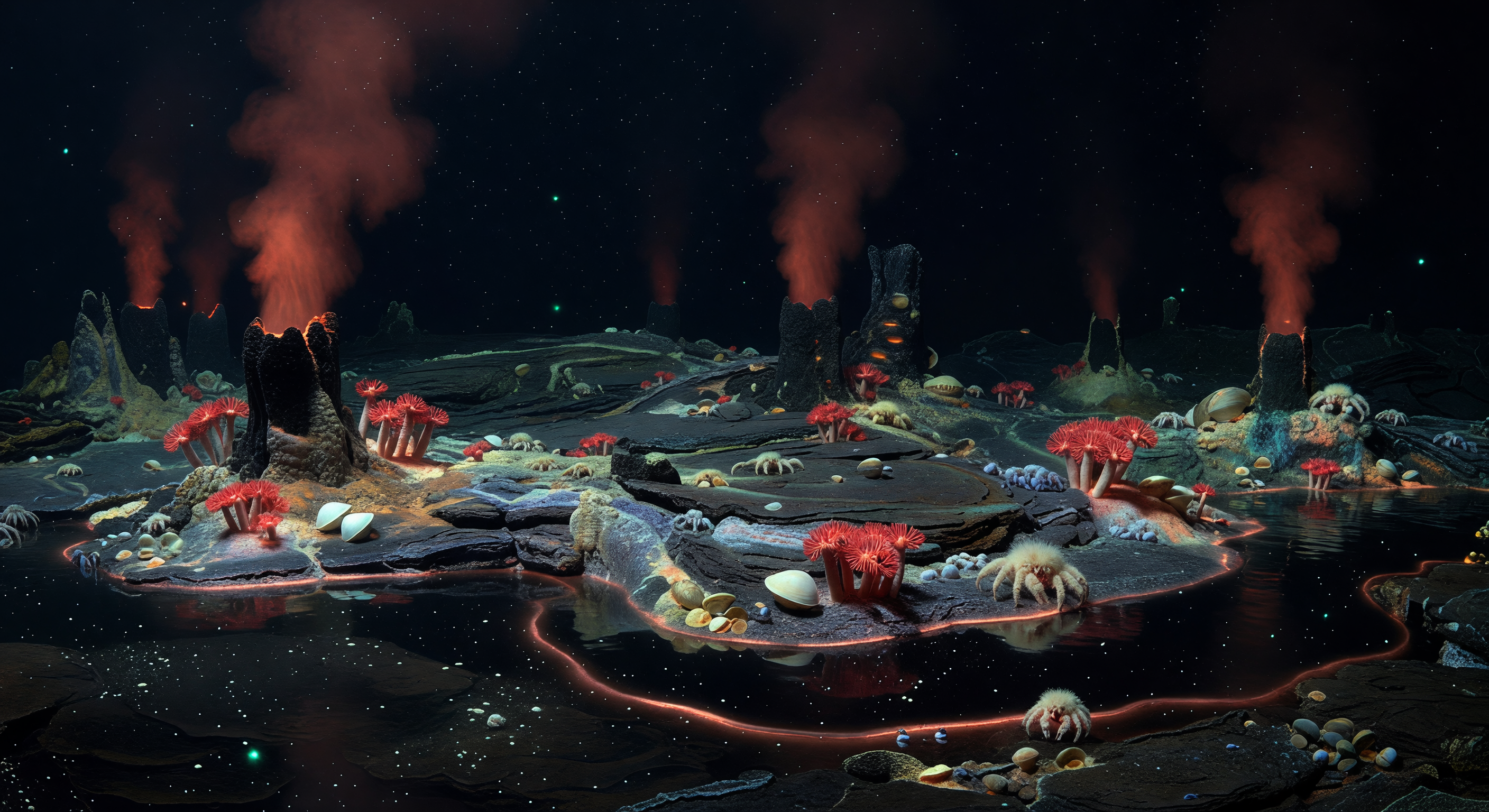
Along the mid-ocean ridge, a ribbon of freshly erupted basalt lies exposed across the seafloor, its glassy black surface still radiating a dull orange-red thermal glow where rock temperatures have not yet surrendered entirely to the near-freezing abyss — a boundary where 350 °C hydrothermal fluid meets water close to 2 °C, producing violent chemical precipitation and the dense, mineralite plumes of black smokers rising as dark sulfide towers above the new crust. Fine sulfur grains settle like pale dust into the folded folds and fractures of pillow lava, while gossamer microbial films — the foundational chemosynthetic organisms of this ecosystem — coat warm surfaces in a faint iridescent sheen, converting hydrogen sulfide into organic energy in the complete absence of sunlight. Clustered around the thermal gradient, scarlet-plumed Riftia pachyptila tube worms stand in pale mineral tubes, their hemoglobin-rich plumes drawing sulfide-laden water toward the endosymbiotic bacteria living within their trophosome tissues, while white Calyptogena clams lie half-buried in sulfide-rich sediment and shaggy yeti crabs patrol the warm basalt margins, cultivating chemosynthetic bacteria across their setae-covered claws. At pressures exceeding 200 to 400 atmospheres, the water column beyond the vent field dissolves from deep cobalt into absolute black, punctuated only by occasional cyan-green bioluminescent pulses and the slow drift of marine snow and mineral particles through immense, indifferent stillness — a self-sustaining world of volcanic heat and chemical energy that has persisted on this planet for hundreds of millions of years, entirely without witness.
Hydrothermal vents