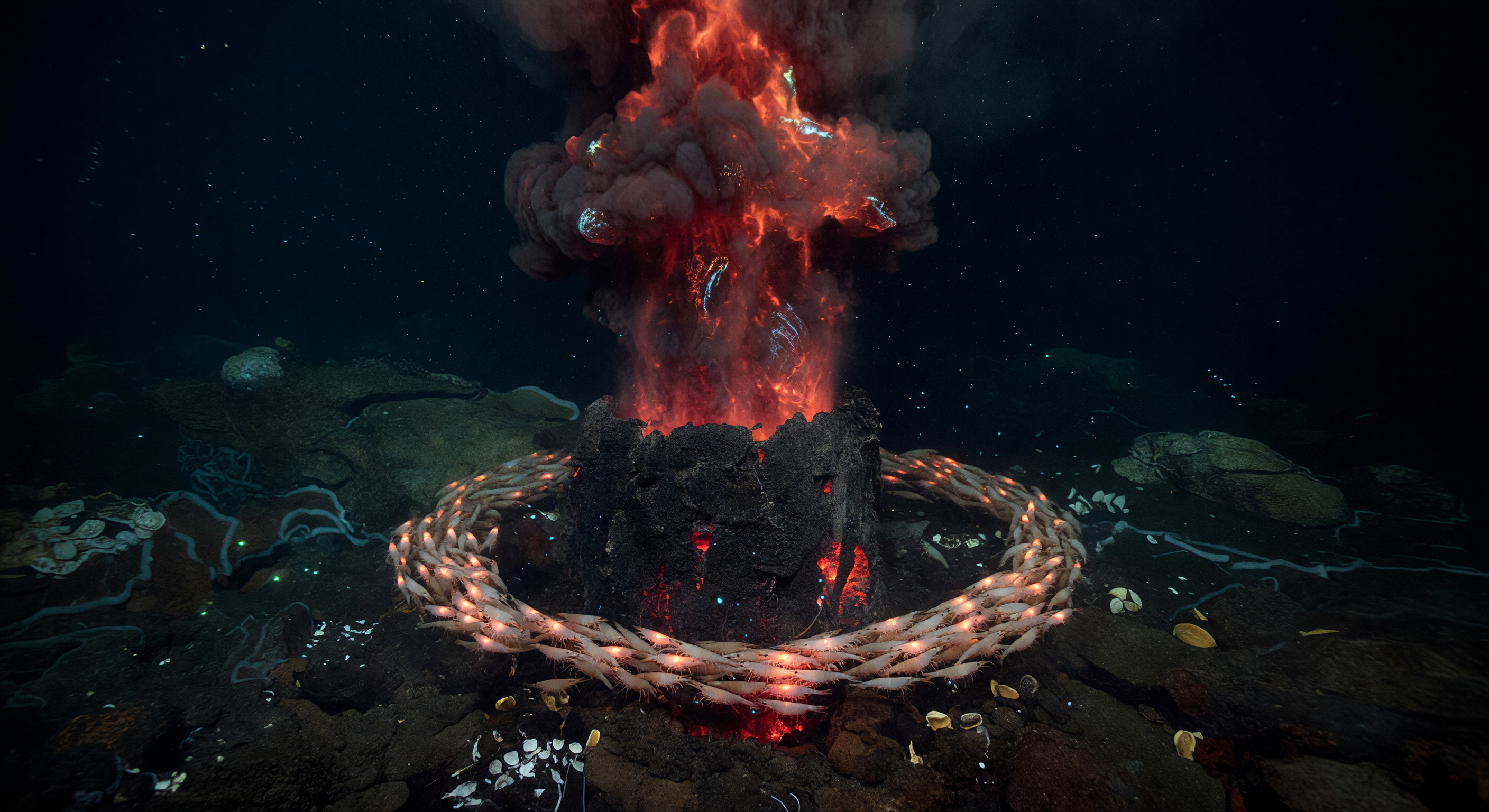
At depths where crushing pressure renders the water column an absolute void of sunlight, a black-smoker chimney of iron and copper sulfides rises from freshly erupted basalt along a mid-ocean ridge, its active orifice venting superheated fluid at roughly 350 °C directly into near-freezing abyssal seawater — a thermal and chemical collision that precipitates the dense black plume billowing upward in folded, stratified turbulence. Around the orifice, a dense living halo of *Rimicaris* vent shrimp crowds the mineralized rock in concentric layers, their translucent exoskeletons catching the faint orange-red chemiluminescent glow emanating from within the plume itself, where oxidizing sulfide compounds release trace wavelengths of light detectable only at this primordial scale. These shrimp are functionally blind in the conventional sense yet possess dorsal photoreceptors adapted to perceive precisely this geothermal radiance, navigating the thermal gradient between lethal scalding and the surrounding 2 °C abyss with evolutionary precision honed across millions of years. The vent ecosystem operates entirely beyond photosynthesis, sustained instead by chemolithoautotrophic bacteria that oxidize hydrogen sulfide into biomass, forming the base of a food web that requires nothing from the sun — a sovereign biosphere thriving at pressures exceeding 300 atmospheres, in permanent darkness, as it has since long before any witness existed to observe it.
Hydrothermal vents