Where no photon from the surface has ever reached, scattered whale vertebrae lie half-buried in fine dark sediment, their bone-white surfaces flaring briefly into visibility each time a nearby organism emits a pulse of cyan-green bioluminescence — then vanishing again into near-total darkness. At pressures exceeding two hundred atmospheres, the water column above this carcass has become a vertical hunting ground, with viperfish hanging obliquely in the blackness, their needle teeth momentarily outlined by the cold living light of swarming scavengers, while the faint silhouette of a Magnapinna squid descends from upper darkness with filaments impossibly thin against the void. Anglerfish hover at different depths, their tiny lures emitting intermittent cyan pulses that ripple through clouds of marine snow drifting with absolute indifference through the cold — organic particles raining slowly downward, connecting the sunlit surface world to this lightless plain as they have for millions of years. A sulfide-darkened haze stains the sediment around the carcass edges where microbial mats process the last biochemical wealth of a life that ended far above, and far at the periphery of perception, a dim reddish-orange chemiluminescent glow suggests the presence of hydrothermal influence beyond the frame. Here the ocean exists entirely on its own terms: high-pressure, near-freezing, stratified by darkness and particle density, populated by predators whose entire evolutionary history is a negotiation with scarcity, silence, and the slow arithmetic of energy in the deep.
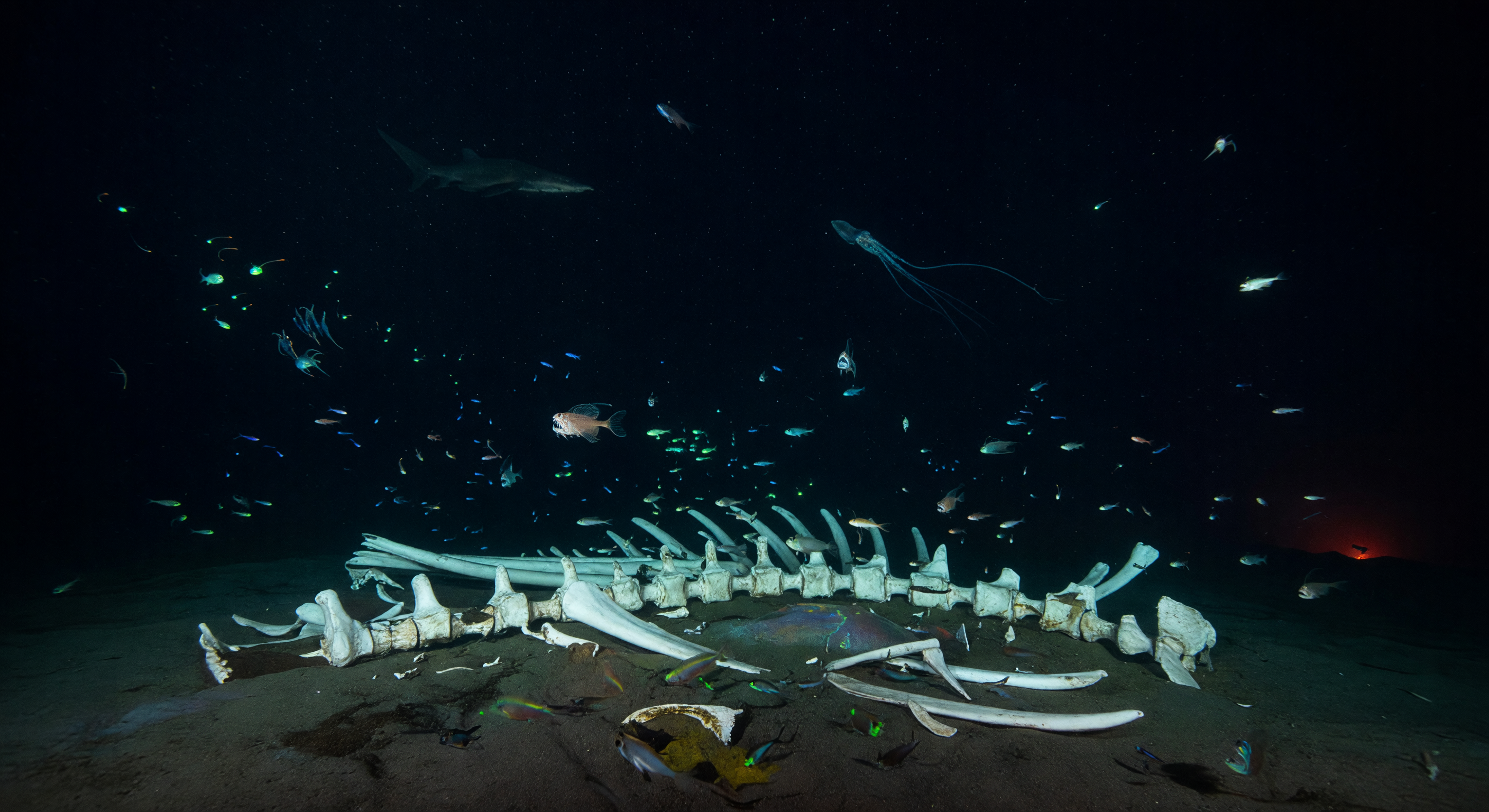
Bathypelagic predators