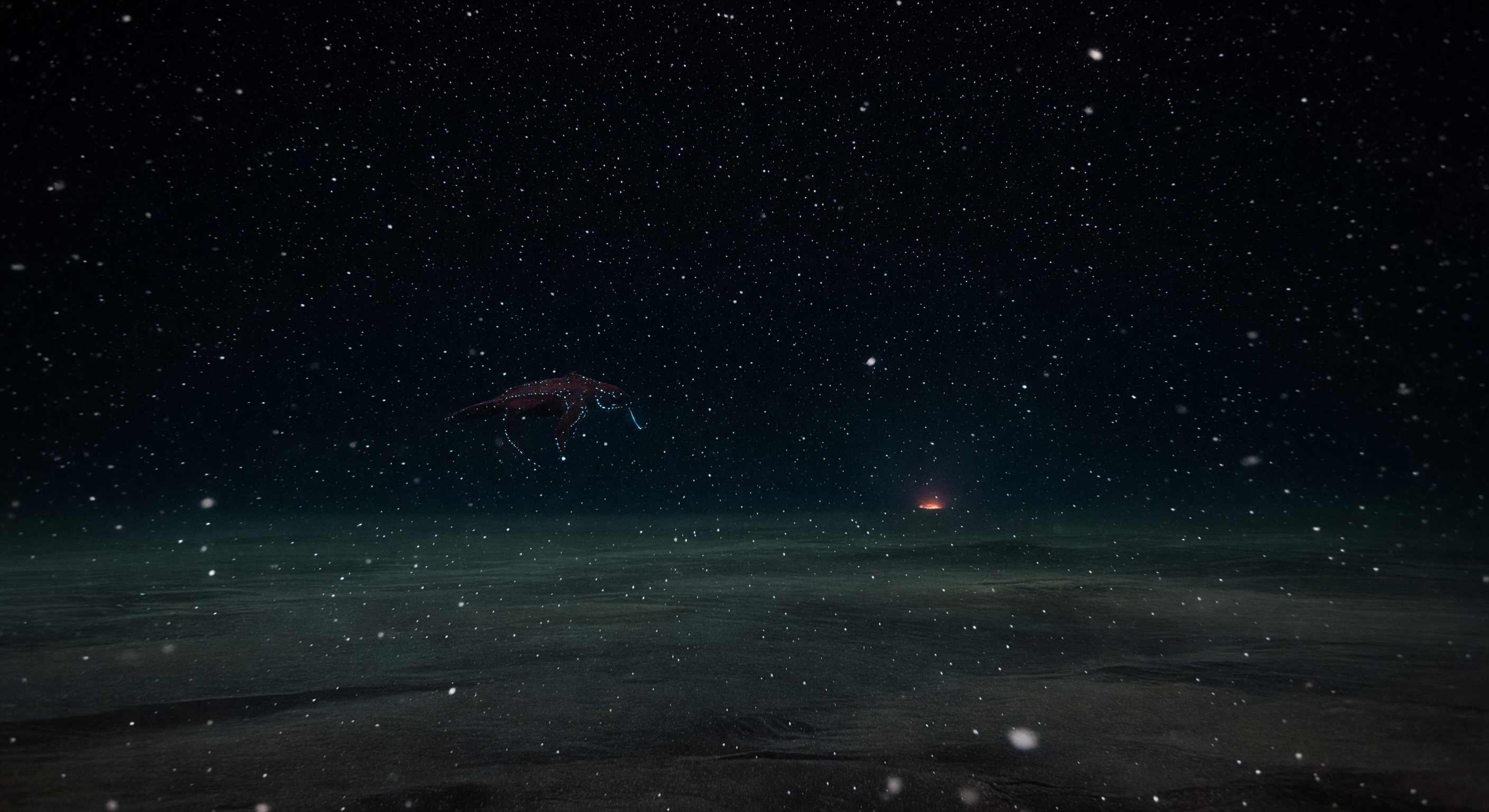
In the midnight zone between one and four kilometers down, where hydrostatic pressure exceeds two hundred atmospheres and cold hovers near two degrees Celsius, a solitary predator moves through open black water with the unhurried deliberateness of a creature shaped entirely by scarcity. Its maroon-black body, likely a dragonfish or elongate bathypelagic form, absorbs rather than reflects, rendering it nearly indistinguishable from the surrounding void except where sparse cyan photophores trace the briefest outline of its passage — bioluminescent organs that serve simultaneously as lure, camouflage-matching counterillumination, and species signal in a world where light is currency. All around it, marine snow descends in continuous silence: the slow, steady rain of organic detritus, fecal pellets, shed exoskeletons, and microbial aggregates that constitutes the only meaningful food link between the sunlit surface and the abyssal floor far below. The plain dimly legible beneath — flat, silted, basaltic — speaks to millions of years of particle accumulation over oceanic crust, its subtle relief fading without boundary into surrounding darkness, while at the horizon's edge a faint orange-red chemiluminescent haze suggests a hydrothermal plume too remote to warm or illuminate, only to remind that even here, energy finds its way. This ocean has no witness; it has always been exactly this — pressured, cold, immense, and entirely itself.
Bathypelagic predators