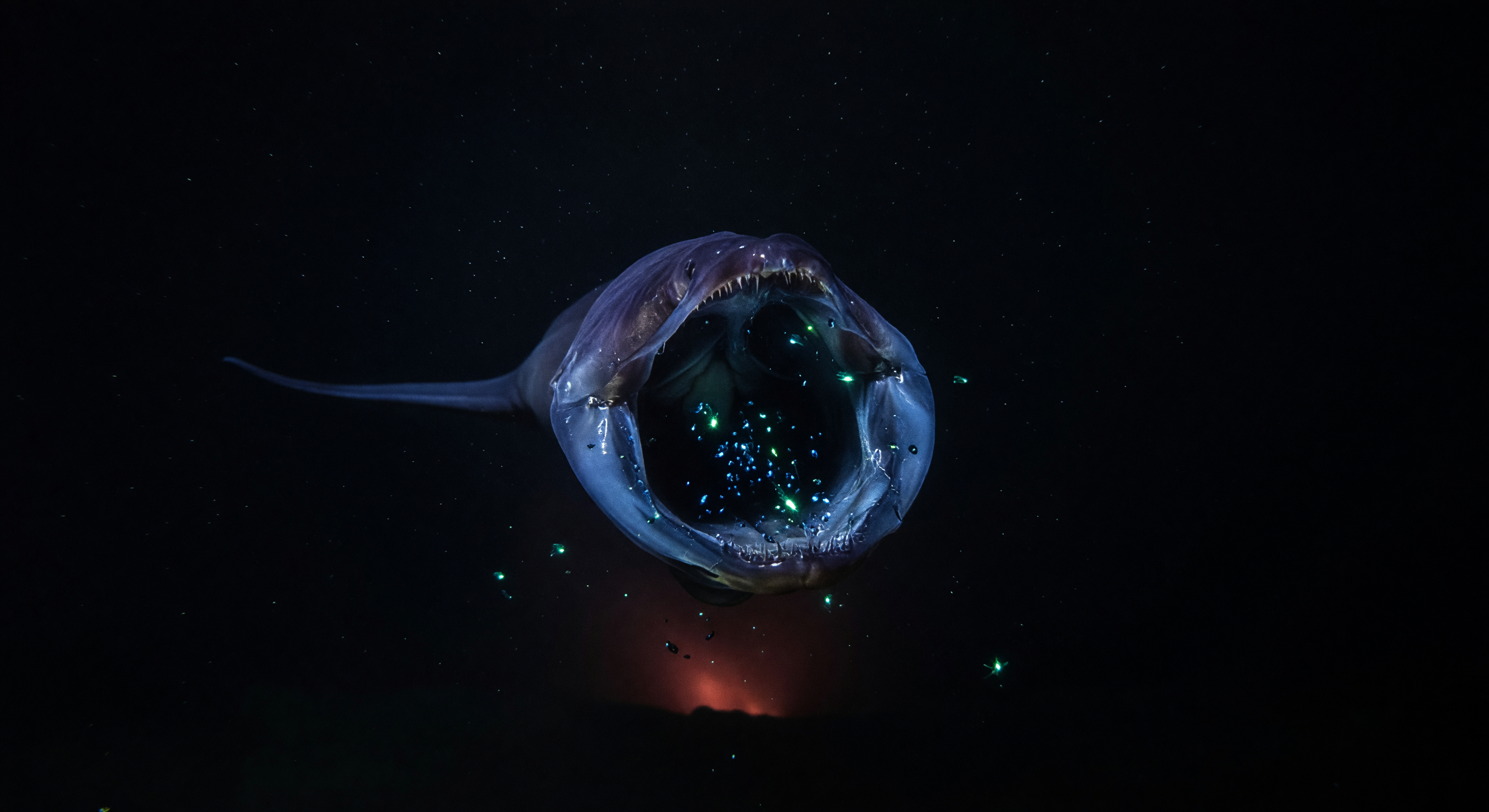
At depths where pressure exceeds two hundred atmospheres and the last photon of sunlight died kilometers above, a gulper eel — Eurypharynx pelecanoides — executes one of the ocean's most extreme feeding strategies: its loosely hinged jaw, unmoored from rigid skeletal constraint, balloons outward into a translucent bluish membrane large enough to engulf prey several times the eel's own girth, the distended oral cavity briefly lit from within by the panicked bioluminescent pulses of trapped organisms whose cold cyan flickers silhouette needle-fine teeth and slick, stretched tissue. The eel's body, black-violet and gelatinous under pressure that would collapse any gas-filled space, tapers to a whip-thin tail threading back into absolute darkness, while sparse marine snow — the slow organic rain of decomposing matter that constitutes the primary nutrient corridor between the sunlit surface and this lightless realm — drifts freely past in every direction, indifferent to the violence occurring within it. Far below, a barely perceptible orange-red thermal tint in the deepest part of the water column hints at hydrothermal chemistry, a reminder that this zone is geologically as well as biologically dynamic, structured by mid-ocean ridges, seamount flanks, and the chemical plumes they release. Here, at two to three thousand meters, predation is not a daily rhythm but an event of rare consequence, shaped entirely by bioluminescent deception, sensory acuity, and anatomy evolved over millions of years in a world that has never required the witness of any other.
Bathypelagic predators