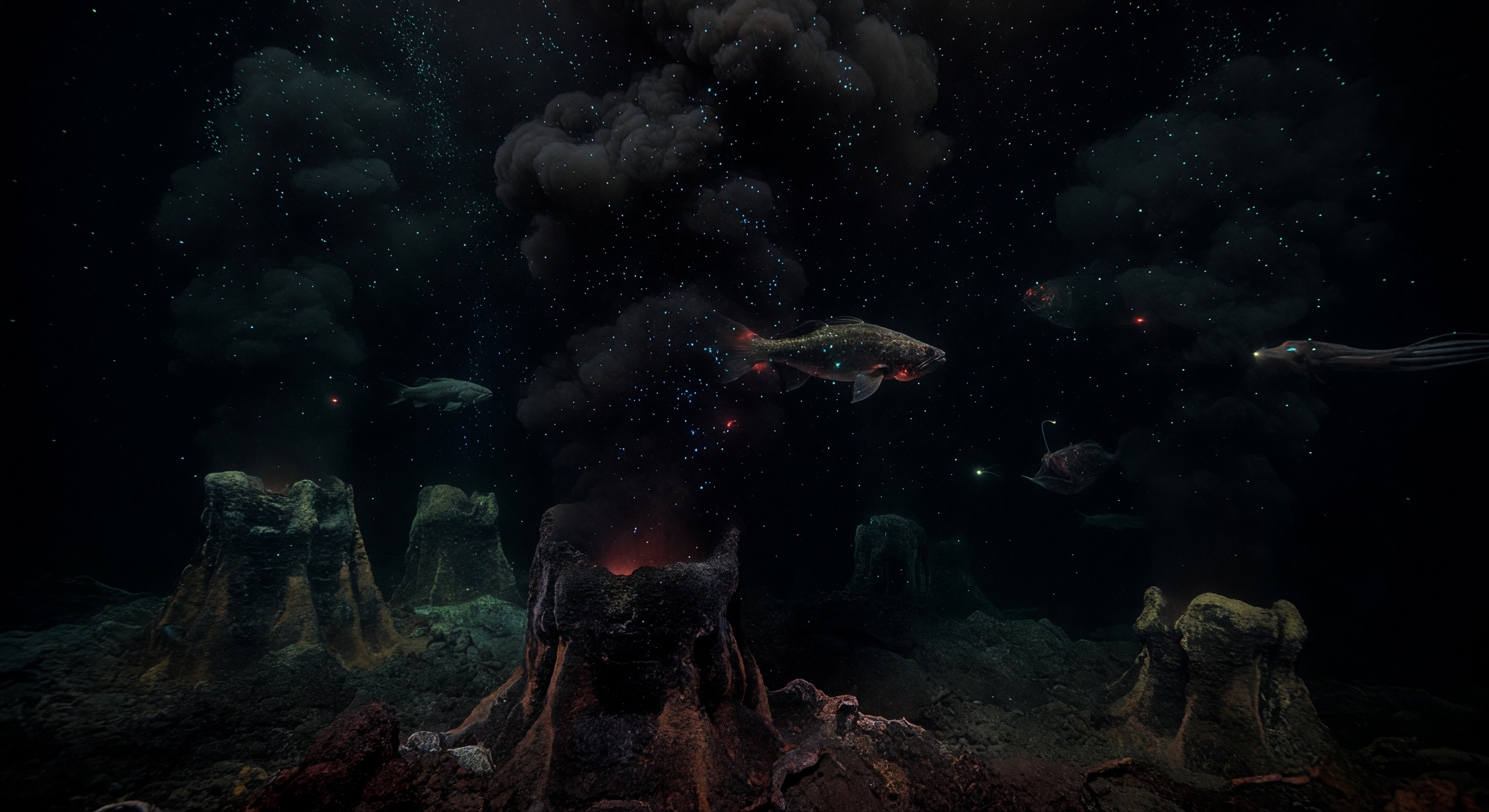
At depths where pressure exceeds two hundred atmospheres and the last trace of solar radiation has long since been extinguished, a sulfide-mineral landscape rises from fresh basalt in towering chimneys that discharge superheated fluids instantly quenched into billowing black plumes — a chemistry of iron, manganese, and sulfide compounds precipitating in real time against water hovering near two degrees Celsius. Along the plume margin, a bathypelagic predator moves with the conserved precision of an animal that cannot afford wasted motion: its musculature is soft and pressure-tolerant, its sensory systems finely tuned to the mechanical signatures and faint bioluminescent sparks that constitute the only available information in this absolute dark. Scattered through the surrounding water column, the scattered blue-green points of bioluminescence — produced by photophores, secreted luciferin compounds, and symbiotic bacteria across dozens of organisms — represent not decoration but a language of lures, counter-illumination, and predator-prey signaling refined across millions of years of evolution beneath any sunlight. Deeper in the darkness, the ghostly suggestion of a Magnapinna squid extends arms of improbable length into water laden with mineral snow and organic detritus drifting down from the productive surface far above, while the faint rust-orange chemiluminescent shimmer of the hottest vent apertures writes the only warm color into a world otherwise composed entirely of black, cold, and the cold fire of living light.
Bathypelagic predators