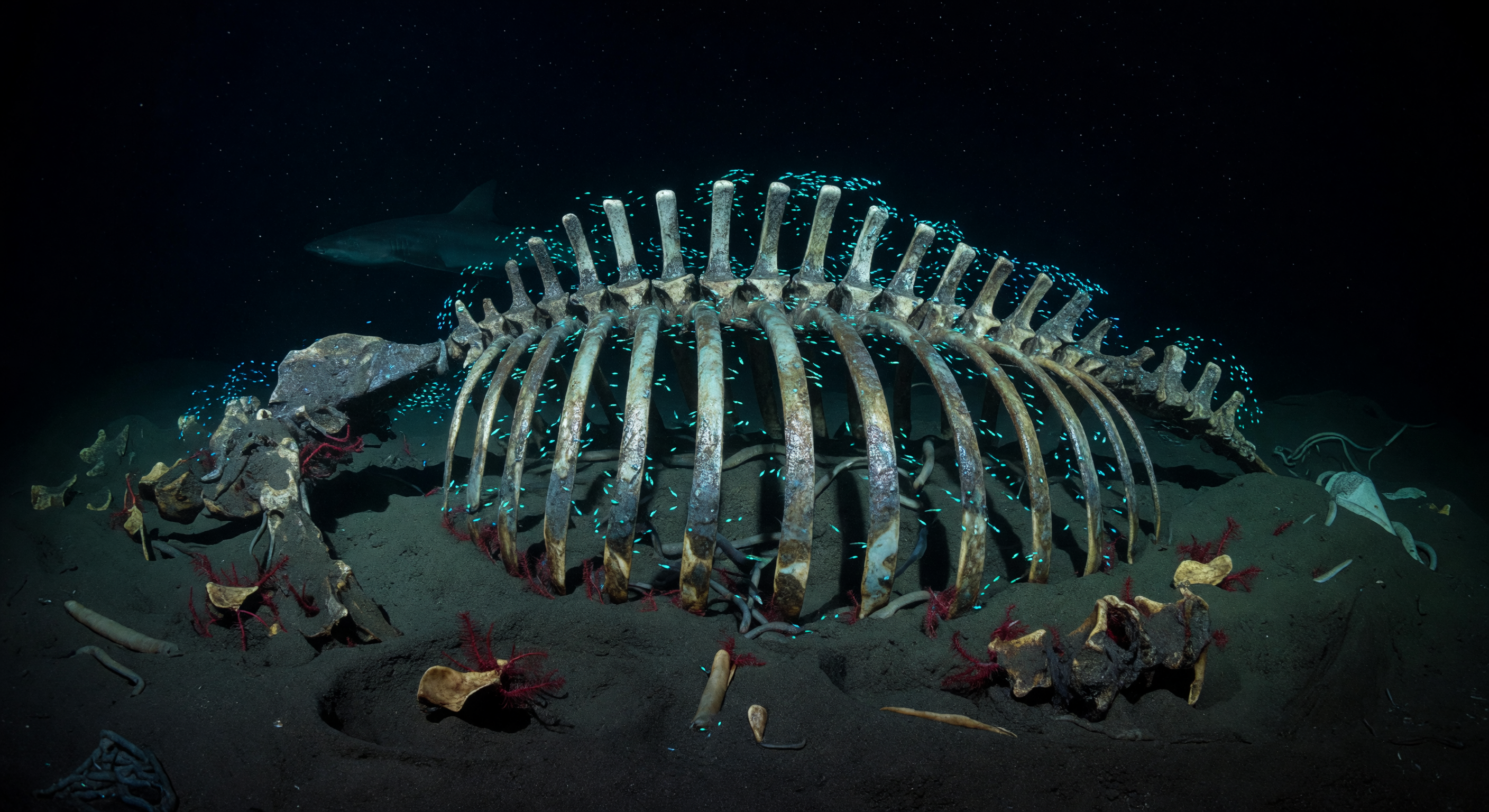
At depths where pressure exceeds three hundred atmospheres and sunlight has been absent for centuries, a whale's skeleton transforms the otherwise barren abyssal mud into a thriving, self-sustaining metropolis of life. The pale arching ribs, stripped by months of scavenger activity, rise from the dark sediment like the nave of a sunken cathedral, their surfaces coated in sulfurous bacterial films fed by lipids still seeping from within the bone matrix — a chemosynthetic process that mirrors, in miniature, the biology of cold seeps and hydrothermal vents. Immense swarms of lysianassid amphipods pulse across the bones in cascading green-blue waves of bioluminescence, their brief cold flashes illuminating slick remnants of collagen, the crimson plumes of *Osedax* worms boring silently into the smaller bones to digest their fats, and hagfish threading through the darkened cavities of the skeleton in slow, boneless loops. Beyond the colonnade, barely resolved in the absolute blackness of the water column, the silhouette of a Greenland sleeper shark drifts at the periphery — metabolically glacial, unhurried, drawn by chemoreception across kilometers of featureless mud to this improbable abundance. Marine snow descends in all directions through the stillness, each particle a fragment of the surface world finally arriving here, joining an ecosystem that will persist and transform for decades without ever requiring the presence of light.
Other languages
- Français: Côtes en Nuées Bleues
- Español: Costillas en Enjambres Azules
- Português: Costelas em Enxames Azuis
- Deutsch: Rippen in Blauen Schwärmen
- العربية: أضلاع في أسراب زرقاء
- हिन्दी: नीले झुंड में पसलियाँ
- 日本語: 青い群れの中の肋骨
- 한국어: 푸른 떼 속의 갈비뼈
- Italiano: Costole tra Sciami Blu
- Nederlands: Ribben in Blauwe Zwermen